

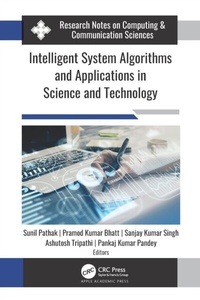
Intelligent System Algorithms and Applications in Science and Technology
1st Edition
Published on 2. February 2022
428 pages
978-1-000-40687-0 (ISBN)
Description

The 21st century has witnessed massive changes around the world in intelligence systems in order to become smarter, energy efficient, reliable, and cheaper. This volume explores the application of intelligent techniques in various fields of engineering and technology. It addresses diverse topics in such areas as machine learning-based intelligent systems for healthcare, applications of artificial intelligence and the Internet of Things, intelligent data analytics techniques, intelligent network systems and applications, and inequalities and process control systems. The authors explore the full breadth of the field, which encompasses data analysis, image processing, speech processing and recognition, medical science and healthcare monitoring, smart irrigation systems, insurance and banking, robotics and process control, and more.
More details
Edition
1. Auflage
Language
English
Place of publication
London
United Kingdom
Publishing group
Taylor & Francis Ltd
Target group
College/higher education
Professional and scholarly
Product notice
Reflowable
Illustrations
32 Tables, black and white; 20 Line drawings, color; 80 Line drawings, black and white; 5 Halftones, color; 8 Halftones, black and white; 25 Illustrations, color; 88 Illustrations, black and white
ISBN-13
978-1-000-40687-0 (9781000406870)
Copyright in bibliographic data and cover images is held by Nielsen Book Services Limited or by the publishers or by their respective licensors: all rights reserved.
Schweitzer Classification
Other editions
Additional editions
Sunil Pathak | Pramod Kumar Bhatt | Sanjay Kumar Singh
Intelligent System Algorithms and Applications in Science and Technology
Book
08/2024
1st Edition
Apple Academic Press Inc.
€139.00
Shipment within 3-4 weeks
Sunil Pathak | Pramod Kumar Bhatt | Sanjay Kumar Singh
Intelligent System Algorithms and Applications in Science and Technology
Book
02/2022
1st Edition
Apple Academic Press Inc.
€222.00
Shipment within 3-4 weeks
Sunil Pathak | Pramod Kumar Bhatt | Sanjay Kumar Singh
Intelligent System Algorithms and Applications in Science and Technology
Book
08/2021
Apple Academic Press
Unfortunately, price unknown
Available (delivery time upon request)
Persons
Sunil Pathak, PhD, is Associate Professor and Head in the Department of Computer Science and Engineering, Amit School of Engineering and Technology at Amity University, Rajasthan, India. Before joining Amity University, he was an Associate Professor and Head in the Department of Computer Science and Engineering at Kautilya Institute of Engineering abd Technology. He was also formerly at Chanakya Technical Campus (Kauutilya Group of College) as Director of Academics and Poornima College of Engineering, Jaipur, India. He has published more than 40 papers in international and national journals and conference proceedings, 10 book and one edited volume. He received 3rd prize for his book Web Programming (Hind Edition) 2010, in the category of engineering diploma level by AICTE New Delhi. His areas of research include clustering in ad hoc networks, QoS supports in wireless networks, channel assignment in cognitive radio network and WDM optical networks, machine learning, and deep learning. He is active as a reviewer for several journals, including IEEE Transactions on Mobile Computing, IET Networks, EURASIP Journal on Wireless Communications and Networking, Recent Patents on Engineering, International Journal of Interactive Mobile Technologies (iJIM), IEEE Transactions on Network and Service Management, IEE Access, etc. He is a professional member of IEEE, ACM, IACSE, and IAEN. He has received his bachelor's degree from Rajasthan University; MSc (Computer Science & Engineer); Master of Technology in Information Technology from Tezpur Central University, Assam, India; and PhD in Computer Science & Engineering from JK Lakshmipat University Jaipur, Rajasthan, India.
Pramod Kumar Bhatt, PhD, is Associate Professor and Coordinator of PhD Programmes with the Amity School of Engineering and Technology (ASET), Jaipur, Rajasthan, India. He has published research papers in indexed journals and conferences. His research interests include artificial intelligence, machine learning, soft computing applications in smart grid power quality analysis and enhancement, renewable energy integration challenges, opportunities in smart distribution and transmission systems, smart microgrids, industrial microgrids, and condition monitoring of smart grid components. For over 10 years he was extensively involved in industrial assignments, in particular R&D, system designing, modification, commissioning, maintenance, systems automation such as PLC, SCADA, and power drive installation and testing. He has worked with various capacities in universities of national repute. His degrees include a BE (EE), ME (Power Electronics), and PhD in Electrical Engineering.
Sanjay Kumar Singh, PhD, is an experienced academician and a research professional with around eight years of industrial experience and almost 16 years of teaching experience at engineering colleges. His research interests are in the areas of intelligent control and automation, bio-inspired techniques, modern instrumentation and control engineering, and industrial electronics with real-time applications. He was awarded his BE with a specialization in Instrumentation from Poona University, India, and MTech in Instrumentation from the School of Instrumentation, Devi Ahilya Vishvidyalaya Indore (MP), India. He was awarded a PhD degree in Engineering from M.N.I.T., Jaipur, India. He has published around 24 research papers in national and international journals and international conferences. He is a reviewer and editorial board member of various national and international journals. He is currently a member of IET UK, ICSES Iran, and IAENG and a lifetime member of ISTE India.
Ashutosh Tripathi, PhD, is Assistant Professor at Amity University, Rajasthan, India. He has presented and organized several conferences and seminars and has published papers in international journals. He has many years of teaching experience engineering and is currently guiding a research associate for a PhD. His area of interest is wireless communication and embedded technology. He received a PhD in Engineering.
Pankaj Kumar Pandey, PhD, is Associate Professor and Head, Chemical Engineering Department at Amity University Rajasthan, India. He has presented and organized several conferences and seminars and has published papers in international journals. He has 19 years of teaching experience at the BE, ME, and PhD levels. He is currently guiding a research associate for a PhD. His area of interest is adsorption engineering and wastewater treatment. He holds a PhD in Engineering.
Pramod Kumar Bhatt, PhD, is Associate Professor and Coordinator of PhD Programmes with the Amity School of Engineering and Technology (ASET), Jaipur, Rajasthan, India. He has published research papers in indexed journals and conferences. His research interests include artificial intelligence, machine learning, soft computing applications in smart grid power quality analysis and enhancement, renewable energy integration challenges, opportunities in smart distribution and transmission systems, smart microgrids, industrial microgrids, and condition monitoring of smart grid components. For over 10 years he was extensively involved in industrial assignments, in particular R&D, system designing, modification, commissioning, maintenance, systems automation such as PLC, SCADA, and power drive installation and testing. He has worked with various capacities in universities of national repute. His degrees include a BE (EE), ME (Power Electronics), and PhD in Electrical Engineering.
Sanjay Kumar Singh, PhD, is an experienced academician and a research professional with around eight years of industrial experience and almost 16 years of teaching experience at engineering colleges. His research interests are in the areas of intelligent control and automation, bio-inspired techniques, modern instrumentation and control engineering, and industrial electronics with real-time applications. He was awarded his BE with a specialization in Instrumentation from Poona University, India, and MTech in Instrumentation from the School of Instrumentation, Devi Ahilya Vishvidyalaya Indore (MP), India. He was awarded a PhD degree in Engineering from M.N.I.T., Jaipur, India. He has published around 24 research papers in national and international journals and international conferences. He is a reviewer and editorial board member of various national and international journals. He is currently a member of IET UK, ICSES Iran, and IAENG and a lifetime member of ISTE India.
Ashutosh Tripathi, PhD, is Assistant Professor at Amity University, Rajasthan, India. He has presented and organized several conferences and seminars and has published papers in international journals. He has many years of teaching experience engineering and is currently guiding a research associate for a PhD. His area of interest is wireless communication and embedded technology. He received a PhD in Engineering.
Pankaj Kumar Pandey, PhD, is Associate Professor and Head, Chemical Engineering Department at Amity University Rajasthan, India. He has presented and organized several conferences and seminars and has published papers in international journals. He has 19 years of teaching experience at the BE, ME, and PhD levels. He is currently guiding a research associate for a PhD. His area of interest is adsorption engineering and wastewater treatment. He holds a PhD in Engineering.
Content
PART I: Machine Learning-Based Intelligent Systems for Healthcare 1. Big Data Analytics and Machine Learning Paradigm: Predictive Analytics in the Healthcare Sector 2. Cancer Cell Growth Discovery Utilizing Computerized Image Processing Strategies 3. Analysis and Prediction of Asthma from Common Symptoms Using Different Machine Learning Algorithms 4. Logistic Regression Based Myocardial Infarction Disease Prediction 5. New N-Valued Refined Neutrosophic Divergence Measure in Medical Investigation and Project Selection 6. Implementation of Quick Response Code in Electronic Records for Healthcare Monitoring 7. An Innovative Approach to Healthcare Using Machine Learning 8. Machine Learning Theory and Methods PART II: Applications of Artificial Intelligence and the Internet of Things 9. Artificial Intelligence (AI) 10. Smart Irrigation Using IoT PART III: Intelligent Data Analytics Techniques 11. A Study for Making Universities Intelligent Using Data Analytics and Artificial Intelligence 12. Sentiment Analysis of Online Learners in Higher Education: A Learning Perspective Through Unstructured Data 13. Prediction of Aging-Related Bugs Using Software Code Metrics 14. Application of CART-Based Modeling in Motor Insurance Fraud 15. Application of Neural Networks for Assessing the Performance of Insurance Business PART IV: Intelligent Network System and Application 16. A New Approach to Evaluate Computer Network Security Under Intuitionistic Trapezoidal Fuzzy Information 17. Optimization of Campus-Wide Fiber Networks: LINGO-Based Derivative of Shortest Path Problems and Solution 18. A Novel Approach to Sensors Using an Intensive Survey 19. Robotic Process Automation: An Application PART V: Inequalities and Process Control Systems: Application and Methods 20. (?IR, ?IR) Fuzzy Ideals in ?-Near-Rings 21. Approximation for Chi-Square F-Divergence via Midpoint Inequalities 22. New Coding Information Inequalities 23. Metaheuristics-Based Multi-Objective Design of Robust Process Control Systems 24. Bianchi Type IX Axially Symmetric Cosmological Model with Negative Deceleration Parameter in General Relativity
