

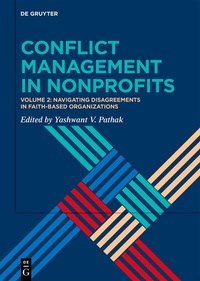
Conflict Management in Nonprofits
Description

Nonprofit organizations (NPOs), where citizens come together to solve societal problems, promote civic engagement, and create the building blocks of democracy, are a major sector and employer both in the United States and the rest of the world. This book addresses conflicts in the nonprofit organization sector and offers ways to resolve and manage these conflicts.
Conflict Management in Nonprofits, Volume 2 explores conflict management with regard to employees vs. volunteers, gender and inclusiveness, mindfulness, religious groups, working with governmental organizations as well as political issues. Perspectives on negotiation, mediation, and facilitation are presented throughout. In this, the second title in a two-volume collection, an exceptional set of renowned authors explore the topic of conflict management with a focus on faith-based nonprofits.
This book will be a valuable resource for academicians, scholars, students, as well as social, political activists and the layperson interested in volunteer-driven nonprofit organization management.
More details
Other editions
Additional editions

Person
Yashwant Pathak completed his PhD at Nagpur University, India, and Executive MBA and Masters in Conflict Management at Sullivan University, Louisville, USA. He has over 45 years' experience in academia and industry. Currently he is Professor and Associate Dean for Faculty Affairs at Taneja College of Pharmacy, University of South Florida, Tampa, USA. Yashwant has published over 400 research papers, reviews and chapters with close to 5000 citations in Google Scholar. He has edited over 70 books in nanotechnology, nutraceuticals, drug delivery systems, artificial intelligence and artificial neural network. He has a keen interest in conflict management and has edited several books in the field, including the De Gruyter Handbook of Organizational Conflict Management (co-edited with LaVena Wilkin).
Content
- Intro
- Foreword
- Contents
- Preface
- Chapter 1 Generational and Cultural Gaps in Nonprofit Conflict Management
- Chapter 2 Working with Gandhi-Inspired Nonprofits in India: Harnessing the Gandhian Philosophy to Effectively Address Social Needs
- Chapter 3 Conflict Management Practices and Remedies in Nonprofit Organizations: Tales from the Trenches
- Chapter 4 A Study of Conflict Management Processes Evolved in the Last 100 Years in the World's Largest Nonprofit, Cultural, and Social Organization: Rashtriya Swayamsevak Sangh
- Chapter 5 Managing Conflict within Nonprofit Organizations through the Lenses of the African Humanistic Ideologies of Ubuntu and Ujamaa
- Chapter 6 Nonprofit Organization Conflict Management - A Sikh Perspective
- Chapter 7 Building Trust through Funded Civil Society Community Organizations in Northern Ireland and the Border Area
- Chapter 8 Conflict Management in Jain Nonprofit Organizations
- Chapter 9 Managing Nonprofit Institutions for Education in the Modern World
- Chapter 10 Hindu Dharmic Perspectives on Resolving Conflicts in Nonprofit Organizations
- Chapter 11 Buddhism and Conflict Transformation in Nonprofit Organizations
- Chapter 12 Conflict Management in Quaker Nonprofits
- Chapter 13 Collaborative Practices in Nonprofits to Achieve Conflict Management
- List of Contributors
- Index
