

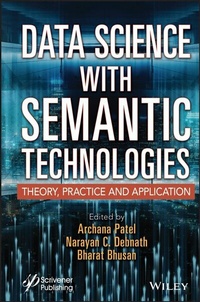
Data Science with Semantic Technologies
Description

This book will serve as an important guide toward applications of data science with semantic technologies for the upcoming generation and thus becomes a unique resource for scholars, researchers, professionals, and practitioners in this field.
To create intelligence in data science, it becomes necessary to utilize semantic technologies which allow machine-readable representation of data. This intelligence uniquely identifies and connects data with common business terms, and it also enables users to communicate with data. Instead of structuring the data, semantic technologies help users to understand the meaning of the data by using the concepts of semantics, ontology, OWL, linked data, and knowledge-graphs. These technologies help organizations to understand all the stored data, adding the value in it, and enabling insights that were not available before. As data is the most important asset for any organization, it is essential to apply semantic technologies in data science to fulfill the need of any organization.
Data Science with Semantic Technologies provides a roadmap for the deployment of semantic technologies in the field of data science. Moreover, it highlights how data science enables the user to create intelligence through these technologies by exploring the opportunities and eradicating the challenges in the current and future time frame. In addition, this book provides answers to various questions like: Can semantic technologies be able to facilitate data science? Which type of data science problems can be tackled by semantic technologies? How can data scientists benefit from these technologies? What is knowledge data science? How does knowledge data science relate to other domains? What is the role of semantic technologies in data science? What is the current progress and future of data science with semantic technologies? Which types of problems require the immediate attention of researchers?
Audience
Researchers in the fields of data science, semantic technologies, artificial intelligence, big data, and other related domains, as well as industry professionals, software engineers/scientists, and project managers who are developing the software for data science. Students across the globe will get the basic and advanced knowledge on the current state and potential future of data science.
Archana Patel, PhD, is a faculty of the Department of Software Engineering, School of Computing and Information Technology, Binh Duong Province, Vietnam. She completed her Postdoc from the Freie Universität Berlin, Berlin, Germany. Dr. Patel is an author or co-author of more than 30 publications in numerous refereed journals and conference proceedings. She has been awarded the Best Paper award (three times) at international conferences. Her research interests are ontological engineering, semantic web, big data, expert systems, and knowledge warehouse.
Narayan C. Debnath, PhD, is the Founding Dean of the School of Computing and Information Technology at Eastern International University, Vietnam. He is also serving as the Head of the Department of Software Engineering at Eastern International University, Vietnam. Dr. Debnath has been the Director of the International Society for Computers and their Applications (ISCA), USA since 2014. Formerly, Dr. Debnath served as a Full Professor of Computer Science at Winona State University, Minnesota, USA for 28 years.
Bharat Bhusan, PhD, is an assistant professor in the Department of Computer Science and Engineering, School of Engineering and Technology, Sharda University, India. In the last three years, he has published more than 80 research papers in various renowned international conferences and SCI indexed journals and edited 11 books.
More details
Other editions
Additional editions
Persons
Archana Patel, PhD, is a faculty of the Department of Software Engineering, School of Computing and Information Technology, Binh Duong Province, Vietnam. She completed her Postdoc from the Freie Universität Berlin, Berlin, Germany. Dr. Patel is an author or co-author of more than 30 publications in numerous refereed journals and conference proceedings. She has been awarded the Best Paper award (three times) at international conferences. Her research interests are ontological engineering, semantic web, big data, expert systems, and knowledge warehouse.
Narayan C. Debnath, PhD, is the Founding Dean of the School of Computing and Information Technology at Eastern International University, Vietnam. He is also serving as the Head of the Department of Software Engineering at Eastern International University, Vietnam. Dr. Debnath has been the Director of the International Society for Computers and their Applications (ISCA), USA since 2014. Formerly, Dr. Debnath served as a Full Professor of Computer Science at Winona State University, Minnesota, USA for 28 years.
Bharat Bhusan, PhD, is an assistant professor in the Department of Computer Science and Engineering, School of Engineering and Technology, Sharda University, India. In the last three years, he has published more than 80 research papers in various renowned international conferences and SCI indexed journals and edited 11 books.
Content
Preface xv
1 A Brief Introduction and Importance of Data Science 1
Karthika N., Sheela J. and Janet B.
1.1 What is Data Science? What Does a Data Scientist Do? 2
1.2 Why Data Science is in Demand? 2
1.3 History of Data Science 4
1.4 How Does Data Science Differ from Business Intelligence? 9
1.5 Data Science Life Cycle 11
1.6 Data Science Components 13
1.7 Why Data Science is Important 14
1.8 Current Challenges 15
1.8.1 Coordination, Collaboration, and Communication 16
1.8.2 Building Data Analytics Teams 16
1.8.3 Stakeholders vs Analytics 17
1.8.4 Driving with Data 17
1.9 Tools Used for Data Science 19
1.10 Benefits and Applications of Data Science 28
1.11 Conclusion 28
References 29
2 Exploration of Tools for Data Science 31
Qasem Abu Al-Haija
2.1 Introduction 32
2.2 Top Ten Tools for Data Science 35
2.3 Python for Data Science 35
2.3.1 Python Datatypes 36
2.3.2 Helpful Rules for Python Programming 37
2.3.3 Jupyter Notebook for IPython 37
2.3.4 Your First Python Program 38
2.4 R Language for Data Science 39
2.4.1 R Datatypes 39
2.4.2 Your First R Program 41
2.5 SQL for Data Science 44
2.6 Microsoft Excel for Data Science 48
2.6.1 Detection of Outliers in Data Sets Using Microsoft Excel 48
2.6.2 Regression Analysis in Excel Using Microsoft Excel 50
2.7 D3.JS for Data Science 57
2.8 Other Important Tools for Data Science 58
2.8.1 Apache Spark Ecosystem 58
2.8.2 MongoDB Data Store System 60
2.8.3 MATLAB Computing System 62
2.8.4 Neo4j for Graphical Database 63
2.8.5 VMWare Platform for Virtualization 65
2.9 Conclusion 66
References 68
3 Data Modeling as Emerging Problems of Data Science 71
Mahyuddin K. M. Nasution and Marischa Elveny
3.1 Introduction 72
3.2 Data 72
3.2.1 Unstructured Data 74
3.2.2 Semistructured Data 74
3.2.3 Structured Data 76
3.2.4 Hybrid (Un/Semi)-Structured Data 77
3.2.5 Big Data 78
3.3 Data Model Design 79
3.4 Data Modeling 81
3.4.1 Records-Based Data Model 81
3.4.2 Non-Record-Based Data Model 84
3.5 Polyglot Persistence Environment 87
References 88
4 Data Management as Emerging Problems of Data Science 91
Mahyuddin K. M. Nasution and Rahmad Syah
4.1 Introduction 92
4.2 Perspective and Context 92
4.2.1 Life Cycle 93
4.2.2 Use 95
4.3 Data Distribution 98
4.4 CAP Theorem 100
4.5 Polyglot Persistence 101
References 102
5 Role of Data Science in Healthcare 105
Anidha Arulanandham, A. Suresh and Senthil Kumar R.
5.1 Predictive Modeling-Disease Diagnosis and Prognosis 106
5.1.1 Supervised Machine Learning Models 107
5.1.2 Clustering Models 110
5.1.2.1 Centroid-Based Clustering Models 110
5.1.2.2 Expectation Maximization (EM) Algorithm 110
5.1.2.3 DBSCAN 111
5.1.3 Feature Engineering 111
5.2 Preventive Medicine-Genetics/Molecular Sequencing 111
5.2.1 Technologies for Sequencing 113
5.2.2 Sequence Data Analysis with BioPython 114
5.2.2.1 Sequence Data Formats 114
5.2.2.2 BioPython 117
5.3 Personalized Medicine 121
5.4 Signature Biomarkers Discovery from High Throughput Data 122
5.4.1 Methodology I - Novel Feature Selection Method with Improved Mutual Information and Fisher Score 123
5.4.1.1 Algorithm for the Novel Feature Selection Method with Improved Mutual Information and Fisher Score 124
5.4.1.2 Computing F-Score Values for the Features 125
5.4.1.3 Block Diagram for the Method-1 125
5.4.1.4 Data Set 126
5.4.1.5 Identification of Biomarkers Using the Feature Selection Technique-I 127
5.4.2 Feature Selection Methodology-II - Entropy Based Mean Score with mRMR 128
5.4.2.1 Algorithm for the Feature Selection Methodology-II 130
5.4.2.2 Introduction to mRMR Feature Selection 132
5.4.2.3 Data Sets 132
5.4.2.4 Identification of Biomarkers Using Rank Product 133
5.4.2.5 Fold Change Values 133
Conclusion 136
References 136
6 Partitioned Binary Search Trees (P(h)-BST): A Data Structure for Computer RAM 139
Pr. D.E Zegour
6.1 Introduction 140
6.2 P(h)-BST Structure 141
6.2.1 Preliminary Analysis 143
6.2.2 Terminology and Conventions 143
6.3 Maintenance Operations 143
6.3.1 Operations Inside a Class 145
6.3.2 Operations Between Classes (Outside a Class) 148
6.4 Insert and Delete Algorithms 153
6.4.1 Inserting a New Element 153
6.4.2 Deleting an Existing Element 157
6.5 P(h)-BST as a Generator of Balanced Binary Search Trees 160
6.6 Simulation Results 162
6.6.1 Data Structures and Abstract Data Types 164
6.6.2 Analyzing the Insert and Delete Process in Random Case 164
6.6.3 Analyzing the Insert Process in Ascending (Descending) Case 168
6.6.4 Comparing P(2)-BST/P(8)-BST to Red-Black/AVL Trees 174
6.7 Conclusion 175
Acknowledgments 176
References 176
7 Security Ontologies: An Investigation of Pitfall Rate 179
Archana Patel and Narayan C. Debnath
7.1 Introduction 179
7.2 Secure Data Management in the Semantic Web 184
7.3 Security Ontologies in a Nutshell 187
7.4 InFra_OE Framework 189
7.5 Conclusion 193
References 193
8 IoT-Based Fully-Automated Fire Control System 199
Lalit Mohan Satapathy
8.1 Introduction 200
8.2 Related Works 201
8.3 Proposed Architecture 203
8.4 Major Components 205
8.4.1 Arduino UNO 205
8.4.2 Temperature Sensor 207
8.4.3 LCD Display (16X2) 208
8.4.4 Temperature Humidity Sensor (DHT11) 209
8.4.5 Moisture Sensor 210
8.4.6 CO2 Sensor 211
8.4.7 Nitric Oxide Sensor 212
8.4.8 CO Sensor (MQ-9) 212
8.4.9 Global Positioning System (GPS) 212
8.4.10 GSM Modem 213
8.4.11 Photovoltaic System 214
8.5 Hardware Interfacing 216
8.6 Software Implementation 218
8.7 Conclusion 222
References 223
9 Phrase Level-Based Sentiment Analysis Using Paired Inverted Index and Fuzzy Rule 225
Sheela J., Karthika N. and Janet B.
9.1 Introduction 226
9.2 Literature Survey 228
9.3 Methodology 233
9.3.1 Construction of Inverted Wordpair Index 234
9.3.1.1 Sentiment Analysis Design Framework 235
9.3.1.2 Sentiment Classification 236
9.3.1.3 Preprocessing of Data 237
9.3.1.4 Algorithm to Find the Score 240
9.3.1.5 Fuzzy System 240
9.3.1.6 Lexicon-Based Sentiment Analysis 241
9.3.1.7 Defuzzification 242
9.3.2 Performance Metrics 243
9.4 Conclusion 244
References 244
10 Semantic Technology Pillars: The Story So Far 247
Michael DeBellis, Jans Aasman and Archana Patel
10.1 The Road that Brought Us Here 248
10.2 What is a Semantic Pillar? 249
10.2.1 Machine Learning 249
10.2.2 The Semantic Approach 250
10.3 The Foundation Semantic Pillars: IRI's, RDF, and RDFS 252
10.3.1 Internationalized Resource Identifier (IRI) 254
10.3.2 Resource Description Framework (RDF) 254
10.3.2.1 Alternative Technologies to RDF: Property Graphs 256
10.3.3 RDF Schema (RDFS) 257
10.4 The Semantic Upper Pillars: OWL, SWRL, SPARQL, and SHACL 259
10.4.1 The Web Ontology Language (OWL) 260
10.4.1.1 Axioms to Define Classes 262
10.4.1.2 The Open World Assumption 263
10.4.1.3 No Unique Names Assumption 263
10.4.1.4 Serialization 264
10.4.2 The Semantic Web Rule Language 264
10.4.2.1 The Limitations of Monotonic Reasoning 267
10.4.2.2 Alternatives to SWRL 267
10.4.3 SPARQL 268
10.4.3.1 The SERVICE Keyword and Linked Data 268
10.4.4 SHACL 271
10.4.4.1 The Fundamentals of SHACL 272
10.5 Conclusion 274
References 274
11 Evaluating Richness of Security Ontologies for Semantic Web 277
Ambrish Kumar Mishra, Narayan C. Debnath and Archana Patel
11.1 Introduction 277
11.2 Ontology Evaluation: State-of-the-Art 280
11.2.1 Domain-Dependent Ontology Evaluation Tools 281
11.2.2 Domain-Independent Ontology Evaluation Tools 282
11.3 Security Ontology 284
11.4 Richness of Security Ontologies 287
11.5 Conclusion 295
References 295
12 Health Data Science and Semantic Technologies 299
Haleh Ayatollahi
12.1 Health Data 300
12.2 Data Science 301
12.3 Health Data Science 301
12.4 Examples of Health Data Science Applications 304
12.5 Health Data Science Challenges 306
12.6 Health Data Science and Semantic Technologies 308
12.6.1 Natural Language Processing (NLP) 309
12.6.2 Clinical Data Sharing and Data Integration 310
12.6.3 Ontology Engineering and Quality Assurance (QA) 311
12.7 Application of Data Science for COVID-19 313
12.8 Data Challenges During COVID-19 Outbreak 314
12.9 Biomedical Data Science 315
12.10 Conclusion 316
References 317
13 Hybrid Mixed Integer Optimization Method for Document Clustering Based on Semantic Data Matrix 323
Tatiana Avdeenko and Yury Mezentsev
13.1 Introduction 324
13.2 A Method for Constructing a Semantic Matrix of Relations Between Documents and Taxonomy Concepts 327
13.3 Mathematical Statements for Clustering Problem 330
13.3.1 Mathematical Statements for PDC Clustering Problem 330
13.3.2 Mathematical Statements for CC Clustering Problem 334
13.3.3 Relations between PDC Clustering and CC Clustering 336
13.4 Heuristic Hybrid Clustering Algorithm 340
13.5 Application of a Hybrid Optimization Algorithm for Document Clustering 342
13.6 Conclusion 344
Acknowledgment 344
References 344
14 Role of Knowledge Data Science During COVID-19 Pandemic 347
Veena Kumari H. M. and D. S. Suresh
14.1 Introduction 348
14.1.1 Global Health Emergency 350
14.1.2 Timeline of the COVID-19 351
14.2 Literature Review 354
14.3 Model Discussion 356
14.3.1 COVID-19 Time Series Dataset 357
14.3.2 FBProphet Forecasting Model 358
14.3.3 Data Preprocessing 360
14.3.4 Data Visualization 360
14.4 Results and Discussions 362
14.4.1 Analysis and Forecasting: The World 362
14.4.2 Performance Metrics 371
14.4.3 Analysis and Forecasting: The Top 20 Countries 377
14.5 Conclusion 388
References 389
15 Semantic Data Science in the COVID-19 Pandemic 393
Michael DeBellis and Biswanath Dutta
15.1 Crises Often Are Catalysts for New Technologies 393
15.1.1 Definitions 394
15.1.2 Methodology 395
15.2 The Domains of COVID-19 Semantic Data Science Research 397
15.2.1 Surveys 398
15.2.2 Semantic Search 399
15.2.2.1 Enhancing the CORD-19 Dataset with Semantic Data 399
15.2.2.2 CORD-19-on-FHIR - Semantics for COVID-19 Discovery 400
15.2.2.3 Semantic Search on Amazon Web Services (AWS) 400
15.2.2.4 COVID*GRAPH 402
15.2.2.5 Network Graph Visualization of CORD-19 403
15.2.2.6 COVID-19 on the Web 404
15.2.3 Statistics 405
15.2.3.1 The Johns Hopkins COVID-19 Dashboard 405
15.2.3.2 The NY Times Dataset 406
15.2.4 Surveillance 406
15.2.4.1 An IoT Framework for Remote Patient Monitoring 406
15.2.4.2 Risk Factor Discovery 408
15.2.4.3 COVID-19 Surveillance in a Primary Care Network 408
15.2.5 Clinical Trials 409
15.2.6 Drug Repurposing 411
15.2.7 Vocabularies 414
15.2.8 Data Analysis 415
15.2.8.1 CODO 415
15.2.8.2 COVID-19 Phenotypes 416
15.2.8.3 Detection of "Fake News" 417
15.2.8.4 Ontology-Driven Weak Supervision for Clinical Entity Classification 417
15.2.9 Harmonization 418
15.3 Discussion 418
15.3.1 Privacy Issues 420
15.3.2 Domains that May Currently be Under Utilized 421
15.3.2.1 Detection of Fake News 421
15.3.2.2 Harmonization 421
15.3.3 Machine Learning and Semantic Technology: Synergy Not Competition 422
15.3.4 Conclusion 423
Acknowledgment 423
References 423
Index 427
1
A Brief Introduction and Importance of Data Science
Karthika N.1*, Sheela J.1 and Janet B.2
1Department of SCOPE, VIT-AP University, Amaravati, Andhra Pradesh, India
2Department of Computer Applications, National Institute of Technology, Tiruchirappalli, India
Abstract
Data is very important component of any organization. According to International Data Corporation, by 2025, global data will reach to 175 zettabytes. They need data to help them make careful decisions in business. Data is worthless until it is transformed into valuable data. Data science plays a vital role in processing and interpreting data. It focuses on the analysis and management of data too. It is concerned with obtaining useful information from large datasets. It is frequently applied in a wide range of industries, including healthcare, marketing, banking, finance, policy work, and more. This enables companies to make informed decisions around growth, optimization, and performance. In this brief monograph, we address following questions.
What is data science and what does a data scientist do? Why data science is in demand? History of data science, how data science differs from business intelligence? The lifecycle of data science, data science components, why data science is important? Challenges of data science, tools used for data science, benefits and applications of data science.
Keywords: Data science, history, lifecycle, components, tools
1.1 What is Data Science? What Does a Data Scientist Do?
Data is very important component of any organization. According to International Data Corporation, by 2025, global data will reach to 175 zettabytes. They need data to help them make careful decisions in business. Data is worthless until it is transformed into valuable data. Data science plays a vital role in processing and interpreting data. It focuses on the analysis and management of data too. It is concerned with obtaining useful information from large datasets. It is frequently applied in a wide range of industries, including healthcare, marketing, banking, finance, policy work, and more. This enables companies to make informed decisions around growth, optimization, and performance. In nutshell, Data science is an integrative strategy for deriving actionable insights from today's organizations' massive and ever-increasing data sets. Preparing data for analysis and processing, performing advanced data analysis, and presenting the findings to expose trends and allow stakeholders to make educated decisions are all part of data science [1, 2]. Data science experts are both well-known, data-driven individuals with advanced technical capabilities who can construct complicated quantitative algorithms to organize and interpret huge amounts of data in order to address questions and drive strategy in their company. This is combined with the communication and leadership skills required to provide tangible results to numerous stake-holders throughout a company or organization. Data scientists must be inquisitive and results-driven, with great industry-specific expertise and communication abilities that enable them to convey highly technical outcomes to non-technical colleagues. To create and analyze algorithms, they have a solid quantitative background in statistics and linear algebra, as well as programming experience with a focus on data warehousing, mining, and modeling [3].
1.2 Why Data Science is in Demand?
Data science is the branch of science concerned with the discovery, analysis, modeling, and extraction of useful information which has become a buzz in a lot of companies. Firms are increasingly aware that they have been sitting on data treasure mines the priority with which this data must be analyzed, and ROI generated is obvious. We look at the most important reasons that data science professions are in high demand [4].
- Data Organization
During the mid-2000s IT boom, the emphasis was on "lifting and shifting" offline business operations into automated computer systems. Digital content generation, transactional data processing, and data log streams have all been consistent throughout the last two decades. This indicates that every company now has a plethora of information that it believes can really be valuable but does not know how to use. This is apparent in Glassdoor's recent analysis, which identifies the 50 greatest jobs in modern era.
- Scarcity of Trained Manpower
According to a McKinsey Global Institute study, by 2018, the United States will be short 190,000 data scientists, 1.5 million managers, including analysts who would properly comprehend and make judgments based on Big Data. The need is particularly great in India, where the tools and techniques are available but there are not enough qualified people. Data scientists, who can perform analytics, and analytics consultants, who can analyze and apply data, are two sorts of talent shortages, according to Srikanth Velamakanni, co-founder and CEO of Fractal Analytics. The supply of talent in these fields, particularly data scientists, is extremely limited, and the demand is enormous."
- The Pay Is Outstanding
A data science position is currently one of the highest paying in the market. The national average income for a data scientist/analyst in the United States, according to Glass Door, is more than $62,000. In India, pay is heavily influenced by experience. Those with the appropriate skillset can earn up to 19 LPA. (source: PayScale.)
- The "X" Factor
A data scientist's major responsibility are exceptional and specific to the position. Because of nature of the profession, they may flourish in their careers by integrating several analytical expertise across diverse areas such as big data, machine learning, and so on. This vast knowledge base gives them an unsurpassed reputation or X-factor.
- Data Scientists' Democratization
Tech behemoths are not the only ones who need data scientists. According to a Harvard Business Report issued many years ago, "Organizations in the top list of their area in the use of data-driven decision making were, on average, 5% more productive and 6% more profitable than their peers". Even mid-sized and small organizations have been driven to adopt data science because of this. In truth, many small businesses are trying to hire entry-level data scientists for a fair wage. This works well for both. The scientist will be able to further develop his or her skills, and the company will be able to pay less than it would otherwise.
- Fewer Barriers for Professionals
Data science is open to a wide range of experts from varied backgrounds because it is a relatively new discipline. Math/statistics, computer science and engineering, and natural science are all areas of knowledge for today's data scientists. Some perhaps have social science, economics, or business degrees. They have all devised a problem-solving technique and improved their skills through formal or online education.
- Abundance of Jobs
Data science is employed in a wide range of business sectors, from production to healthcare, Information Technology to finance, therefore there are plenty of data science jobs available for individuals who are interested and willing to put in the effort. It is true not only in terms of industries, but also in terms of geography. So, regardless of one's geographical location or current domain, data science and analytics are available to everybody.
- A Wide Range of Roles
Even if data science job is indeed a broad term, there are numerous subroles that fall under its scope. Data scientists, data architects, business intelligence engineers, business analysts, data engineers, database administrators, and data analytics managers are all in considerable demand.
1.3 History of Data Science
The terminology "data science" was just recently coined a new profession interested in trying to make sense of large volumes of data. Making sense of data, on the other hand, has a significant background, and it has been addressed for years by many computer scientists, scientists, librarians, statisticians, and others. The history below shows how the terminology: data science" evolved over time, as well as attempts to describe it and associated concepts [5].
In 1974, Peter Naur's book gives a broad overview of modern data processing techniques that are employed in a variety of applications. The IFIP Guide to Data Processing Concepts and Terms states that it is organized around the data principle: "Data is a codified representation of ideas or facts that may be communicated and even perhaps changed by certain process." According to the book's preface, a course plan titled "Datalogy, the science of data and data processes, and its position in education" was presented at the 1968 IFIP Congress, and the name "data science" has been widely used since then. Data science, according to Naur, is defined as "the science of working with data after it has been established, but the relationship of the data to what it represents is assigned to other disciplines and sciences."
In 1977, the International Association for Statistical Computing (IASC) was founded as an ISI chapter. "The goal of the IASC is to connect conventional statistical techniques, innovative computer technology, and domain specialists' skills to transform data into...
