

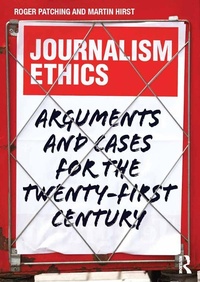
Journalism Ethics
Arguments and cases for the twenty-first century
1st Edition
Published on 20. November 2013
320 pages
978-1-317-96374-5 (ISBN)
Description

Journalism Ethics: Arguments and Cases for the 21st Century explores the major ethical dilemmas facing journalists in the digital age.
Engaging with both the theory and practice of journalism ethics, this text explains the key ethical concepts and dilemmas in journalism and provides an international range of examples and case studies, considering traditional and social media from a global perspective.
Journalism Ethics offers an introductory philosophical underpinning to ethics that traces the history of the freedom of expression from the time of Greek philosophers like Aristotle, through the French and American revolutions, to modern day.
Throughout the book Patching and Hirst examine ethically-challenging issues such as deception, trial by media, dealing with sources and privacy intrusion. They also explore continuing ethical fault lines around accuracy, bias, fairness and objectivity, chequebook journalism, the problems of the foreign correspondent, the conflicts between ethics and the law and between journalists and public relations consultants.
Concluding with a step-by-step guide to ethical thinking on the job, this textbook is an invaluable resource for students of journalism, media and communication.
Engaging with both the theory and practice of journalism ethics, this text explains the key ethical concepts and dilemmas in journalism and provides an international range of examples and case studies, considering traditional and social media from a global perspective.
Journalism Ethics offers an introductory philosophical underpinning to ethics that traces the history of the freedom of expression from the time of Greek philosophers like Aristotle, through the French and American revolutions, to modern day.
Throughout the book Patching and Hirst examine ethically-challenging issues such as deception, trial by media, dealing with sources and privacy intrusion. They also explore continuing ethical fault lines around accuracy, bias, fairness and objectivity, chequebook journalism, the problems of the foreign correspondent, the conflicts between ethics and the law and between journalists and public relations consultants.
Concluding with a step-by-step guide to ethical thinking on the job, this textbook is an invaluable resource for students of journalism, media and communication.
More details
Edition
1. Auflage
Language
English
Place of publication
London
United Kingdom
Publishing group
Taylor & Francis Ltd
Target group
College/higher education
Illustrations
1 s/w Tabelle, 5 s/w Photographien bzw. Rasterbilder, 1 s/w Zeichnung
1 Tables, black and white; 1 Line drawings, black and white; 5 Halftones, black and white
ISBN-13
978-1-317-96374-5 (9781317963745)
Copyright in bibliographic data and cover images is held by Nielsen Book Services Limited or by the publishers or by their respective licensors: all rights reserved.
Schweitzer Classification
Other editions
Additional editions
Book
11/2013
1st Edition
Routledge
€242.40
Shipment within 15-20 days
Book
11/2013
1st Edition
Routledge
€118.20
Shipment within 15-20 days

Book
11/2013
Routledge
Unfortunately, price unknown
Available (delivery time upon request)
Persons
Roger Patching has spent more than half a century in journalism and journalism education. This is the eighth journalism text he has co-authored in the past four decades. In 'semi-retirement', he still teaches part time at Bond University on Queensland's Gold Coast, and his doctorate on privacy invasion is nearing completion. His contribution to journalism education has been recognised with life membership of his professional association, the Journalism Education Association of Australia.
Martin Hirst has been a journalism scholar for more than 20 years. He worked as a broadcast journalist for 20 years, including a stint in the Parliamentary Press Gallery in Canberra, Australia. He is author, co-author or editor of seven books and scores of journal articles. He is a regular commentator on media matters and currently works at Deakin University in Melbourne, Australia.
Martin Hirst has been a journalism scholar for more than 20 years. He worked as a broadcast journalist for 20 years, including a stint in the Parliamentary Press Gallery in Canberra, Australia. He is author, co-author or editor of seven books and scores of journal articles. He is a regular commentator on media matters and currently works at Deakin University in Melbourne, Australia.
Content
Section I: The theoretical framework for arguments and cases 1. Ethics and Philosophy 2. An age of revolutions: Journalism, ethics and freedom of the press 3. Journalism ethics today Section II: Ethics in practice 4. How far do you go? Deception and the public interest 5. 'Do you want lies with that?' - The problems with chequebook journalism 6. Crisis, what crisis? Foreign correspondence and war reporting - The price of truth Section III: Dealing with the law - ethically speaking 7. Covering the courts and legal issues 8. Trial by media 9. Fair dealing - sources, shield laws and PR Section IV: The big issues in media ethics 10. Do we need to know? Privacy and the press, an ethico-legal fault line 11. The Ethics of the Image 12. Social media: the game-changer 13. Ethical decision-making in the newsroom
