

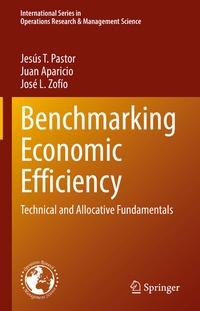
Benchmarking Economic Efficiency
Technical and Allocative Fundamentals
1st Edition
Published on 12. July 2022
XXXIV, 640 pages
978-3-030-84397-7 (ISBN)
Description

This book unifies and extends the definition and measurement of economic efficiency and its use as a real-life benchmarking technique for actual organizations. Analytically, the book relies on the economic theory of duality as guiding framework. Empirically, it shows how the alternative models can be implemented by way of Data Envelopment Analysis. An accompanying software programmed in the open-source Julia language is used to solve the models. The package is a self-contained set of functions that can be used for individual learning and instruction. The source code, associated documentation, and replication notebooks are available online.
The book discusses the concept of economic efficiency at the firm level, comparing observed to optimal economic performance, and its decomposition according to technical and allocative criteria. Depending on the underlying technical efficiency measure, economic efficiency can be decomposed multiplicatively or additively. Part I of the book deals with the classic multiplicative approach that decomposes cost and revenue efficiency based on radial distance functions. Subsequently, the book examines how these partial approaches can be expanded to the notion of profitability efficiency, considering both the input and output dimensions of the firm, and relying on the generalized distance function for the measurement of technical efficiency.
Part II is devoted to the recent additive framework related to the decomposition of economic inefficiency defined in terms of cost, revenue, and profit. The book presents economic models for the Russell and enhanced graph Russell measures, the weighted additive distance function, the directional distance function, the modified directional distance function, and the Hölder distance function. Each model is presented in a separate chapter. New approaches that qualify and generalize previous results are also introduced in the last chapters, including the reverse directional distance function and the general direct approach.
The book concludes by highlighting the importance of benchmarking economic efficiency for all business stakeholders and recalling the main conclusions obtained from many years of research on this topic. The book offers different alternatives to measure economic efficiency based on a set of desirable properties and advises on the choice of specific economic efficiency models.
The book discusses the concept of economic efficiency at the firm level, comparing observed to optimal economic performance, and its decomposition according to technical and allocative criteria. Depending on the underlying technical efficiency measure, economic efficiency can be decomposed multiplicatively or additively. Part I of the book deals with the classic multiplicative approach that decomposes cost and revenue efficiency based on radial distance functions. Subsequently, the book examines how these partial approaches can be expanded to the notion of profitability efficiency, considering both the input and output dimensions of the firm, and relying on the generalized distance function for the measurement of technical efficiency.
Part II is devoted to the recent additive framework related to the decomposition of economic inefficiency defined in terms of cost, revenue, and profit. The book presents economic models for the Russell and enhanced graph Russell measures, the weighted additive distance function, the directional distance function, the modified directional distance function, and the Hölder distance function. Each model is presented in a separate chapter. New approaches that qualify and generalize previous results are also introduced in the last chapters, including the reverse directional distance function and the general direct approach.
The book concludes by highlighting the importance of benchmarking economic efficiency for all business stakeholders and recalling the main conclusions obtained from many years of research on this topic. The book offers different alternatives to measure economic efficiency based on a set of desirable properties and advises on the choice of specific economic efficiency models.
More details
Series
Language
English
Place of publication
Cham
Switzerland
Publishing group
Springer International Publishing
Target group
Professional and scholarly
Product notice
Reflowable
Illustrations
XXXIV, 640 p. 124 illus., 118 illus. in color.
File size
22,41 MB
ISBN-13
978-3-030-84397-7 (9783030843977)
DOI
10.1007/978-3-030-84397-7
Schweitzer Classification
Other editions
Additional editions
Jesús T. Pastor | Juan Aparicio | José L. Zofío
Benchmarking Economic Efficiency
Technical and Allocative Fundamentals
Book
07/2022
Springer
€149.79
Shipment within 7-9 days
Persons
Jesus T. Pastor is a professor of Statistics and Operations Research at the Universidad Miguel Hernandez of Elche, Spain. He has been visiting researcher at the Universities of Georgia (USA), Toronto (Canada), Queensland (Australia) and Warwick (UK). Prof. Pastor's research fields include location science, banking and, for the last twenty-five years, efficiency analysis.
Juan Aparicio is a professor Statistics, Mathematics and Information Technology at the Miguel Hernandez University of Elche (UMH), Spain, and the head of the Center of Operations Research. His research interest includes efficiency and productivity analysis combined with Machine Learning and Data Science. He is associate editor of Omega; The International Journal of Management Science , Journal of Productivity Analysis , Ma thematics and Advances in Operations Research .
José Luis Zofío is a professor of Economics at the Universidad Autónoma de Madrid and former Chair of the Department of Economics. He is also Visiting Professor at Erasmus University and Wageningen University and Research, and Visiting Fellow to the Erasmus Research Institute of Management ERIM, where he collaborates with several academics from the Rotterdam School of Management. His research interests are related to measurement theory in economics, in particular the use of index numbers for efficiency and productivity analysis, as well as spatial economics and trade theory.
Juan Aparicio is a professor Statistics, Mathematics and Information Technology at the Miguel Hernandez University of Elche (UMH), Spain, and the head of the Center of Operations Research. His research interest includes efficiency and productivity analysis combined with Machine Learning and Data Science. He is associate editor of Omega; The International Journal of Management Science , Journal of Productivity Analysis , Ma thematics and Advances in Operations Research .
José Luis Zofío is a professor of Economics at the Universidad Autónoma de Madrid and former Chair of the Department of Economics. He is also Visiting Professor at Erasmus University and Wageningen University and Research, and Visiting Fellow to the Erasmus Research Institute of Management ERIM, where he collaborates with several academics from the Rotterdam School of Management. His research interests are related to measurement theory in economics, in particular the use of index numbers for efficiency and productivity analysis, as well as spatial economics and trade theory.
Content
Chapter 1: Introduction.- Chapter 2: Conceptual background: firms' objectives, decision variables and economic efficiency.- Part I.- Chapter 3: Shephard's input and output distance functions: cost and revenue efficiency decompositions.- Chapter 4: The generalized distance function (GDF): Profitability efficiency decomposition.- Part II.- Chapter 5: The Russell Measures: Economic Inefficiency Decompositions.- Chapter 6: The Weighted Additive Distance Function (WADF): Economic inefficiency decompositions.- Chapter 7: The enhanced Russell graph measure (ERG=SBM): economic inefficiency decompositions.- Chapter 8: The directional distance function (DDF): economic inefficiency decompositions.- Chapter 9: The Hölder distance functions: economic inefficiency decompositions.- Chapter 10: The loss distance function: economic inefficiency decompositions.- Chapter 11: The modified directional distance function (MDDF): economic inefficiency decompositions.- Chapter 12: The reverse directional distance function (RDDF): economic inefficiency decompositions.- Chapter 13: A unifying framework for decomposing economic inefficiency: The general direct approach and the standard and flexible reverse approaches.- Chapter 14: A final overview: economic efficency models and properties.- Bibliography.- Subject Index.- Author Index.
