

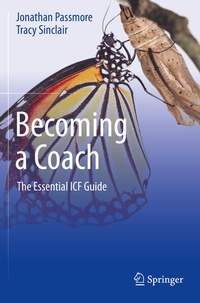
Becoming a Coach
Description

Authored by masters in the field of coaching, this book is designed as a course textbook for those studying coaching in general, but with a specific reference to the updated competences introduced by the International Coaching Federation in 2020. It focuses on core coaching skills, knowledge, and developing self-awareness. This is a definitive text for coach training and go-to guide for those undertaking ICF-accredited programs throughout the world.
This book helps readers equip themselves with the skills and knowledge needed to develop as a professional coach. It encourages readers to reflect on who they are, what they can do, and how they can enhance their skills. By drawing on the Gold Standard for coach training and the latest coaching research, this book ensures that a trainer's practice is well informed by evidence and is up to the highest professional standards.
More details
Other editions
Additional editions
Persons
Jonathan Passmore is an award winning and internationally respected chartered psychologist based in the UK. He has written or edited over 30 books including Excellence in Coaching and Top Business Psychology Models , which have been widely translated in to multiple languages, and over 100 book chapters and articles. He holds five degrees and is the director of the Centre for Coaching at Henley Business School, University of Reading, UK, which delivers post-graduate coach training to over 300 students per year in the UK and internationally. The latest book, Mastering Executive Coaching is co-authored with Marshall Goldsmith and Brain Underhill.
Tracy Sinclair is a Past Global Chair of the International Coaching Federation, an ICF credentialed coach, a coaching supervisor, mentor coach and ICF assessor. She has practiced as a coach for 13 years and now leads a coaching, coach mentor, coach training and coaching consultancy business helping clients, organizations and coaches in their development journeys. In recognition of her efforts to develop the field of coaching, she was named as one of the Leading Global Coaches winners of the Thinkers50 Marshall Goldsmith Coaching Awards 2019.
Content
Introduction: Marshall Goldsmith.- Section 1.- Chapter 1. What is coaching?.- Chapter 2. Who am I?.- Chapter 3. Understanding clients.- Chapter 4. Coach maturity.- Section 2. Developing core coaching competences.- Chapter 5. Ethics & professional conduct (competency 1).- Chapter 6. Contracting (competency 2).- Chapter 7. Relationship (competency 3).- Chapter 8. Presence (competency 4).- Chapter 9. Active listening (competency 5).- Chapter 10. Powerful questions (competency 6).- Chapter 11. Direct communication (competency 7).- Chapter 12. Creating awareness (competency 8).- Chapter 13. Moving to action (competency 9, 10 & 11).- Chapter 14. Integrating the behaviors (Summary).- Section 3. Approaches to coaching.- Chapter 15. The Henley Eclectic Model .- Chapter 16. Behavioural approach and the GROW model.
