

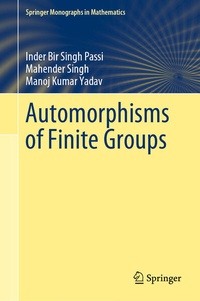
Automorphisms of Finite Groups
Description

The book describes developments on some well-known problems regarding the relationship between orders of finite groups and that of their automorphism groups. It is broadly divided into three parts: the first part offers an exposition of the fundamental exact sequence of Wells that relates automorphisms, derivations and cohomology of groups, along with some interesting applications of the sequence. The second part offers an account of important developments on a conjecture that a finite group has at least a prescribed number of automorphisms if the order of the group is sufficiently large. A non-abelian group of prime-power order is said to have divisibility property if its order divides that of its automorphism group. The final part of the book discusses the literature on divisibility property of groups culminating in the existence of groups without this property. Unifying various ideas developed over the years, this largely self-contained book includes results that are either proved or with complete references provided. It is aimed at researchers working in group theory, in particular, graduate students in algebra.
Reviews / Votes
"The book is valuable as a source of results that are less known and are of independent interest. . the book is aimed at researchers in group theory and at graduate students in algebra. Far from being a comprehensive treatise, it is a useful book to have for those interested in studying the relation between a finite group and its automorphism group." (Marian Deaconescu, zbMATH 1447.20004, 2020)"The audience for this interesting book includes group theorists and graduate students headed in this direction." (Michael Berg, MAA Reviews, October 6, 2019)
"It represents a useful reference text for researchers in the area, but easily doubles as a very readable introductory text for graduate students . ." (Andrea Caranti, Mathematical Reviews, August, 2019)
More details
Other editions
Additional editions
Persons
Mahender Singh is Assistant Professor at the Indian Institute of Science Education and Research, Mohali. He earned his Ph.D. in mathematics from Harish-Chandra Research Institute, Allahabad (2010). His research interests lie broadly in topology and algebra, with a focus on compact group actions on manifolds, equivariant maps, automorphisms and cohomology of groups, and quandles. He is a recipient of the INSPIRE Faculty award of the Department of Science and Technology, Government of India (2011). He has published several research papers in respected international journals, conference proceedings, and contributed volumes.
Manoj Kumar Yadav is Professor at the Harish-Chandra Research Institute, Allahabad. He received his Ph.D. in mathematics from Kurukshetra University, Haryana (2002). He is a recipient of the Indian National Science Academy Medal for Young Scientists (2009) and the Department of Science and Technology, Science and Engineering Research Council (SERC), fellowship Fast Track Scheme for Young Scientists (2005). He is a member of the National Academy of Sciences, India (NASI). His research interests lie in group theory, particularly the automorphisms, conjugacy classes, and Schur multipliers of groups. He has published several research papers in respected international journals, conference proceedings, and contributed volumes.
