

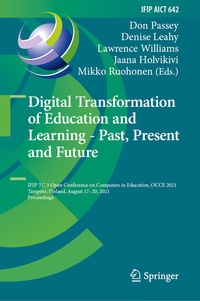
Digital Transformation of Education and Learning - Past, Present and Future
Description

This book constitutes the refereed post-conference proceedings of the IFIP TC 3 Open Conference on Computers in Education, OCCE 2021, held in Tampere, Finland, in August 2021.
The 22 full papers and 2 short papers included in this volume were carefully reviewed and selected from 44 submissions. The papers discuss key emerging topics and evolving practices in the area of educational computing research. They are organized in the following topical sections: Digital education across educational institutions; National policies and plans for digital competence; Learning with digital technologies; and Management issues.
More details
Other editions
Additional editions
Content
Digital education across educational institutions.- An Integrated Model of Digitalisation-Related Competencies in Teacher Education.- Primary Education Student Teachers' Perceptions of Computational Thinking through Bebras Tasks.- Programming Concepts in Lower Primary Years and their Cognitive Demands.- "Literacy from Python" Using Python for a Proposed Cross-curricular Teaching and Learning Model.- Advocating for Educational Support to Develop Socially Disadvantaged Young People's Digital Skills and Competencies: Can Support Encourage their Human Development as Digital Citizens?.- Developing Inclusive Digital Pedagogies: Reflections on the Past, the Present and Future Directions.- Students' Conceptions of Programming in the Context of Game Design.- A Closer Look at and Confirmation of the General and Study Interests of Future Computer Science Students.- Starter Projects in Python Programming Classes.- National policies and plans for digital competence.- Computer Education in Australia Fifty Years Ago.- Computational Thinking - Forces Shaping Curriculum and Policy in Finland, Sweden and the Baltic Countries.- Changing Computer Curricula in Australia.- Development of IPSJ Data Science Curriculum Standard.- Proof of Concept Teaching for 21 st Century Digital Literacy in Portugal: A Pedagogical Approach Towards a New Educational Model.- Use of Vclass in Mathematics Education Delivery: The UEW Experience.- Needs and Challenges of Smart Agriculture and Entrepreneurship Education - A Case Study by the University of Agricultural Sciences, Dharwad, Karnataka, India.- Learning with digital technologies.- Vocational Education during School Shutdown - A Danish Case on Emergency Remote Teaching.- Analysis of Practical Examples of a Real-time Online Class on Agriculture in Space, Using the Collaborative Learning Tool "Digital Diamond Mandala Matrix".- AsTRA - An Assessment Tool for Recognition and Adaptation of Prior Professional Experience and Vocational Training.- Is It Real? - Learners' Perceptions on Tele-immersive 3D Video Technology and its Further Use in K-12 Education.- DigiFit4All - Conceptualisation of a Platform to Generate Personalised Open Online Courses (POOCs).- Management issues.- What Kind of E-assessment Feedback is Important to Students? An Empirical Study.- Shifting to a Technology-Driven Work Mode: Workplace Learning and Dynamic Capability in the Case of a Public-Sector Service Organisation.- Digital Transformation of Education and Learning through Information Technology in Educational Management.
