

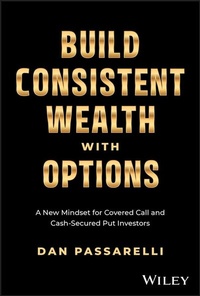
Build Consistent Wealth with Options
Description

A step-by-step guide to market-beating options trading strategies that work in the real world
In Build Consistent Wealth with Options: A New Mindset for Covered Call and Cash-Secured Put Investors, experienced trader and author Dan Passarelli shares for the first time a practical, hands-on guide to the popular options trading strategy known as "The Wheel." Passarelli helps you overcome the most common and daunting obstacles that stand in the way of investors who try this strategy, changes theory into action and reveals the real-world steps to finally make it work for you.
The book introduces the "Cycle/Recycle Trade," a blueprint that turns a nuanced and effective options trading strategy-often praised as beating the trusted buy-and-hold-into repeatable results most miss.
Inside the book:
- A step-by-step guide to building a mindset that nurtures the strengths of probability and edge in your investing
- Expert guidance on setting and achieving objectives
- Hands-on examples demonstrating how to react to common options trading scenarios
Perfect for both retail and professional investors everywhere, Build Consistent Wealth with Options is an incisive, effective manual for the real-world application of options trading strategies that have stood the test of time.
More details
Other editions
Additional editions
Person
DAN PASSARELLI is the founder and CEO of Market Taker Mentoring, Inc., a leading options education firm. He is a former member and market maker of the Chicago Board Options Exchange and CME Group, where he traded as an equity options market maker and agricultural options and futures trader.
Content
Preface xv
Acknowledgments xvii
About the Author xix
Chapter 1: Alpha and Building Wealth 1
Chapter 2: Deriving Better Tools 13
Chapter 3: How and Why Covered Calls Work 19
Chapter 4: How and Why Cash-Secured Puts Work 35
Chapter 5: Straight-Up OG Covered Call Setups 53
Chapter 6: Cash-Secured Puts: Classic Dish, Special Sauce 69
Chapter 7: Buy-Writes and Opportunistic Improvements on Covered Calls 87
Chapter 8: The Wheel: Where the Rubber Hits the Road 107
Chapter 9: The Cycle/Recycle Trade 121
Chapter 10: Rewiring Your Brain for Investing 137
Chapter 11: Skate or Trade: How Objectives Drive Results 153
Chapter 12: The Trifecta of Analyses 159
Chapter 13: Metrics for Edge and Locking in Advantages 191
Chapter 14: Taxes, Commissions, and Liquidity 221
Chapter 15: Specific Situations and Optimizing for Optionality 241
Chapter 16: Trends and Ends (of Trends) 265
Chapter 17: Skate Objective Cycles 283
Chapter 18: Trade Objective Cycles 301
Chapter 19: How Are You Doing? And Goodbye 319
Notes 329
Index 331
Chapter 1
Alpha and Building Wealth
Can you beat the market?
Well, there's a doozie to start out with. As you can imagine, if the answer was a solid "no," I wouldn't have written this book. My answer is "yes." But it's a lot to unpack. In fact, we require a good part of a whole chapter to even understand the question well enough so we can properly ponder the answer.
First, allow me to pose a different question: what is the market? Then we'll be able to take a better look at why and how investors can beat the market and explore why it matters.
The Market
I make a distinction between trading and investing. Trading tends to involve shorter-term positions, which attempt to capture fluctuations in price movements, whereas investing consists of longer-term positions expected to appreciate in value over time. And sometimes I refer to trading as the act of placing a trade and thus entering into or getting out of a position, which could be an investment or a trading position.
Anyway, in the context of trading and investing, the word "market" can take on different and distinct meanings. They're all sort of etymologically related. And it's important to understand this. So let's jump in.
The purest sense of the word "market" is a place to buy and sell goods or services-meaning a physical place or a virtual place (online). As for trading stocks, think about when traders would gather and stand under the famed buttonwood tree on Wall Street in the late 1700s. It was a marketplace for stocks and bonds. Soon after, that marketplace evolved into trading pits on an exchange floor. Then near the end of the past century, the exchanges took the market online. Evolution!
And some of the individuals under the tree or on the exchange (physically or virtually) made/make a market, which is the next evolution of the word: a person or firm that quotes both a buy price and a sell price for something. In our trader context, the price at which someone wants to buy is called the "bid," and the price at which someone wants to sell is the "ask" or the "offer." And the "something" in this case is a financial instrument-a "security."
The highest price any market participant wants to pay for a specific security is simply referred to as the "market bid," and the lowest price any market participant wants to sell it is the "market ask." Those two together are "the market" for that security.
These days the market(place) is mostly online, and anyone can get a market for any stock or individual option position from online brokers or other sources. There are many exchanges that all list the same securities, which is called "multiple listing." They are all fungible, which means if you buy it on one exchange, you can sell it on another. The markets for each individual stock or option are aggregated from each of the exchanges on which they are listed and disseminated as a single, aggregate market called the National Best Bid and Offer (NBBO).
That's the bid and the offer you see in an online brokerage account. In that regard, there are literally hundreds of thousands of fleeting "markets" that update on your screen, flashing by the millisecond (or however fast your data feed and infrastructure can handle).
But what people sometimes mean when they talk about "the market" often isn't either of those things. It's kind of an adulteration of those earlier contexts. The main way people use the word "market" is to describe a collective group (or "basket") of stocks, often called an "index."
One of the most common indexes people are referring to when they talk about "the market" is the Dow Jones Industrial Average (DJIA). This may strike many people as a bit odd, as this index has only 30 stocks in it, and yet still many people call it "the market." Seemingly, 30 stocks chosen by a committee with some discretion of which stocks they'll include in the index doesn't seem to be super representative of the whole market-the entire universe of stocks. But the DJIA was one of the first stock indexes ever created and followed widely, so it's sort of burned in the psyche of traders. I guess it's good to be first to market. There's that word again..
Soon other indexes followed suit and published prices of their own baskets of stocks. The S&P 500, a market-capitalization-weighted index of 500 companies' stock prices, was eventually born and is accepted by the majority of investors as the gauge of the health of U.S. stocks overall-"the market."
This is a little bit of an overstatement as well. There are more than 8,000 stocks listed on U.S. exchanges at the writing of this book-though the number changes over time. The ones in the S&P 500 index are stocks selected by a committee of individuals. For all intents and purposes, these committee members are "stock pickers" like anyone else who curates a basket of stocks-though there is less discretion with which stocks qualify for S&P 500 index components.
Interestingly and remarkably, the DJIA and the S&P 500 track one another reasonably closely. So it's not a big stretch to call the Dow the market. But I, and in my observation most market participants, prefer to refer to the S&P 500 as the market.
As far as these "stock pickers" who select the component stocks of such indexes go, one could argue that their motivations are somewhat different from big traders or investors who are picking stocks for their investment portfolios. Index curators are not including stocks in the index to profit from them, as traders do. Though they, or their companies, surely benefit by picking good ones. If they pick a lot of lemons and the index struggles to keep up with the majority of stocks out there-ones not in the index-well.that's.less than ideal. These stocks are the "industry leaders" as with the DJIA, or the largest U.S. corporations by market cap, as with the S&P 500.
What's the point? A big one, actually. Other stock pickers, i.e., individual investors, mutual fund managers, pension fund managers, hedge fund managers, and others, need a benchmark-something to measure their own results against. Thus is the role of these indexes.
"Did I beat the S&P 500?" "Did I beat.the market?"
Building Wealth in the Stock Market
This thing we call the stock market is designed to create wealth. For many people in Western Civilization, in a society born out of the tenets of the ideals of capitalism, those stock investments are a big part of one's wealth-wealth to fund retirement and other expenses during the latter part of life. Of course, there are also bonds, real estate, precious metals, collectibles, and what have you. But unlike most other investments, the stock market creates value. And that creates wealth for the investors in the stock market.
Those seem like pretty big statements: "creates value" and "creates wealth." But that is what stocks are intended to do, and empirically have done, for the long-term investor for centuries.
When there is division of specialized labor, skilled management, and economies of scale, a well-run corporation should be able to sell goods and services at a higher profit margin than a typical mom-and-pop shop. They get to use the equity capital they get from issuing stock. They can sell bonds to borrow money. Or just take out loans. And they can use that cash to capitalize on economies of scale. And they can hire experts, including and especially experts in hiring the right people-HR executives-who find the best talent. I've heard it argued rather compellingly that the value of a company is the value of the talent who works there.
The stock market is where equity capital is raised and transferred, and any individual can buy a piece of it and invest in these talented people running a proven, successful business.
The expertly talented people who know how to turn a profit.
Out of which the company will pay shareholders dividends.
Or reinvest those profits back into the company.
Continuing to put invested funds to good, profit-generating use.
They create goods or services and sell them at a higher price than it cost them to create. The best companies create value for the customer, value for the employee, and value for the owners (shareholders).
Consider corporations' (stock issuing companies') activities. Assembling component parts in a smart, cost-efficient way-adding value through synergy of components-the company literally creates value. Building a factory that runs more efficiently than could be done otherwise also creates value. Likewise, for service companies. Selling expertise to a person or company to make that customer more productive is a value-added/value-created activity.
If a company finds a way to create more value, like cutting costs but not output (or growing output and not costs), creating new solutions for problems people have sought solutions to (or problems they didn't know they had), finding the cure for cancer, or whatever, the company becomes more valuable.
A...
