

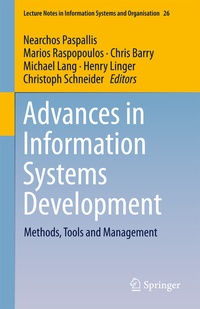
Advances in Information Systems Development
Description

This volume features a collection of papers on emerging concepts, significant insights, novel approaches and ideas in information systems development. It examines advances in information systems development in general, and their impact on the development of new methods, tools and management.
The book draws on selected invited papers from the 26th International Conference on Information Systems Development (ISD) held in Larnaca, Cyprus, September 6 - 8, 2017. The revised and expanded papers present research that focuses on methods, tools and management in information systems development. These issues are significant as they provide the basis for organizations to identify new markets, support innovative technology deployment, and enable mobile applications to detect, sense, interpret and respond to the environment.
More details
Other editions
Additional editions
Persons
Nearchos Paspallis is Assistant Professor at the University of Central Lancashire in Larnaca, Cyprus. His research is focusing on software engineering methods for enabling context-aware and self-adaptive behavior in mobile and pervasive computing environments, as well as on gamification applications.
Marios Raspopoulos is Assistant Professor in Electrical and Electronic Engineering at the University of Central Lancashire in Larnaca, Cyprus. His research interests span the wide spectrum of ICTs with a special focus on telecommunications and mobile wireless communications and information systems.
Henry Linger is an Associate Professor in the Faculty of Information Technology and a senior researcher with the Centre for Organisational and Social Informatics (COSI) at Monash University in Melbourne, Australia. His research is at the intersection of information systems, knowledge management, and project management, with a focus on the design of information systems to support knowledge work.
Chris Barry works with the Cairnes School of Business and Economics at the National University of Ireland, Galway. He lectures and researches a range of areas in information systems including systems analysis and design, information systems management, and ethics in information systems development.
Michael Lang is a Senior Lecturer in Business Information Systems at the Cairnes School of Business and Economics, National University of Ireland, Galway. His research interests are business systems analysis and design, information systems privacy, and information systems education.
Christoph Schneider is an Assistant Professor in the Department of Information Systems at City University of Hong Kong. His research focuses on the effects of user interface design on cognition, affect, and behavior, in particular in the context of Web-based user interfaces.
