

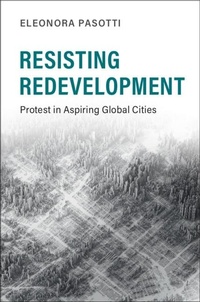
Resisting Redevelopment
Protest in Aspiring Global Cities
Published on 11. March 2020
978-1-108-80642-8 (ISBN)
Description

The politics of urban development is one of the most enduring, central themes of urban politics. In Resisting Redevelopment, Eleonora Pasotti explores the forces that enable residents of 'aspiring global cities,' or economically competitive cities, to mobilize against gentrification and other forms of displacement, as well as what makes mobilizations successful. Scholars and activists alike will benefit from this one-of-a-kind comparative study. Impressive in its scope, this book examines twenty-nine protest campaigns over a decade in ten major cities across five continents, from Santiago to Seoul to Los Angeles. Pasotti sheds light on an approach that is both understudied and remarkably effective - the practice of successful organizers deploying 'experiential tools,' or events, social archives, neighborhood tours, and performances designed to attract participants and transform the protest site into the place to be. With this book, Pasotti promises to provide a creative and novel contribution to the literature of contentious politics.
Reviews / Votes
'Nearly forty years ago, Manual Castells argued that the central arena of class conflict had moved from the factory floor to urban neighborhoods. Since then, the frequency and intensity of urban development struggles has only increased. And yet, the insights of urbanists and social movement scholars have rarely been integrated and brought to bear on the study of development struggles. Pasotti's groundbreaking book goes a long way toward remedying this problem. Hers is not simply a theoretical contribution, but arguably the best comparative study of urban development struggles conducted to date.' Doug McAdam, Stanford University 'Examining cities as diverse as Seoul, Hamburg, Istanbul, Buenos Aires, and Los Angeles, Resisting Development brings a fresh perspective to the study of contentious politics. Pasotti's innovative study shows how successful mobilizations against urban redevelopment increasingly utilize 'experiential tools' such as cultural events that increase neighborhood pride and salience, and connect residents with outsiders. This creative qualitative study should reinvigorate the study of urban social movements within Political Science and more broadly.' Alison Post, University of California, Berkeley 'In a work of stunning geographic scope, Eleonora Pasotti shows how local movements in cities around the world have succeeded in advancing struggles over gentrification. Her analysis poses persuasive challenges to both neoliberal and Neomarxist presumptions about the possibilities for contesting configurations of urban power across the contemporary world. Packed with lessons for movement activists as well as for academics, Resisting Redevelopment exemplifies what a truly global perspective on urban politics can deliver.' Jefferey Moore Sellers, University of Southern California 'Resisting Redevelopment offers a sweeping, theoretically rich analysis of the politics of gentrification and redevelopment in twenty-first century aspiring global cities. Analyzing twenty-nine cases of protest against redevelopment in ten meticulously researched cities, Pasotti asks how residents are mobilized and what makes resistance successful. Her breakthrough findings highlight the role of experiential tools that activate neighborhood identities, even without being overtly political. The results offer a nuanced and insightful look at who wins and who loses in battles over urban space.' Jessica Trounstine, University of California, Merced 'Each part of the book is complete enough to serve as a stand-alone volume. Another strength is that the cases are presented thematically. The breadth and depth will greatly expand readers' knowledge by highlighting cultural producers and demonstrating that grassroots protest activities go well beyond militant marches and rallies. Scholars and students of urban politics, civic engagement, and social movements will be strongly engaged by this work.' M. L. Godwin, Choice '... the book is an ambitious undertaking. It demonstrates the vast variations in economic, political, and legal institutions across cities in both the Global South and North and how these conditions shape protest strategies and outcomes ... can be a useful guide for broadening the comparative lens for small-N studies on urban protests in globalizing cities.' Werner Eichhorst, American Journal of SociologyMore details
Series
Language
English
Place of publication
Cambridge
United Kingdom
Target group
Professional and scholarly
College/higher education
Illustrations
Worked examples or Exercises; 7 Tables, black and white; 3 Line drawings, black and white
File size
5,29 MB
ISBN-13
978-1-108-80642-8 (9781108806428)
Copyright in bibliographic data and cover images is held by Nielsen Book Services Limited or by the publishers or by their respective licensors: all rights reserved.
Schweitzer Classification
Other editions
Additional editions
Book
03/2020
Cambridge University Press
€109.50
Shipment within 15-20 days
Book
03/2020
Cambridge University Press
€49.50
Shipment within 15-20 days
Person
Content
Part I. Setting the Comparison: 1. Introduction; 2. Explaining protest against urban redevelopment; 3. Research design and overview of results; 4. Aspiring global cities; Part II. Explaining Mobilization: 5. Experiential tools and networks; 6. Squatting, experiential tools, and protest legacies; 7. Judicial resistance, experiential tools, and protest legacies; 8. Protest with high union support: Buenos Aires; Part III. Explaining Impact: 9. Council allies and partisan alignments; 10. Shaping redevelopment in public housing estates; 11. Militancy with a twist: fighting art to deter displacement in Boyle Heights, Los Angeles; 12. Conclusion; Appendix 1. Qualitative comparative analysis; Appendix 2. Partisan alignments; Bibliography; Index.
