
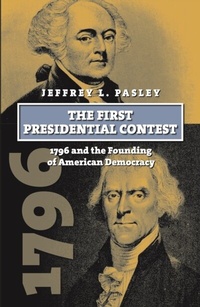
The First Presidential Contest
Description
Alles über E-Books | Antworten auf Fragen rund um E-Books, Kopierschutz und Dateiformate finden Sie in unserem Info- & Hilfebereich.
This is the first study in half a century to focus on the election of 1796. At first glance, the first presidential contest looks unfamiliar?parties were frowned upon, there was no national vote, and the candidates did not even participate (the political mores of the day forbade it). Yet for all that, Jeffrey L. Pasley contends, the election of 1796 was ?absolutely seminal,? setting the stage for all of American politics to follow.
Challenging much of the conventional understanding of this election, Pasley argues that Federalist and Democratic-Republican were deeply meaningful categories for politicians and citizens of the 1790s, even if the names could be inconsistent and the institutional presence lacking. He treats the 1796 election as a rough draft of the democratic presidential campaigns that came later rather than as the personal squabble depicted by other historians. It set the geographic pattern of New England competing with the South at the two extremes of American politics, and it established the basic ideological dynamic of a liberal, rights-spreading American left arrayed against a conservative, society-protecting right, each with its own competing model of leadership.
Rather than the inner thoughts and personal lives of the Founders, covered in so many other volumes, Pasley focuses on images of Adams and Jefferson created by supporters?and detractors?through the press, capturing the way that ordinary citizens in 1796 would have actually experienced candidates they never heard speak. Newspaper editors, minor officials, now forgotten congressman, and individual elector candidates all take a leading role in the story to show how politics of the day actually worked.
Pasley's cogent study rescues the election of 1796 from the shadow of 1800 and invites us to rethink how we view that campaign and the origins of American politics.
All prices
More details
Other editions
Additional editions
Person
Content
Editors' Foreword
Acknowledgments
Introduction: The Unintentional Campaign
1. A New Republic and Its Discontents
2. Popular Politics in a Postcolonial Nation
3. The Jay Treaty Crisis and the Origins of the 1796 Campaign
4. From Measures to ?that man?: Toward the Presidential Option for Political Change
5. The Long Goodbye: finding Candidates in the Shadow of Washington
6. The First Culture War: Themes and Issues of the Federalist Campaign against Thomas Jefferson
7. His Rotundity: Themes and Issues of the Democratic-Republican Campaign against John Adams
8. Taking the Electoral College to School: How Presidential Electors Helped Create the National Presidential Election Rather Than Preventing It
9. The Party Racers: Voting for President in 1796
Epilogue: Kiss My Ass and Go to Hell
Notes
Bibliographic Essay
Index

System requirements
File format: ePUB
Copy protection: Adobe-DRM (Digital Rights Management)
System requirements:
- Computer (Windows; MacOS X; Linux): Install the free reader Adobe Digital Editions prior to download (see eBook Help).
- Tablet/smartphone (Android; iOS): Install the free app Adobe Digital Editions or the app PocketBook before downloading (see eBook Help).
- E-reader: Bookeen, Kobo, Pocketbook, Sony, Tolino and many more (not Kindle).
The file format ePub works well for novels and non-fiction books – i.e., „flowing” text without complex layout. On an e-reader or smartphone, line and page breaks automatically adjust to fit the small displays.
This eBook uses Adobe-DRM, a „hard” copy protection. If the necessary requirements are not met, unfortunately you will not be able to open the eBook. You will therefore need to prepare your reading hardware before downloading.
Please note: We strongly recommend that you authorise using your personal Adobe ID after installation of any reading software.
For more information, see our ebook Help page.
File format: PDF
Copy-Protection: Adobe-DRM (Digital Rights Management)
System requirements:
- Computer (Windows; MacOS X; Linux): Install the free reader Adobe Digital Editions prior to download (see eBook Help).
- Tablet/smartphone (Android; iOS): Install the free app Adobe Digital Editions or the app PocketBook before downloading (see eBook Help).
- E-reader: Bookeen, Kobo, Pocketbook, Sony, Tolino and many more (only limited: Kindle).
The file format PDF always displays a book page identically on any hardware. This makes PDF suitable for complex layouts such as those used in textbooks and reference books (images, tables, columns, footnotes). Unfortunately, on the small screens of e-readers or smartphones, PDFs are rather annoying, requiring too much scrolling.
This eBook uses Adobe-DRM, a „hard” copy protection. If the necessary requirements are not met, unfortunately you will not be able to open the eBook. You will therefore need to prepare your reading hardware before downloading.
Please note: We strongly recommend that you authorise using your personal Adobe ID after installation of any reading software.
For more information, see our eBook Help page.
File format: ePUB
Copy protection: Watermark-DRM (Digital Rights Management)
System requirements:
- Computer (Windows; MacOS X; Linux): Use a reading software that can process the file format ePUB: e.g., Adobe Digital Editions or FBReader – both free (see eBook Help).
- Tablet/Smartphone (Android; iOS): Before downloading, install the free app Adobe Digital Editions (see eBook Help).
- E-reader: Bookeen, Kobo, Pocketbook, Sony, Tolino and many more (not Kindle).
The file format ePUB works well for novels and non-fiction books – i.e., „flowing” text without complex layout. On an e-reader or smartphone, line and page breaks automatically adjust to fit the small displays.
This eBook uses Watermark-DRM, a „soft” copy protection. This means that there are no technical restrictions to prevent illegal distribution. However, there is a personalised watermark embedded in the eBook that can be used to identify the purchaser of the eBook in the event of misuse and to provide evidence for legal purposes.
For more information, see our eBook Help page.
