

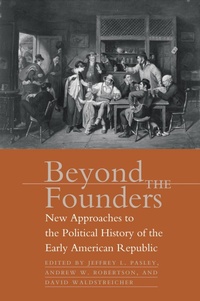
Beyond the Founders
New Approaches to the Political History of the Early American Republic
Published on 4. November 2009
450 pages
978-0-8078-9883-3 (ISBN)
Description

In pursuit of a more sophisticated and inclusive American history, the contributors to Beyond the Founders propose new directions for the study of the political history of the republic before the Civil War. In ways formal and informal, symbolic and tactile, this political world encompassed blacks, women, entrepreneurs, and Native Americans, as well as the Adamses, Jeffersons, and Jacksons, all struggling in their own ways to shape the new nation and express their ideas of American democracy.
Taking inspiration from the new cultural and social histories, these political historians show that the early history of the United States was not just the product of a few “founding fathers,” but was also marked by widespread and passionate popular involvement; print media more politically potent than that of later eras; and political conflicts and influences that crossed lines of race, gender, and class.
Contributors:
John L. Brooke, The Ohio State University
Andrew R. L. Cayton, Miami University (Ohio)
Saul Cornell, The Ohio State University
Seth Cotlar, Willamette University
Reeve Huston, Duke University
Nancy Isenberg, University of Tulsa
Richard R. John, University of Illinois at Chicago
Albrecht Koschnik, Florida State University
Rich Newman, Rochester Institute of Technology
Jeffrey L. Pasley, University of Missouri, Columbia
Andrew W. Robertson, City University of New York
William G. Shade, Lehigh University
David Waldstreicher, Temple University
Rosemarie Zagarri, George Mason University
Taking inspiration from the new cultural and social histories, these political historians show that the early history of the United States was not just the product of a few “founding fathers,” but was also marked by widespread and passionate popular involvement; print media more politically potent than that of later eras; and political conflicts and influences that crossed lines of race, gender, and class.
Contributors:
John L. Brooke, The Ohio State University
Andrew R. L. Cayton, Miami University (Ohio)
Saul Cornell, The Ohio State University
Seth Cotlar, Willamette University
Reeve Huston, Duke University
Nancy Isenberg, University of Tulsa
Richard R. John, University of Illinois at Chicago
Albrecht Koschnik, Florida State University
Rich Newman, Rochester Institute of Technology
Jeffrey L. Pasley, University of Missouri, Columbia
Andrew W. Robertson, City University of New York
William G. Shade, Lehigh University
David Waldstreicher, Temple University
Rosemarie Zagarri, George Mason University
More details
Other editions
Additional editions
David Waldstreicher
Beyond the Founders
New Approaches to the Political History of the Early American Republic
Book
11/2004
The University of North Carolina Press
€53.30
Shipment within 15-20 days
Persons
Jeffrey L. Pasley is associate professor of history at the University of Missouri, Columbia, and author of “The Tyranny of Printers”: Newspaper Politics in the Early American Republic. Andrew W. Robertson is associate professor of history at Lehman College and the Graduate Center, City University of New York, and author of The Language of Democracy: Political Rhetoric in the U.S. and Britain, 1790–1900. David Waldstreicher is professor of history at Temple University and author of Runaway America: Benjamin Franklin, Slavery, and the American Revolution.
Content
- Intro
- Contents
- Acknowledgments
- Introduction: Beyond the Founders
- PART I. DEMOCRACY AND OTHER PRACTICES
- 1. The Cheese and the Words: Popular Political Culture and Participatory Democracy in the Early American Republic
- 2. Voting Rites and Voting Acts: Electioneering Ritual, 1790-1820
- 3. Why Thomas Jefferson and African Americans Wore Their Politics on Their Sleeves: Dress and Mobilization between American Revolutions
- PART II. GENDER, RACE, AND OTHER IDENTITIES
- 4. Women and Party Conflict in the Early Republic
- 5. The ''Little Emperor'': Aaron Burr, Dandyism, and the Sexual Politics of Treason
- 6. Young Federalists, Masculinity, and Partisanship during the War of 1812
- 7. Protest in Black and White: The Formation and Transformation of an African American Political Community during the Early Republic
- PART III. NORMS AND FORMS
- 8. Consent, Civil Society, and the Public Sphere in the Age of Revolution and the Early American Republic
- 9. Beyond the Myth of Consensus: The Struggle to Define the Right to Bear Arms in the Early Republic
- 10. The Federalists' Transatlantic Cultural Offensive of 1798 and the Moderation of American Democratic Discourse
- PART IV. INTERESTS, SPACES, AND OTHER STRUCTURES
- 11. Continental Politics: Liberalism, Nationalism, and the Appeal of Texas in the 1820s
- 12. Private Enterprise, Public Good?: Communications Deregulation as a National Political Issue, 1839-1851
- 13. Popular Movements and Party Rule: The New York Anti-Rent Wars and the Jacksonian Political Order
- 14. Commentary: Déjà Vu All Over Again: Is There a New New Political History?
- Contributors
- Index
- A
- B
- C
- D
- E
- F
- G
- H
- I
- J
- K
- L
- M
- N
- O
- P
- Q
- R
- S
- T
- U
- V
- W
- X
- Y
- Z
