

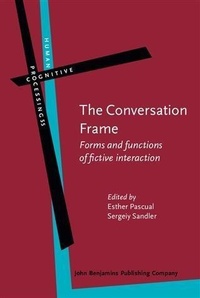
Conversation Frame
Forms and functions of fictive interaction
1st Edition
Published on 1. November 2016
396 pages
978-90-272-6650-7 (ISBN)
Description

This edited volume brings together the latest research on fictive interaction, that is the use of the frame of ordinary conversation as a means to structure cognition (talking to oneself), discourse (monologues organized as dialogues), and grammar ("e;why me? attitude"e;). This follows prior work on the subject by Esther Pascual and other authors, most of whom are also contributors to this volume. The 17 chapters in the volume explore fictive interaction as a fundamental cognitive phenomenon, as a ubiquitous discourse-structuring device, as a possibly universal linguistic construction, and as an effective communicative strategy in persuasion and language pathology. The data discussed involve a wide variety of unrelated languages (spoken and signed) and modes of communication (oral, written, visual), across cultural contexts and historical time.The research presented combines linguistics and cognitive science, while bridging the gap between core grammatical studies and modern conversation and discourse analysis. The volume further reaches across what may be the most basic divide in linguistics: that between descriptive, theoretical, and applied linguistics.
More details
Other editions
Additional editions
Book
11/2016
John Benjamins Publishing Co
€123.30
Shipment within 10-15 days
Content
- Intro
- The Conversation Frame
- Editorial page
- Title page
- LCC data
- Table of contents
- List of contributors
- Acknowledgements
- Part I. Introduction
- 1. Fictive interaction and the conversation frame: An overview
- 1. Fictive interaction: A cognitive, discursive and linguistic phenomenon
- 2. How can we tell it is fictive interaction?
- 3. Fictive interaction - Why bother?
- 4. The structure of this volume
- References
- 2. Fictive interaction and the nature of linguistic meaning
- 1. The logical approach to language
- 2. The monological approach to language
- 3. The dialogical approach to language
- References
- Part II. Fictive interaction as cognitive reality
- 3. Generic integration templates for fictive communication
- 1. Blending, blending templates, and fictive interaction
- 2. Generic integration templates underlying fictive communication
- 3. The generic integration template for fictive communication
- 4. The fictive communication GIT at work
- 5. Fictive communication and generic integration templates
- References
- 4. Real, imaginary, or fictive? Philosophical dialogues in an early Daoist text and its pictorial version
- 1. Introduction
- 2. The Zhuangzi text and its pictorial version
- 3. Interactional networks in the Zhuangzi text
- 4. Summary and conclusions
- References
- Appendix
- 5. Silent abstractions versus "Look at me" drawings: Corpus evidence that artworks' subject matter affects their fictive speech
- 1. Introduction
- 2. Method
- 3. Results
- 4. Discussion
- 5. Conclusion
- References
- Appendix 1
- Part III. Fictive interaction as discourse structure
- 6. Persuading and arguing with the reader: Fictive interaction as discourse organizing device in witchcraft pamphlet prefaces (1566-1621)
- 1. Introduction
- 2. Witchcraft pamphlets and their prefaces: Socio-linguistic aspects
- 3. Theoretical foundations: Footing and speaker roles
- 4. Data and methodology
- 5. Findings
- 6. Conclusion
- References
- 7. Invocation or apostrophe?: Prayer and the conversation frame in public discourse
- 1. Introduction: Interacting with/about the Divine
- 2. Macroscopic and microscopic rhetorical analyses
- 3. Results
- 4. Microscopic rhetorical analysis
- 5. Discussion: The rhetorical dimensions of prayer
- 6. Conclusion
- References
- Appendix
- 8. On discourse-motivated "sorries": Fictive apologies in English, Hungarian, and Romanian
- 1. Introduction
- 2. Method
- 3. Forms and functions of fictive apologies
- 4. Conclusions
- References
- Part IV. Fictive interaction as linguistic construction
- 9. What about? Fictive question-answer pairs for non-information-seeking functions across signed languages
- 1. Introduction
- 2. Method
- 3. Questions in signed languages
- 4. Linguistic constructions
- 5. Discussion
- 6. Final remarks
- References
- Appendix
- 10. Fictive questions in conditionals? Synchronic and diachronic evidence from German and English
- 1. Introduction
- 2. The synchronic perspective
- 3. The diachronic perspective
- 4. Revisiting the origins: From V1-declarative to emergent V1 order
- 5. Summary and conclusions
- References
- 11. Intonation of fictive vs. actual direct speech in a Brazilian Portuguese corpus
- 1. Introduction
- 2. Fictive direct speech
- 3. Prosody and direct speech
- 4. Methodological foundations for empirical answers
- 5. Findings and analysis
- 6. Discussion
- 7. Final remarks
- References
- 12. Polish nominal construction involving fictive interaction: Its scope and functions in discourse
- 1. Introduction
- 2. Semantic categories of the Polish fictive interaction construction
- 3. Functions of the Polish fictive interaction construction
- 4. FI and Polish cultural values
- 5. Concluding remarks and suggestions for further research
- References
- Appendix
- 13. Evidential fictive interaction (in Ungarinyin and Russian)
- 1. Introduction
- 2. Two case studies: Ungarinyin and Russian evidential fictive interaction
- 3. Participants stepping out of the shadows
- 4. Conclusions
- References
- 14. Recursive inflection and grammaticalized fictive interaction in the southwestern Amazon
- 1. Introduction
- 2. Factive and fictive interaction in Kwaza
- 3. Fictive interaction in Aikanã
- 4. Fictive interaction in Portuguese as a second language of Aikanã speakers
- 5. The origin of fictive interaction, and its spread, in the region
- 6. Conclusion
- References
- Appendix
- Part V. Fictive interaction as communicative strategy
- 15. "Say hello to this ad": The persuasive rhetoric of fictive interaction in marketing
- 1. Introduction
- 2. Database
- 3. Non-genuine conversational turns as strategy in advertising
- 4. Conversational participants in the construal of non-genuine verbal interaction
- 5. The Say X to Y subscript: Directives embedding FI conversations
- 6. Intra-sentential fictive interaction in marketing
- 7. Fictive interaction and theatricality as linguistic strategy
- 8. Concluding remarks
- References
- 16. The use of interactive structures as communicative strategy in Dutch and Portuguese aphasic speakers
- 1. Introduction
- 2. The present study
- 3. Method
- 4. Fictive interaction in agrammatic ellipsis
- 5. Discussion
- References
- Appendix
- 17. Echolalia as communicative strategy: Fictive interaction in the speech of children with autism
- 1. Introduction
- 2. Echolalia
- 3. Methodology
- 4. Data analysis
- 5. Discussion
- 6. Final remarks
- References
- About the contributors
- Author index
- Language index
- Subject index
