

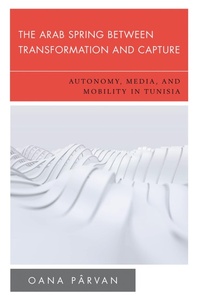
The Arab Spring Between Transformation and Capture
Autonomy, Media and Mobility in Tunisia
1st Edition
Published on 29. September 2020
230 pages
979-8-8818-6635-8 (ISBN)
Description

The Tunisian revolution raises important questions regarding the articulation of resistance and political subjectivity in the context of global governmentality. By drawing from political theory, philosophy, ethnography and readings of local street art, this book restores the radical significance of the political event as an instance of possible collective action.
Using the 2011 Tunisian revolution as a starting point for a broader discussion, this book analyses the processes of Orientalisation of non-Western examples of collective action and critiquing the narrative frame of the 'Arab Spring'. By focusing on the aspect of autonomous mobilities and transformations, occurred within a beyond the Tunisian space, Oana Pârvan is able answer key questions including, how moments of political rupture (such as revolutions) are interpreted by the wider public and how mobility across the Mediterranean rearticulates the distribution and recomposition of political theory categories such as class. She narrates how the Tunisian revolution can be inscribed into a long history of dispossession (colonial, regional, neoliberal) and resistance; and the culture and practices of the Tunisian revolutionaries have spread in the country and abroad (seen as a way to think beyond the methodological framework of the nation-state).
This work builds on research fieldwork and the analysis of Tunisian street art (mostly of the Ahl Al Kahf collective), drawing from migration-centred ethnographic work in order to suggest a reconstruction of the event. By applying theoretical reflections inspired by continental philosophy, media theory and autonomy of migration theory, this work develops an event-based theoretical reflection able to contribute towards rethinking contemporary Orientalism, self-representation and political subjectivity.
Using the 2011 Tunisian revolution as a starting point for a broader discussion, this book analyses the processes of Orientalisation of non-Western examples of collective action and critiquing the narrative frame of the 'Arab Spring'. By focusing on the aspect of autonomous mobilities and transformations, occurred within a beyond the Tunisian space, Oana Pârvan is able answer key questions including, how moments of political rupture (such as revolutions) are interpreted by the wider public and how mobility across the Mediterranean rearticulates the distribution and recomposition of political theory categories such as class. She narrates how the Tunisian revolution can be inscribed into a long history of dispossession (colonial, regional, neoliberal) and resistance; and the culture and practices of the Tunisian revolutionaries have spread in the country and abroad (seen as a way to think beyond the methodological framework of the nation-state).
This work builds on research fieldwork and the analysis of Tunisian street art (mostly of the Ahl Al Kahf collective), drawing from migration-centred ethnographic work in order to suggest a reconstruction of the event. By applying theoretical reflections inspired by continental philosophy, media theory and autonomy of migration theory, this work develops an event-based theoretical reflection able to contribute towards rethinking contemporary Orientalism, self-representation and political subjectivity.
More details
Series
Edition
1. Auflage
Language
English
Place of publication
United States
Publishing group
Bloomsbury Publishing Plc
ISBN-13
979-8-8818-6635-8 (9798881866358)
Copyright in bibliographic data and cover images is held by Nielsen Book Services Limited or by the publishers or by their respective licensors: all rights reserved.
Schweitzer Classification
Other editions
Additional editions
Oana Parvan
The Arab Spring Between Transformation and Capture
Autonomy, Media and Mobility in Tunisia
Book
09/2020
Rowman & Littlefield International
€150.40
Shipment within 3-4 weeks
Person
Oana Pârvan is an Assistant Lecturer (within the BA in Philosophy, Politics and Economics) and a Visiting Lecturer (at a postgraduate level, teaching Practices of the Cultural Industry) at Goldsmiths University.
Content
Preface
Introduction
1. The 'Arab Spring': The Projection of a 'Familiar' Revolution
2. The Event of Resistance and Its Capture
3. A Microhistory of the Tunisian Revolution. The Struggle of the Disenfranchised
4. Histories of Dispossession and Contemporary Vanguards
5. Mediation of An Event. Circulation of Cultures and Practices of Resistance
Conclusion
Index
Introduction
1. The 'Arab Spring': The Projection of a 'Familiar' Revolution
2. The Event of Resistance and Its Capture
3. A Microhistory of the Tunisian Revolution. The Struggle of the Disenfranchised
4. Histories of Dispossession and Contemporary Vanguards
5. Mediation of An Event. Circulation of Cultures and Practices of Resistance
Conclusion
Index
