

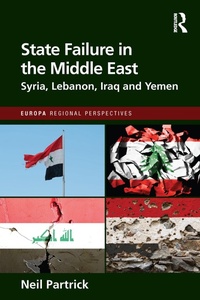
State Failure in the Middle East
Syria, Lebanon, Iraq and Yemen
1st Edition
Published on 19. August 2025
238 pages
978-1-040-39795-4 (ISBN)
Description

The collapse of the regime of Bashar al-Assad in Syria begs the question as to why that country so lacked institutional and organized capacity that the Syrian state melted away. In neighbouring Lebanon, the state has been absent in any meaningful sense for much of the country's independent history, while powerful sectarian interest groups dominate governance and maintain their own armed options. In Iraq, the state has collapsed twice since the US-led invasion of 2003 and is currently existing in parallel with armed sectarian militias whose political wings utilize governmental apparatus to further their narrow interests. In Yemen, there is no single state encompassing its internationally recognized boundaries, but instead there are three competing authorities ruling different parts of the country.
This book assesses why the state is failing in these four particular cases and, where relevant, examines common explanatory themes, while remaining mindful of each country's distinct domestic and international context. Much of the material is based on research carried out in the countries themselves, involving interviews with existing or former state officials, their advisers, senior analysts, or those seeking state authority. Through this process a debate is conducted as to where power lies in each of the four cases.
This book will be invaluable for anyone seeking to understand how the state does, or rather does not, operate, in these four Middle Eastern examples, including academics, students and postgraduates, and professionals with an interest in the Middle East.
This book assesses why the state is failing in these four particular cases and, where relevant, examines common explanatory themes, while remaining mindful of each country's distinct domestic and international context. Much of the material is based on research carried out in the countries themselves, involving interviews with existing or former state officials, their advisers, senior analysts, or those seeking state authority. Through this process a debate is conducted as to where power lies in each of the four cases.
This book will be invaluable for anyone seeking to understand how the state does, or rather does not, operate, in these four Middle Eastern examples, including academics, students and postgraduates, and professionals with an interest in the Middle East.
Reviews / Votes
"An invaluable, and urgently needed, guide to the most significant conundrum facing the contemporary Middle East: why and how are so many Arab states failed or failing entities? By examining in detail state failure in Syria, Iraq, Yemen, and Lebanon, he (Partrick) has sketched an invaluable roadmap to the political crisis that has rendered so many Arab countries hotbeds of instability, extremism, foreign meddling, terrorism and refugee flight. Anyone seeking to understand the cascading disasters in the Arab world need to look no further than this crucial volume. It is an indispensable addition to the literature on one of the world's most important yet troubled regions, and will remain required reading for decades."Dr Hussein Ibish, Senior Resident Scholar, AGSIW (Arab Gulf Studies Institute in Washington)
"This cutting-edge study explores power contestations between nominal state and non-state actors, focusing on the Middle East's 'weakest' states where the genealogical lines of power relations have been broken due to civil war and external nation-building. Partrick, a foremost expert in the field, offers a sophisticated and highly informative analysis of the intricacies of state dysfunctionality which will be indispensable for scholars and policy makers."
Gabriele vom Bruck, SOAS, University of London
"Collapse of the state devastates lives. Partrick looks through the eyes of people on the ground to show the dynamics of power inside and outside the state bodies of very different countries in the Middle East. This is first class research that explains clearly the events, the causes and the consequences of state failure."
Sir Richard Dalton, former UK Consul-general in Jerusalem and Ambassador to Libya and Iran
"In State Failure in the Middle East, Neil Partrick examines four case studies to investigate the very meaning of statehood in the Arab world, and assesses the dynamics and features of both state dysfunctionality and state resilience. This book is an essential addition to the literature on the contemporary Arab state by a scholar deeply immersed in both the subject and the region. The extensive reliance on Arabic sources, and numerous, incisive interviews in particular, is a particular strength."
Mouin Rabbani, an analyst of the contemporary Middle East and co-editor of the ezine Jadaliyya
"Neil Partrick brings his extensive experience of the Middle East to a rigorous analysis of the region's four weakest states: Lebanon, Iraq, Syria and Yemen. Combining his deep regional knowledge with on-the-ground reporting, Partrick delivers a comprehensive tour of the internal fissures weakening these failed and failing states, overlaid with a cogent explanation of outside powers' influence over the conflicts and political discord that have beset all four over the past couple of decades.
His book outlines these countries' principal actors and security networks, along with their linkages to, and troubles with, militias undermining central control, from the complexities of Yemen's fractured state to the sectarian tensions bedevilling the political systems of Lebanon and Iraq. It also includes a timely evaluation of the rapid ouster of the Assads in Syria, where the survival of a regime dominated by a narrow clique hollowed out the state apparatus to the point where a little-noticed Islamist militant group swept into Damascus."
Simeon Kerr, Scotland Correspondent, Financial Times
"One of the great puzzles of the modern world is why so many Arab states are in such a mess. How can this be when these countries have long and distinguished histories? Nowadays we see these countries divided by tribes, clans and militias, failing to build lasting institutions. Neil Partrick's book examines four such states in depth, which sheds a great deal of light on this intractable conundrum."
Anthony Harris, former British Ambassador to the United Arab Emirates and currently a businessman in the Gulf
More details
Series
Edition
1. Auflage
Language
English
Place of publication
London
United Kingdom
Publishing group
Taylor & Francis Ltd
Target group
Professional and scholarly
Illustrations
1 Line drawings, black and white; 1 Illustrations, black and white
File size
1,95 MB
ISBN-13
978-1-040-39795-4 (9781040397954)
Copyright in bibliographic data and cover images is held by Nielsen Book Services Limited or by the publishers or by their respective licensors: all rights reserved.
Schweitzer Classification
Other editions
Additional editions
Book
approx. 12/2026
1st Edition
Routledge
€73.22
Not yet published
Book
08/2025
1st Edition
Routledge
€199.40
Shipment within 10-20 days
Person
Neil Partrick has worked on the Middle East since being an editor and author at Panorama, a Palestinian research centre, in East Jerusalem, in 1993-95. He has headed the Middle East Programme at the Royal United Services Institute (RUSI) in Whitehall, London, UK and has been a senior editor with the Economist Intelligence Unit (EIU). In 2006 Neil obtained a PhD in International Relations from the London School of Economics (LSE). From 2007-09 he was based in the United Arab Emirates, where he taught politics at the American University of Sharjah. Since then, Neil has been a freelance researcher on the region. He is the main contributor to and editor of Saudi Arabian Foreign Policy: Conflict and Cooperation, published by IB Tauris in 2016 and updated in 2018.
Content
List of Figures
The Author
Acknowledgements
Glossary
Introduction
1 Syria
2 Lebanon
3 Iraq
4 Yemen
Conclusion
Index
The Author
Acknowledgements
Glossary
Introduction
1 Syria
2 Lebanon
3 Iraq
4 Yemen
Conclusion
Index
