

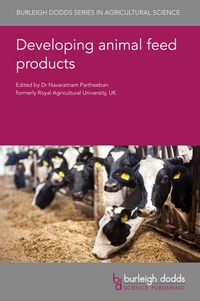
Developing animal feed products
Published on 15. June 2021
256 pages
978-1-78676-465-2 (ISBN)
Description

The animal feed sector faces increasingly complex challenges. It needs to improve feed digestibility/efficiency whilst also promoting growth and enhancing both product quality and safety. At the same time it has an increasingly important role in helping to promote animal health, welfare and the sustainability of farming.
Developing animal feed products reviews advances in optimising the key stages in developing successful new animal feed products, from assessing feed ingredients, product development and processing to maintaining quality and safety. The collection features authoritative discussions by leading experts on the relationship between nutrition and animal health, as well as how best to implement risk management systems for the prevention and control of contaminants present in animal feed.
Edited by Dr Navaratnam Partheeban, Royal Agricultural University, UK, Developing animal feed products will be a standard reference for companies involved in the manufacture of animal feed, as well as researchers in livestock nutrition, government and other agencies regulating the animal feed sector.
Developing animal feed products reviews advances in optimising the key stages in developing successful new animal feed products, from assessing feed ingredients, product development and processing to maintaining quality and safety. The collection features authoritative discussions by leading experts on the relationship between nutrition and animal health, as well as how best to implement risk management systems for the prevention and control of contaminants present in animal feed.
Edited by Dr Navaratnam Partheeban, Royal Agricultural University, UK, Developing animal feed products will be a standard reference for companies involved in the manufacture of animal feed, as well as researchers in livestock nutrition, government and other agencies regulating the animal feed sector.
More details
Series
Language
English
Place of publication
Cambridge
United Kingdom
Publishing group
Burleigh Dodds
Target group
Companies involved in the manufacture of animal feed;researchers in livestock nutrition;government and other agencies regulating the animal feed sector
Illustrations
Color tables, photos and figures
ISBN-13
978-1-78676-465-2 (9781786764652)
DOI
10.19103/AS.2021.0083
Schweitzer Classification
Other editions
Additional editions
Navaratnam Partheeban
Developing Animal Feed Products
Book
06/2021
Burleigh Dodds Science Publishing Limited
€226.90
Shipment within 3-4 weeks
Persons
Editor
Dairy Technical SpecialistPhilbro Animal Health (United Kingdom)
Dr Navaratnam Partheeban is Dairy Technical Specialist for Phibro Animal Health. He was formerly Senior Lecturer in Livestock Production at the internationally-renowned Royal Agricultural University (RAU) in the UK. In addition to his experience in teaching and research, Dr Partheeban is a practicing farm vet and manages his own herd of sheep. He is actively involved in training farmers and other livestock professionals. Dr Partheeban is also currently an Honorary Editor of the journal Advances in Agricultural Technology & Plant Sciences.
Dr Navaratnam Partheeban is Dairy Technical Specialist for Phibro Animal Health. He was formerly Senior Lecturer in Livestock Production at the internationally-renowned Royal Agricultural University (RAU) in the UK. In addition to his experience in teaching and research, Dr Partheeban is a practicing farm vet and manages his own herd of sheep. He is actively involved in training farmers and other livestock professionals. Dr Partheeban is also currently an Honorary Editor of the journal Advances in Agricultural Technology & Plant Sciences.
Contributions
Institute of Global Food Security - Queen's University Belfast (United Kingdom)
Centre for Research in Biosciences - University of the West of England (United Kingdom)
Institute of Global Food Security - Queen's University Belfast (United Kingdom)
Dennis Forte & Associates Pty Ltd (Australia)
A chemical engineering graduate of the RMIT, Dennis Forte spent ten years with the MARS Corporation. During this time he was involved in both process and product development roles within the areas of Confectionery, Canned Pet Food and Dry Pet Food Extrusion Technologies. He is now practicing as an Independent Engineering Consultant to the food industry, providing technical support, design expertise and training to a broad range of manufacturers.
A chemical engineering graduate of the RMIT, Dennis Forte spent ten years with the MARS Corporation. During this time he was involved in both process and product development roles within the areas of Confectionery, Canned Pet Food and Dry Pet Food Extrusion Technologies. He is now practicing as an Independent Engineering Consultant to the food industry, providing technical support, design expertise and training to a broad range of manufacturers.
Kansas State University
Walloon Agricultural Research Center (CRA-W) (Belgium)
Walloon Agricultural Research Center (CRA-W) (Belgium)
Walloon Agricultural Research Center (CRA-W) (Belgium)
Walloon Agricultural Research Center (CRA-W) (Belgium)
Walloon Agricultural Research Center (CRA-W) (Belgium)
Walloon Agricultural Research Center (CRA-W) (Belgium)
Walloon Agricultural Research Center (CRA-W) (Belgium)
Walloon Agricultural Research Center (CRA-W) (Belgium)
Walloon Agricultural Research Center (CRA-W) (Belgium)
Walloon Agricultural Research Center (CRA-W) (Belgium)
Institute of Animal Nutrition - Friedrich-Loeffler-Institut (FLI) (Germany)
Institute of Animal Nutrition - Friedrich-Loeffler-Institut (FLI) (Germany)
University of Milan
University of Milan
University of Milan
University of Milan
University of Milan
University of Milan
Schothorst Feed Research
Saqual GmbH
Content
Part 1 Developing animal products
1.Techniques for identifying new animal feed ingredients and additives: Jordi Ortuño, Institute of Global Food Security - Queen's University Belfast, UK; Alexandros Ch. Stratakos, Centre for Research in Biosciences - University of the West of England, UK; and Katerina Theodoridou, Institute of Global Food Security - Queen's University Belfast, UK;
2.Effect of processing techniques on the quality of animal feed: Dennis Forte, Dennis Forte & Associates Pty Ltd, Australia;
3.Processing techniques to optimize digestibility and nutritional value of animal feed: Charles Stark, Kansas State University, USA;
4.Trends in analytical techniques for testing animal feed: F. Debode, J. A. Fernández Pierna, M. C. Lecrenier, P. Veys, O. Fumiere, O. Minet, A. Pissard, J. Hulin, N. Chamberland, and V. Baeten, Walloon Agricultural Research Center (CRA-W), Belgium;
Part 2 Quality and safety assurance
5.Developments in techniques to test the efficacy of animal feed products: Gerhard Flachowsky and Ulrich Meyer, Institute of Animal Nutrition - Friedrich-Loeffler-Institut (FLI), Germany;
6.Advances in understanding key contamination risks in animal feed: mycotoxins: Luciano Pinotti, Luca Ferrari, Nicoletta Rovere, Francesca Fumagalli, Sharon Mazzoleni and Federica Cheli, University of Milan, Italy;
7.Risk management systems for prevention and control of contaminants in animal feed: Regiane R. Santos, Schothorst Feed Research, The Netherlands;
8.Developing effective product dossiers for regulatory approval of new animal feed products: Manfred Lützow, saqual GmbH, Switzerland;
1.Techniques for identifying new animal feed ingredients and additives: Jordi Ortuño, Institute of Global Food Security - Queen's University Belfast, UK; Alexandros Ch. Stratakos, Centre for Research in Biosciences - University of the West of England, UK; and Katerina Theodoridou, Institute of Global Food Security - Queen's University Belfast, UK;
2.Effect of processing techniques on the quality of animal feed: Dennis Forte, Dennis Forte & Associates Pty Ltd, Australia;
3.Processing techniques to optimize digestibility and nutritional value of animal feed: Charles Stark, Kansas State University, USA;
4.Trends in analytical techniques for testing animal feed: F. Debode, J. A. Fernández Pierna, M. C. Lecrenier, P. Veys, O. Fumiere, O. Minet, A. Pissard, J. Hulin, N. Chamberland, and V. Baeten, Walloon Agricultural Research Center (CRA-W), Belgium;
Part 2 Quality and safety assurance
5.Developments in techniques to test the efficacy of animal feed products: Gerhard Flachowsky and Ulrich Meyer, Institute of Animal Nutrition - Friedrich-Loeffler-Institut (FLI), Germany;
6.Advances in understanding key contamination risks in animal feed: mycotoxins: Luciano Pinotti, Luca Ferrari, Nicoletta Rovere, Francesca Fumagalli, Sharon Mazzoleni and Federica Cheli, University of Milan, Italy;
7.Risk management systems for prevention and control of contaminants in animal feed: Regiane R. Santos, Schothorst Feed Research, The Netherlands;
8.Developing effective product dossiers for regulatory approval of new animal feed products: Manfred Lützow, saqual GmbH, Switzerland;
