

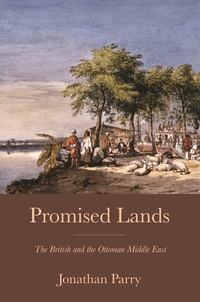
Promised Lands
The British and the Ottoman Middle East
1st Edition
Published on 7. February 2022
480 pages
978-0-691-23145-7 (ISBN)
Description

A major history of the British Empire's early involvement in the Middle East
Napoleon's invasion of Egypt in 1798 showed how vulnerable India was to attack by France and Russia. It forced the British Empire to try to secure the two routes that a European might use to reach the subcontinent-through Egypt and the Red Sea, and through Baghdad and the Persian Gulf. Promised Lands is a panoramic history of this vibrant and explosive age.
Charting the development of Britain's political interest in the Middle East from the Napoleonic Wars to the Crimean War in the 1850s, Jonathan Parry examines the various strategies employed by British and Indian officials, describing how they sought influence with local Arabs, Mamluks, Kurds, Christians, and Jews. He tells a story of commercial and naval power-boosted by the arrival of steamships in the 1830s-and discusses how classical and biblical history fed into British visions of what these lands might become. The region was subject to the Ottoman Empire, yet the sultan's grip on it appeared weak. Should Ottoman claims to sovereignty be recognised and exploited, or ignored and opposed? Could the Sultan's government be made to support British objectives, or would it always favour France or Russia?
Promised Lands shows how what started as a geopolitical contest became a drama about diplomatic competition, religion, race, and the unforeseen consequences of history.
Napoleon's invasion of Egypt in 1798 showed how vulnerable India was to attack by France and Russia. It forced the British Empire to try to secure the two routes that a European might use to reach the subcontinent-through Egypt and the Red Sea, and through Baghdad and the Persian Gulf. Promised Lands is a panoramic history of this vibrant and explosive age.
Charting the development of Britain's political interest in the Middle East from the Napoleonic Wars to the Crimean War in the 1850s, Jonathan Parry examines the various strategies employed by British and Indian officials, describing how they sought influence with local Arabs, Mamluks, Kurds, Christians, and Jews. He tells a story of commercial and naval power-boosted by the arrival of steamships in the 1830s-and discusses how classical and biblical history fed into British visions of what these lands might become. The region was subject to the Ottoman Empire, yet the sultan's grip on it appeared weak. Should Ottoman claims to sovereignty be recognised and exploited, or ignored and opposed? Could the Sultan's government be made to support British objectives, or would it always favour France or Russia?
Promised Lands shows how what started as a geopolitical contest became a drama about diplomatic competition, religion, race, and the unforeseen consequences of history.
More details
Other editions
Additional editions
Book
12/2024
Princeton University Press
€38.50
Shipment within 10-20 days
Book
02/2022
Princeton University Press
€55.80
Shipment within 10-20 days
Person
Jonathan Parry is professor of modern British history at the University of Cambridge and a fellow of Pembroke College. His books include The Politics of Patriotism: English Liberalism, National Identity, and Europe, 1830-1886. He is a frequent contributor to the London Review of Books. Twitter @JonParryHis
Content
- Cover
- Contents
- List of Maps
- Preliminary Note
- Places and Provinces
- Names and Spellings
- Rayas, Millets, and Franks
- The East India Company
- Introduction
- The Lands, Their Rulers, and Their Aggressors
- Strategies and Visions
- The Claims of Chronology
- A Tale of Two Obelisks
- Chapter 1. Napoleon, India, and the Battle for Egypt
- Grenville, the Eurocentric Approach, and Sidney Smith
- Dundas, India, and the Blue Water Strategy
- Chapter 2. Sealing off Egypt and the Red Sea
- The Search for Stability in Egypt, 1801-3
- Egyptian Chaos, the French Threat, and the British Response, 1803-7
- The Red Sea: Popham and Valentia, Arabs and Abyssinians
- Chapter 3. Striving for Leverage in Baghdad
- Harford Jones: Failure of the Dundas Strategy
- Claudius Rich: Pomp and Mediation in an Indian Outstation
- The Wahhabi, the Qawasim, and British Sea Power in the Gulf
- "Our Koordistan": The Extraordinary Ambitions of Claudius Rich
- Rich's Legacy
- Chapter 4. Filling the Arabian Vacuum: Steam, the Arabs, and the Defence of India in the 1830s
- Ottoman Collapse and Russian Threat
- Steam and Plague: Progress and Decay
- Steamers and Arabs in Mesopotamia
- Steam, the Red Sea, and Southern Arabia
- Hobhouse, Palmerston, the Middle East, and India
- Chapter 5. Britain, Egypt, and Syria in the Heyday of Mehmet Ali
- Samuel Briggs and the Afterlife of the Levant Company
- Economic and Cultural Exchanges
- Steam and the Two Faces of Mehmet Ali's Egypt
- Benthamism, Islam, and the Pursuit of Good Government in Egypt
- Syria, Liberalism, and the Russian Threat to Asia
- New Voices on Syria: Embassy Ottomanists and Christian Tourists
- Chapter 6. Constantinople, London, the Eastern Crisis, and the Middle East
- David Urquhart, Islam, and Free Commerce
- Factional Gridlock at Constantinople
- Ending the Stalemate
- Britain, France, and the Future of Syria
- Reshid, Richard Wood, and the Edict of Gülhane
- Napier or Wood, Smith or Elgin, Cairo or Constantinople?
- Chapter 7. The Brief History of British Religious Sectarianism in Syria and Kurdistan
- Protestant Missions and Eastern Christians
- Jerusalem, City of Sin
- The Appeal to Jews and Its Limits
- The War of Institutional Christianity over Syria
- The Druze and the Perils of Sectarianism in Syria
- The Nestorians of Kurdistan
- Chapter 8. Confining the Sectarian Problem: Syria, Kurdistan, France, and the Porte
- Finding a Balance in Lebanon
- Persecution, Protestantism, and the Tanzimat
- Institutionalising Protestant Weakness
- The Problem of Order in Kurdistan
- Britain, France, and Religious Protection in the New Kurdistan
- Chapter 9. Stratford Canning and the Politics of Christianity and Islam
- Canning, Russia, and Islam
- Palmerston, Canning, and the Liberal Project
- Henry Layard and the Lessons of Nineveh
- Chapter 10. The Ring of Steam, the Lands of Islam, and the Search for Order
- Ottoman Sovereignty and the Persian Border
- Conflicts with Ottomanism: Muhammara and the Gulf
- Steam Power, Economic Improvement, and Regional Security in Baghdad
- Aden: A New Centre of Stability
- The French, the Ottomans, and the Western Red Sea Harbours
- Chapter 11. The British Corridor in Egypt
- England in Egypt, Egypt in England
- Mehmet Ali and the Transit
- Abbas and the Railway Project
- A Rage for Order
- The French and the Sultan
- Chapter 12. Jerusalem and the Crimean War
- Unholy Places
- Whose War?
- Conclusion
- Acknowledgments
- Bibliography
- Index
