

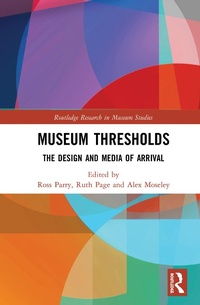
Museum Thresholds
The Design and Media of Arrival
1st Edition
Published on 11. May 2018
280 pages
978-1-317-23909-3 (ISBN)
Description

Museum Thresholds is a progressive, interdisciplinary volume and the first to explore the importance and potential of entrance spaces for visitor experience. Bringing together an international collection of writers from different disciplines, the chapters in this volume offer different theoretical perspectives on the nature of engagement, interaction and immersion in threshold spaces, and the factors which enable and inhibit those immersive possibilities.
Organised into themed sections, the book explores museum thresholds from three different perspectives. Considering them first as a problem space, the contributors then go on to explore thresholds through different media and, finally, draw upon other subjects and professions, including performance, gaming, retail and discourse studies, in order to examine them from an entirely new perspective. Drawing upon examples that span Asia, North America and Europe, the authors set the entrance space in its historical, social and architectural contexts. Together, the essays show how the challenges posed by the threshold can be rethought and reimagined from a variety of perspectives, each of which have much to bring to future thinking and design.
Combining both theory and practice, Museum Thresholds should be essential reading for academics, researchers and postgraduate students working in museum studies, digital heritage, architecture, design studies, retail studies and media studies. It will also be of great interest to museum practitioners working in a wide variety of institutions around the globe.
Organised into themed sections, the book explores museum thresholds from three different perspectives. Considering them first as a problem space, the contributors then go on to explore thresholds through different media and, finally, draw upon other subjects and professions, including performance, gaming, retail and discourse studies, in order to examine them from an entirely new perspective. Drawing upon examples that span Asia, North America and Europe, the authors set the entrance space in its historical, social and architectural contexts. Together, the essays show how the challenges posed by the threshold can be rethought and reimagined from a variety of perspectives, each of which have much to bring to future thinking and design.
Combining both theory and practice, Museum Thresholds should be essential reading for academics, researchers and postgraduate students working in museum studies, digital heritage, architecture, design studies, retail studies and media studies. It will also be of great interest to museum practitioners working in a wide variety of institutions around the globe.
More details
Series
Edition
1. Auflage
Language
English
Place of publication
London
United Kingdom
Publishing group
Taylor & Francis Ltd
Target group
College/higher education
Professional and scholarly
Product notice
Reflowable
Illustrations
8 Tables, black and white
ISBN-13
978-1-317-23909-3 (9781317239093)
Copyright in bibliographic data and cover images is held by Nielsen Book Services Limited or by the publishers or by their respective licensors: all rights reserved.
Schweitzer Classification
Other editions
Additional editions
Book
02/2020
1st Edition
Routledge
€68.00
Shipment within 15-20 days
Book
05/2018
1st Edition
Routledge
€215.41
Shipment within 10-20 days
Persons
Ross Parry is Deputy Pro-Vice-Chancellor (Digital) at the University of Leicester (UK), and associate professor in its School of Museum Studies. For over twenty years, his interdisciplinary and highly collaborative research has considered the relationship between digital media and the cultural heritage sector. A former national chair of the UK's Museums Computer Group, and a Tate Research Fellow, he was one of the founding Trustees of the Jodi Mattes Trust - for accessible digital culture. He is the author of the book Recoding the Museum (the first major history of museum computing) and Museums in a Digital Age - a volume that helped define the subject area of 'digital heritage'.
Ruth Page spends her time teaching and writing about storytelling, especially focussing on the stories that people tell in social media contexts. She has written several books including Stories and Social Media (Routledge, 2012), Narratives Online: Shared Stories and Social Media (2018), and was the lead author of the student textbook, Researching the Language of Social Media (Routledge, 2014). Her publications in journals and edited collections have explored narratives in a wide range of contexts, from print literature and the mainstream media to conversational stories and stories published in online contexts such as blogs, social network sites and Wikipedia.
Alex Moseley is a National Teaching Fellow and Head of Curriculum Advancement at the University of Leicester. He has had long experience as both practitioner and researcher of course design and development for higher education and also teaches innovative Digital Media courses in Museum Studies and Historical Studies. His principal research area is in games-based learning: he has written widely in this area including Using Games to Enhance Teaching and Learning (Routledge, 2012) and New Traditional Games for Learning: A Case Book (Routledge, 2013), has designed and consulted on a number of games for museum and education contexts, chairs the Association for Learning Technology special interest group on Playful Learning, and co-organises the Playful Learning conference.
Ruth Page spends her time teaching and writing about storytelling, especially focussing on the stories that people tell in social media contexts. She has written several books including Stories and Social Media (Routledge, 2012), Narratives Online: Shared Stories and Social Media (2018), and was the lead author of the student textbook, Researching the Language of Social Media (Routledge, 2014). Her publications in journals and edited collections have explored narratives in a wide range of contexts, from print literature and the mainstream media to conversational stories and stories published in online contexts such as blogs, social network sites and Wikipedia.
Alex Moseley is a National Teaching Fellow and Head of Curriculum Advancement at the University of Leicester. He has had long experience as both practitioner and researcher of course design and development for higher education and also teaches innovative Digital Media courses in Museum Studies and Historical Studies. His principal research area is in games-based learning: he has written widely in this area including Using Games to Enhance Teaching and Learning (Routledge, 2012) and New Traditional Games for Learning: A Case Book (Routledge, 2013), has designed and consulted on a number of games for museum and education contexts, chairs the Association for Learning Technology special interest group on Playful Learning, and co-organises the Playful Learning conference.
Content
1. On a new threshold
Ross Parry, Ruth Page and Alex Moseley
PART 1: Locating and defining the threshold
2. Hysterical atria
Katherine Skellon and Ben Tunstall
3. The complexity of welcome: visitor experience at the museum threshold
Colin Mulberg
Conversation 1: The Royal Air Force Museum London
4. Design-driven innovation for museum entrances
Marco Mason
PART II: Affordances and potential of the threshold
5. Suspended: art in the threshold
Peter Ride
6. Curation at the threshold: making museum meanings through new interfaces
Angelina Russo and Philip Pond
Conversation 2: Birmingham Museum and Art Gallery
7. Using 3D visualisation technology to improve design and visitor orientation
David Burden
8. Difficult Thresholds: negotiating shared and embedded entrances
Steven Kruse
PART II: The threshold rethought
9. Games in the Lobby: a playful approach
Alex Moseley and Eric Kristiansen
Conversation 3: The British Postal Museum and Archive
10. Retail Perspectives on the Threshold
Tracy Harwood
11. Setting the tone for the visit: soundscape design
Christian Hviid Mortensen and Angus Deuchars
Conversation 4: The Royal Shakespeare Company
12. The visitor as evaluator: using appraisal theory to understand 'Threshold Fear'
Ruth Page
Ross Parry, Ruth Page and Alex Moseley
PART 1: Locating and defining the threshold
2. Hysterical atria
Katherine Skellon and Ben Tunstall
3. The complexity of welcome: visitor experience at the museum threshold
Colin Mulberg
Conversation 1: The Royal Air Force Museum London
4. Design-driven innovation for museum entrances
Marco Mason
PART II: Affordances and potential of the threshold
5. Suspended: art in the threshold
Peter Ride
6. Curation at the threshold: making museum meanings through new interfaces
Angelina Russo and Philip Pond
Conversation 2: Birmingham Museum and Art Gallery
7. Using 3D visualisation technology to improve design and visitor orientation
David Burden
8. Difficult Thresholds: negotiating shared and embedded entrances
Steven Kruse
PART II: The threshold rethought
9. Games in the Lobby: a playful approach
Alex Moseley and Eric Kristiansen
Conversation 3: The British Postal Museum and Archive
10. Retail Perspectives on the Threshold
Tracy Harwood
11. Setting the tone for the visit: soundscape design
Christian Hviid Mortensen and Angus Deuchars
Conversation 4: The Royal Shakespeare Company
12. The visitor as evaluator: using appraisal theory to understand 'Threshold Fear'
Ruth Page
