

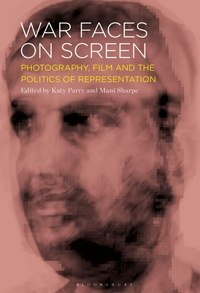
War Faces on Screen
Photography, Film and the Politics of Representation
1st Edition
Published on 11. December 2025
272 pages
979-8-7651-2923-4 (ISBN)
Description

How have images of the face been used to document and distort the phenomenon of war? Such is the question that drives this book, with the face forming a recurring - almost ubiquitous - motif throughout visual depictions of military conflict.
At once interdisciplinary, transnational, and transhistorical, War Faces on Screen is organised into three sections. Section One examines representations of the face in war photography, illustrating how photographers have visualised the invisible violence of psychic trauma. Ethical and political concerns are at the forefront of each essay, from the advocacy work of portraiture, to AI tools capable of generating a range of aesthetically convincing yet potentially discriminatory images. Section Two focuses on the aesthetics of the cinematic close-up, drone vision, and how the selective digital colourisation of bodies and faces from archival footage works to impose a moral hierarchy. Section Three concludes the book with a focus on colonisation, decolonisation and defacement, extending earlier discussions of the imperial violence found in recent Hollywood films, where empathy is displaced from the ethnic other to the suffering Western soldier. Our final chapters chart how the face is central to articulating the meaning and sentiment of colonial and civil wars, with even seemingly progressive documentaries perpetuating unequal power dynamics and problematic notions of victimhood. Foregrounding the work of artists and practitioners, alongside theoretical frameworks, War Faces on Screen ultimately forms a radically innovative contribution to the study of image-making and war-making.
At once interdisciplinary, transnational, and transhistorical, War Faces on Screen is organised into three sections. Section One examines representations of the face in war photography, illustrating how photographers have visualised the invisible violence of psychic trauma. Ethical and political concerns are at the forefront of each essay, from the advocacy work of portraiture, to AI tools capable of generating a range of aesthetically convincing yet potentially discriminatory images. Section Two focuses on the aesthetics of the cinematic close-up, drone vision, and how the selective digital colourisation of bodies and faces from archival footage works to impose a moral hierarchy. Section Three concludes the book with a focus on colonisation, decolonisation and defacement, extending earlier discussions of the imperial violence found in recent Hollywood films, where empathy is displaced from the ethnic other to the suffering Western soldier. Our final chapters chart how the face is central to articulating the meaning and sentiment of colonial and civil wars, with even seemingly progressive documentaries perpetuating unequal power dynamics and problematic notions of victimhood. Foregrounding the work of artists and practitioners, alongside theoretical frameworks, War Faces on Screen ultimately forms a radically innovative contribution to the study of image-making and war-making.
More details
Edition
1. Auflage
Language
English
Place of publication
New York
United States
Publishing group
Bloomsbury Publishing Plc
Target group
Professional and scholarly
Illustrations
42 colour illus
ISBN-13
979-8-7651-2923-4 (9798765129234)
Copyright in bibliographic data and cover images is held by Nielsen Book Services Limited or by the publishers or by their respective licensors: all rights reserved.
Schweitzer Classification
Other editions
Additional editions
Book
approx. 01/2026
Bloomsbury Academic USA
€121.50
Not yet published
Persons
Katy Parry is Professor of Media and Politics at the University of Leeds, UK. Her books include Visual Communication: Understanding Images in Media Culture (2019), co-authored with Giorgia Aiello, and Spaces of War, War of Spaces (Bloomsbury, 2020), co-edited with Sarah Maltby, Ben O'Loughlin and Laura Roselle. She is a co-editor of the journal Media, War & Conflict.
Mani Sharpe is Lecturer in Film at the University of Leeds, UK. He is author of the monograph Late-colonial French Cinema: Filming the Algerian War of Independence (2023). He is generally interested in how films convey the process of military-colonial loss through different formal techniques and themes.
Mani Sharpe is Lecturer in Film at the University of Leeds, UK. He is author of the monograph Late-colonial French Cinema: Filming the Algerian War of Independence (2023). He is generally interested in how films convey the process of military-colonial loss through different formal techniques and themes.
Content
List of Figures
List of Contributors
Acknowledgements
Introduction: War Faces on Screen
Mani Sharpe (University of Leeds, UK)
Part 1: Photographing Faces of War
1. Now You See Them, Now You Don't: A Photographic series of Afghan Interpreters and Veteran Advocates in the Aftermath of the War in Afghanistan (2001-2021)
Sara de Jong (University of York, UK) and Andy Barnham (Photographer, UK)
2. Faces of War: An Interview with Alexander Chekmenev
Mani Sharpe (University of Leeds, UK) and Kseniia Lazareva (University of Leeds, UK)
3. Sentimentalizing Trauma: Ways of Seeing War Faces in Visual Generative AI
Katy Parry (University of Leeds, UK) and Giorgia Aiello (University of Milan, Italy)
Part 2: Cinematic Close-ups and Drone Vision
4. The Face, Combat Trauma and the Other in Apocalypse Now
Guy Westwell (Queen Mary University of London, UK)
5. Pathos Signals in the Contemporary American War Film: The Transfer of Affect
Robert Burgoyne (Writer, UK)
6. Target Confirmed: Drone Visuality, Dehumanization, and the Weeping Soldier in Eye in the Sky
Alex Adams (Independent Scholar)
7. Attending the Dead: Digital Colourization, Injury and the First World War Archive
Liz Watkins (University of Leeds, UK)
Part 3: Colonization, Decolonization and Defacement
8. The War Face Off-Screen: Catalogue Descriptions, Imperial Interpellations, and Reading On- and Off-Screen Faces in British Boer War Films
Anushrut Ramakrishnan Agrwaal (University of St Andrews, UK)
9. In Defence of Facelessness: Opacity in Trinh T. Minh-ha's Documentaries Surname Viet Given Name Nam (1989) and Shoot for the Contents (1992)
Leonie Gschwendtberger (University of Bristol, UK)
10. Screening the Faces and Non-Faces of War: A Political Physiognomy
Mangalika de Silva (New York University, USA)
Index
List of Contributors
Acknowledgements
Introduction: War Faces on Screen
Mani Sharpe (University of Leeds, UK)
Part 1: Photographing Faces of War
1. Now You See Them, Now You Don't: A Photographic series of Afghan Interpreters and Veteran Advocates in the Aftermath of the War in Afghanistan (2001-2021)
Sara de Jong (University of York, UK) and Andy Barnham (Photographer, UK)
2. Faces of War: An Interview with Alexander Chekmenev
Mani Sharpe (University of Leeds, UK) and Kseniia Lazareva (University of Leeds, UK)
3. Sentimentalizing Trauma: Ways of Seeing War Faces in Visual Generative AI
Katy Parry (University of Leeds, UK) and Giorgia Aiello (University of Milan, Italy)
Part 2: Cinematic Close-ups and Drone Vision
4. The Face, Combat Trauma and the Other in Apocalypse Now
Guy Westwell (Queen Mary University of London, UK)
5. Pathos Signals in the Contemporary American War Film: The Transfer of Affect
Robert Burgoyne (Writer, UK)
6. Target Confirmed: Drone Visuality, Dehumanization, and the Weeping Soldier in Eye in the Sky
Alex Adams (Independent Scholar)
7. Attending the Dead: Digital Colourization, Injury and the First World War Archive
Liz Watkins (University of Leeds, UK)
Part 3: Colonization, Decolonization and Defacement
8. The War Face Off-Screen: Catalogue Descriptions, Imperial Interpellations, and Reading On- and Off-Screen Faces in British Boer War Films
Anushrut Ramakrishnan Agrwaal (University of St Andrews, UK)
9. In Defence of Facelessness: Opacity in Trinh T. Minh-ha's Documentaries Surname Viet Given Name Nam (1989) and Shoot for the Contents (1992)
Leonie Gschwendtberger (University of Bristol, UK)
10. Screening the Faces and Non-Faces of War: A Political Physiognomy
Mangalika de Silva (New York University, USA)
Index
