

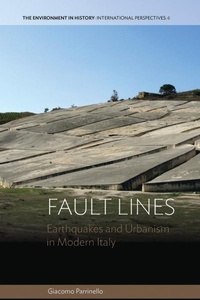
Fault Lines
Description

Earth's fractured geology is visible in its fault lines. It is along these lines that earthquakes occur, sometimes with disastrous effects. These disturbances can significantly influence urban development, as seen in the aftermath of two earthquakes in Messina, Italy, in 1908 and in the Belice Valley, Sicily, in 1968. Following the history of these places before and after their destruction, this book explores plans and developments that preceded the disasters and the urbanism that emerged from the ruins. These stories explore fault lines between "rural" and "urban," "backwardness" and "development," and "before" and "after," shedding light on the role of environmental forces in the history of human habitats.
More details
Other editions
Additional editions
Person
Giacomo Parrinello is a Marie Curie Fellow in the Department of Geography and Anthropology at Louisiana State University and the Institute of Social Ecology in Vienna. He has published in the fields of environmental history, history of urban planning, and modern Italian history.
Content
List of Illustrations
Acknowledgements
Sites of disaster map
Introduction: Can Earthquakes Speak?
- The Voice of the Earthquake
- A Tale of Two Earthquakes
- The Structure of This Book
Part I: The 1908 Messina Earthquake
Chapter 1. The 1908 Messina Earthquake
- Earthquake, Tsunami, and Fire
- Earthquake Science
- Earthquake-Proof Urbanism
Chapter 2. Urban Reform 1880-1908
- Sanitizing the City
- A New Geography of Urban Water
- Engineering the City's Environment
- To Live Happily and Forget the Quake
Chapter 3. The Modern City 1909-1943
- The Provisional City (and Its Permanent Consequences)
- The Master Plan
- The City Developers versus the Hut Dwellers
- The New City and Its Darker Sides
Part II: The 1968 Belice Valley Earthquake
Chapter 4. The 1968 Belice Valley Earthquake
- "Like an Atomic Wasteland"
- The Disaster of Poverty
- Road Maps to Development
Chapter 5. Rural Modernity 1933-1967
- Reclamation and Redemption
- Development Plans
- Grassroots Counter-Measures
- The Many Virtues of Water
Chapter 6. Urbanized Countryside 1968-1993
- Tents, Barracks, and Committees
- The City Territory
- New Towns and Ghost Factories
- Rural Urbanism
Conclusion: Fault Lines
- Tales of Earthquake Urbanism
- Fault Lines in a Seismic Country
- Hazards, Urbanization, and Nature
Bibliography
