

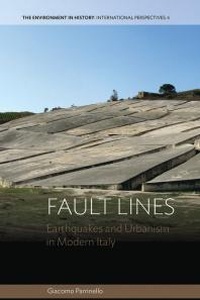
Fault Lines
Earthquakes and Urbanism in Modern Italy
1st Edition
Published on 1. May 2015
274 pages
978-1-78238-951-4 (ISBN)
Description

Earth's fractured geology is visible in its fault lines. It is along these lines that earthquakes occur, sometimes with disastrous effects. These disturbances can significantly influence urban development, as seen in the aftermath of two earthquakes in Messina, Italy, in 1908 and in the Belice Valley, Sicily, in 1968. Following the history of these places before and after their destruction, this book explores plans and developments that preceded the disasters and the urbanism that emerged from the ruins. These stories explore fault lines between "rural" and "urban," "backwardness" and "development," and "before" and "after," shedding light on the role of environmental forces in the history of human habitats.
Reviews / Votes
"Fault Lines provides a critical and novel lens through which to understand the intersections between natural disasters, planning and politics." * Modern Italian Studies"This book by Giacomo Parrinello is an important source to be added to this field of study. Hopefully, the topics explored here will soon become an established part of academic research and of social and political debates, and not just an issue superficially and randomly considered when a disaster happens." * Undisciplined Environments
"Its many historiographical references, the multiplicity of sources, the analytical finesse, the wealth of insights and a fluid writing style make this book a stimulating and interesting reading for anyone interested in urban and environmental history." * Il Mestiere di Storico
"an original an innovative study...an effective and fascinating narrative structure...a very rigorous research" * From the motivation of the Anci Storia Award
"In this book Parrinello combines two research paths, investigating the two most important Sicilian earthquakes of the twentieth century, the 1908 Messina earthquake/tsunami and the 1968 Belice earthquake. The result is an original and innovative study both in its methodology and primary source acquisition. The effective and fascinating narrative structure opens with a focus on the two seismic events which make the subject of the two sections of the book, and offers a tragic picture of their unfolding and immediate consequences on society and the environment." * Anci Storia Review
"This book by Giacomo Parrinello is an important source to be added to [the study of disasters]. Hopefully, the topics explored here will soon become an established part of academic research and of social and political debates, and not just an issue superficially and randomly considered when a disaster happens." * Il Lavoro Culturale
"The challenge that Parrinello posed in the introduction - let the earthquake speak - has been crowned with success." * Global Environment
"An extremely interesting and well-written book, which takes two major Italian disasters in detail and uses them to tell a series of stories about urban change, the state, national identity, and other issues... The author is passionate about the subject matter he is dealing with-and the material itself is red hot." * John Foot, University of Bristol
"This is a really fascinating and innovative study on disaster perception and management, on urban-rural development, and on the interconnections of environmental, political, social, and economic history. An essential book for all who want to better understand Sicily's history in the twentieth century." * Christian Rohr, University of Bern
More details
Series
Edition
1. Auflage
Language
English
Place of publication
Oxford
United Kingdom
Target group
Professional and scholarly
Illustrations
Bibliography; Index; 23 Illustrations; 2 Tables, unspecified
ISBN-13
978-1-78238-951-4 (9781782389514)
DOI
10.3167/9781782389507
Copyright in bibliographic data and cover images is held by Nielsen Book Services Limited or by the publishers or by their respective licensors: all rights reserved.
Schweitzer Classification
Other editions
Additional editions
Book
04/2020
1st Edition
Berghahn Books
€41.80
Shipment within 3-4 weeks
Book
05/2015
1st Edition
Berghahn Books
€147.20
Shipment within 3-4 weeks
Person
Giacomo Parrinello is a Marie Curie Fellow in the Department of Geography and Anthropology at Louisiana State University and the Institute of Social Ecology in Vienna. He has published in the fields of environmental history, history of urban planning, and modern Italian history.
Content
List of Illustrations
Acknowledgements
Sites of disaster map
Introduction: Can Earthquakes Speak?
The Voice of the Earthquake
A Tale of Two Earthquakes
The Structure of This Book
Part I: The 1908 Messina Earthquake
Chapter 1. The 1908 Messina Earthquake
Earthquake, Tsunami, and Fire
Earthquake Science
Earthquake-Proof Urbanism
Chapter 2. Urban Reform 1880-1908
Sanitizing the City
A New Geography of Urban Water
Engineering the City's Environment
To Live Happily and Forget the Quake
Chapter 3. The Modern City 1909-1943
The Provisional City (and Its Permanent Consequences)
The Master Plan
The City Developers versus the Hut Dwellers
The New City and Its Darker Sides
Part II: The 1968 Belice Valley Earthquake
Chapter 4. The 1968 Belice Valley Earthquake
"Like an Atomic Wasteland"
The Disaster of Poverty
Road Maps to Development
Chapter 5. Rural Modernity 1933-1967
Reclamation and Redemption
Development Plans
Grassroots Counter-Measures
The Many Virtues of Water
Chapter 6. Urbanized Countryside 1968-1993
Tents, Barracks, and Committees
The City Territory
New Towns and Ghost Factories
Rural Urbanism
Conclusion: Fault Lines
Tales of Earthquake Urbanism
Fault Lines in a Seismic Country
Hazards, Urbanization, and Nature
Bibliography
Acknowledgements
Sites of disaster map
Introduction: Can Earthquakes Speak?
The Voice of the Earthquake
A Tale of Two Earthquakes
The Structure of This Book
Part I: The 1908 Messina Earthquake
Chapter 1. The 1908 Messina Earthquake
Earthquake, Tsunami, and Fire
Earthquake Science
Earthquake-Proof Urbanism
Chapter 2. Urban Reform 1880-1908
Sanitizing the City
A New Geography of Urban Water
Engineering the City's Environment
To Live Happily and Forget the Quake
Chapter 3. The Modern City 1909-1943
The Provisional City (and Its Permanent Consequences)
The Master Plan
The City Developers versus the Hut Dwellers
The New City and Its Darker Sides
Part II: The 1968 Belice Valley Earthquake
Chapter 4. The 1968 Belice Valley Earthquake
"Like an Atomic Wasteland"
The Disaster of Poverty
Road Maps to Development
Chapter 5. Rural Modernity 1933-1967
Reclamation and Redemption
Development Plans
Grassroots Counter-Measures
The Many Virtues of Water
Chapter 6. Urbanized Countryside 1968-1993
Tents, Barracks, and Committees
The City Territory
New Towns and Ghost Factories
Rural Urbanism
Conclusion: Fault Lines
Tales of Earthquake Urbanism
Fault Lines in a Seismic Country
Hazards, Urbanization, and Nature
Bibliography
