

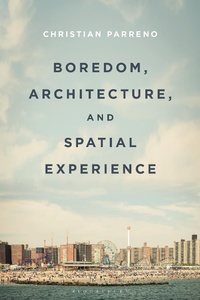
Boredom, Architecture, and Spatial Experience
1st Edition
Published on 11. February 2021
272 pages
978-1-350-14815-4 (ISBN)
Description

Boredom is a ubiquitous feature of modern life. Endured by everyone, it is both cause and effect of modernity, and of situations, spaces and surroundings. As such, this book argues, boredom shares an intimate relationship with architecture-one that has been seldom explored in architectural history and theory.
Boredom, Architecture, and Spatial Experience investigates that relationship, showing how an understanding of boredom affords us a new way of looking at and understanding the modern experience. It reconstructs a series of episodes in architectural history, from the 19th century to the present, to survey how boredom became a normalized component of the everyday, how it infiltrated into the production and reception of architecture, and how it serves to diagnose moments of crisis in the continuous transformations of the built environment.
Erudite and innovative, the work moves deftly from architectural theory and philosophy to literature and psychology to make its case. Combining archival material, scholarly sources, and illuminating excerpts from conversations with practitioners and thinkers-including Charles Jencks, Rem Koolhaas, Sylvia Lavin, and Jorge Silvetti-it reveals the complexity and importance of boredom in architecture.
Boredom, Architecture, and Spatial Experience investigates that relationship, showing how an understanding of boredom affords us a new way of looking at and understanding the modern experience. It reconstructs a series of episodes in architectural history, from the 19th century to the present, to survey how boredom became a normalized component of the everyday, how it infiltrated into the production and reception of architecture, and how it serves to diagnose moments of crisis in the continuous transformations of the built environment.
Erudite and innovative, the work moves deftly from architectural theory and philosophy to literature and psychology to make its case. Combining archival material, scholarly sources, and illuminating excerpts from conversations with practitioners and thinkers-including Charles Jencks, Rem Koolhaas, Sylvia Lavin, and Jorge Silvetti-it reveals the complexity and importance of boredom in architecture.
More details
Edition
1. Auflage
Language
English
Place of publication
London
United Kingdom
Publishing group
Bloomsbury Publishing PLC
Target group
College/higher education
Illustrations
20 bw illus
ISBN-13
978-1-350-14815-4 (9781350148154)
Copyright in bibliographic data and cover images is held by Nielsen Book Services Limited or by the publishers or by their respective licensors: all rights reserved.
Schweitzer Classification
Other editions
Additional editions
Christian Parreno
Boredom, Architecture, and Spatial Experience
Book
08/2022
Bloomsbury Visual Arts
€57.13
Shipment within 15-20 days
Person
Christian Parreno is Assistant Professor of History and Theory of Architecture at Universidad San Francisco de Quito, Ecuador.
Content
List of Illustrations
Preface
Foreword by Iain Borden
Acknowledgements
Introduction: Boredom as Architecture
1. A Component of Modernity
Differential Distances
2. Fascination and Aversion
3. Søren Kierkegaard's Babylonian Tower
4. Catherine Gore and Charles Dickens: Idle Restlessness/Restless Idleness
5. Blunting and Jading
6. Coney Island, Misleading Structures
Circular Trajectories
7. A Unity of Disarray
8. Martin Heidegger's Urge to Be at Home
9. Oran, the Capital of Boredom
10. International Style Confusions: Sigfried Giedion
11. Los Angeles, Flat Enough
Extended Thresholds
12. Potential Architectures
13. Andrew Benjamin's Antithesis to Boredom
14. Boredom in Domus
15. Servitude and Liberalism: Russell Kirk
16. Charles Jencks, Rem Koolhaas, and the Generic
17. Jorge Silvetti and Sylvia Lavin: Unamused Muses and Lying Fallow
Epilogue: Architectures of Boredom
Bibliography
Index
Preface
Foreword by Iain Borden
Acknowledgements
Introduction: Boredom as Architecture
1. A Component of Modernity
Differential Distances
2. Fascination and Aversion
3. Søren Kierkegaard's Babylonian Tower
4. Catherine Gore and Charles Dickens: Idle Restlessness/Restless Idleness
5. Blunting and Jading
6. Coney Island, Misleading Structures
Circular Trajectories
7. A Unity of Disarray
8. Martin Heidegger's Urge to Be at Home
9. Oran, the Capital of Boredom
10. International Style Confusions: Sigfried Giedion
11. Los Angeles, Flat Enough
Extended Thresholds
12. Potential Architectures
13. Andrew Benjamin's Antithesis to Boredom
14. Boredom in Domus
15. Servitude and Liberalism: Russell Kirk
16. Charles Jencks, Rem Koolhaas, and the Generic
17. Jorge Silvetti and Sylvia Lavin: Unamused Muses and Lying Fallow
Epilogue: Architectures of Boredom
Bibliography
Index
