

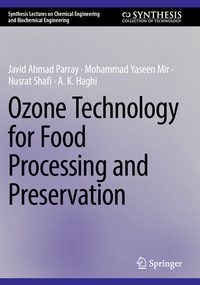
Ozone Technology for Food Processing and Preservation
Description

Ozone is a powerful disinfectant with many applications. This book describes the unique advantages of using ozone technology for food decontamination. Food contamination, especially microbial contamination of fresh produce, is a serious concern in many parts of the world. Ozone decontamination can contribute to food safety and quality retention while avoiding the concerns associated with the use of pesticides.
The book begins with an introduction about ozone properties and ozone technology followed by a detailed description of applications of ozone for preservation of grain, fruits, and vegetables, as well as meat and seafood. Possible effects on product quality and shelf life are discussed, and potential research directions for the future are also suggested.
More details
Other editions
Additional editions
Persons
Javid A Parray - Dr Parray teaches at the Department of Environmental Science, GDC (Government Degree College) Eidgah Srinagar, which is affiliated with Cluster University Srinagar, India. Dr Parray obtained his MPhil and PhD degrees from the University of Kashmir, India, where he has also done his post-doctoral research. His research interests include ecological and agricultural microbiology, climate change and microbial biotechnology, environmental microbiome, etc.
Dr Parray has published over 50 research papers and has authored more than 25 books with international publishers. Dr Parray is on the editorial board, a permanent reviewer of several journals, an invited speaker at various scientific meetings/conferences in India and abroad, and a member of many international and national scientific organizations and societies. Dr parray was awarded PIFI scholarship by Chinese academy science for the year 2024.
Mohammad Yaseen Mir - Dr Mir has recently joined the Department of Education J&K as a teacher. Earlier on, he was a senior researcher for a research project funded by Ministry of Environment, Forest & Climate Change (MoEF & CC), Government of India along with G.B. Pant National Institute of Himalayan Environment & Sustainable Development under National Mission on Himalayan Studies (NMHS). Dr Mir obtained his MPhil and PhD degrees from the University of Kashmir. He is currently editor and reviewer of journals, and has published research papers, review papers, referred international and national journals, as well as book chapters.
Nusrat Shafi - Dr Nusrat Shafi is an Associate Professor at the Department of Chemistry, GDC Eidgah Srinagar India. She has 20 years of teaching and research experience. She has more than 20 publications to her credit. She is editor and reviewer for many national and international journals. Dr Shafi has been an invited speaker at various scientific meetings/conferences in India. She has recently published a book on Sustainable Education with AAP CRC Press.
A. K. Haghi - Dr Haghi is a retired professor who is currently a research associate at the University of Coimbra, Portugal. Professor Haghi holds a BSc in urban and environmental engineering from the University of North Carolina (USA) and holds two MSc degrees, one in mechanical engineering from North Carolina State University (USA) and another one in applied mechanics, acoustics, and materials from the Université de Technologie de Compiègne (France). He was awarded a PhD in engineering sciences at Université de Franche-Comté (France).
Dr Haghi has written, co-written, edited, or co-edited more than 1000 publications, including books, book chapters, and papers in refereed journals with over 4200 citations and an h-index of 34, according to Google Scholar database. He has supervised several PhD and MSc theses at the University of Guilan (UG) and co-supervised international doctoral candidates.
Content
Chapter 1: Ozone: Physical and Chemical Properties.- Chapter 2: Application of Ozone Technology in the Grain Processing.- Chapter 3: Ozone applications for fruits and vegetables.- Chapter 4: Ozone applications in Meat Processing and sea foods.
