

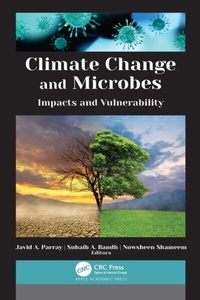
Climate Change and Microbes
Impacts and Vulnerability
1st Edition
Published on 18. May 2022
320 pages
978-1-000-41003-7 (ISBN)
Description

This book provides an enlightening picture of the role of microbes for sustaining life systems and how climatic factors will change the course of the processes. Climate Change and Microbes: Impacts and Vulnerability explores the little-addressed issue of the effects of climate change on microbial ecosystems and the influence of climate change on microbiome diversity across various habitats and regions.
Recent years have seen the evidence that microbial communities are neither immune to disruption nor do they have the capacity to recover completely after a stressful climate event. This volume documents the important role of microorganisms as climate engineers and considers mitigation and adaptation strategies as well. It goes on to present the research that addresses a diverse array of topics on the impact of climate change on plant-microbe interactions and microbial aquatic life and change-induced aggravations in microbial populations and processes. The book also addresses microbial foodborne diseases resulting from challenging climates. Other topics include algae as indicators of climate change and strategies for facilitating sustainable agro-ecosystems.
This book will be immensely helpful in the study of plant microbiology, agricultural sciences, biotechnology, climate science, and environmental microbiology. It will also be applicable to the field of microbial biotechnology, agricultural, and other life and environmental sciences.
Recent years have seen the evidence that microbial communities are neither immune to disruption nor do they have the capacity to recover completely after a stressful climate event. This volume documents the important role of microorganisms as climate engineers and considers mitigation and adaptation strategies as well. It goes on to present the research that addresses a diverse array of topics on the impact of climate change on plant-microbe interactions and microbial aquatic life and change-induced aggravations in microbial populations and processes. The book also addresses microbial foodborne diseases resulting from challenging climates. Other topics include algae as indicators of climate change and strategies for facilitating sustainable agro-ecosystems.
This book will be immensely helpful in the study of plant microbiology, agricultural sciences, biotechnology, climate science, and environmental microbiology. It will also be applicable to the field of microbial biotechnology, agricultural, and other life and environmental sciences.
More details
Edition
1. Auflage
Language
English
Place of publication
London
United Kingdom
Publishing group
Taylor & Francis Ltd
Target group
College/higher education
Professional and scholarly
Product notice
Reflowable
Illustrations
6 Tables, black and white; 5 Line drawings, color; 1 Halftones, color; 6 Illustrations, color
ISBN-13
978-1-000-41003-7 (9781000410037)
Copyright in bibliographic data and cover images is held by Nielsen Book Services Limited or by the publishers or by their respective licensors: all rights reserved.
Schweitzer Classification
Other editions
Additional editions
Javid A. Parray | Suhaib A. Bandh | Nowsheen Shameem
Climate Change and Microbes
Impacts and Vulnerability
Book
08/2024
1st Edition
Apple Academic Press Inc.
€130.70
Shipment within 3-4 weeks
Javid A. Parray | Suhaib A. Bandh | Nowsheen Shameem
Climate Change and Microbes
Impacts and Vulnerability
Book
05/2022
1st Edition
Apple Academic Press Inc.
€203.00
Shipment within 3-4 weeks
Persons
Javid A. Parray, PhD, is Assistant Professor in the Higher Education Department at Government Degree College Eidgah, Srinagar, India, where he teaches environmental science. He has published research articles and has authored books, including Approaches to Heavy Metal Tolerance in Plants; Sustainable Agriculture: Biotechniques in Plant Biology; and Sustainable Agriculture: Advances in Plant Metabolome and Microbiome. He was awarded the Emerging Scientist of Year Award by the Indian Academy of Environmental Science. Dr. Parray completed a fast-track project entitled "Molecular characterization and metabolic potential of rhizospheric bacteria from Arnebia benthamii across North Western Himalaya" at CORD, University of Kashmir, India.
Suhaib A. Bandh, PhD, is Assistant Professor in the Higher Education Department of Jammu and Kashmir at Government Degree College, Pulwama, India, where he teaches courses on environmental science and disaster management. He is the President of the Academy of EcoScience and a life member of the Academy of Plant Sciences and the National Environmental Science Academy. He is a recipient of many awards and has participated in national and international conferences. He has recently edited and authored several books, including Freshwater Microbiology: Perspectives of Bacterial Dynamics in Lake Ecosystems; Environmental Management: Environmental Issues, Awareness and Abatement; and Environmental Perspectives and Issues.
Nowsheen Shameem, PhD, is Assistant Professor in the Department of Environmental Science at Cluster University Srinagar, India. She has worked as a project associate on the DBT-sanctioned project on "Spawn production for the entrepreneurs of Kashmir Valley" at CORD, University of Kashmir, India. She has also worked as a group leader for drafting research proposals and ideas. She has published many research articles in international and national journals and has presented her research work at conferences. Dr. Shameem finished her doctorate through the University of Kashmir on "Phytochemical analysis and nutraceutical value of some wild mushrooms growing in Kashmir Valley" in 2017.
Suhaib A. Bandh, PhD, is Assistant Professor in the Higher Education Department of Jammu and Kashmir at Government Degree College, Pulwama, India, where he teaches courses on environmental science and disaster management. He is the President of the Academy of EcoScience and a life member of the Academy of Plant Sciences and the National Environmental Science Academy. He is a recipient of many awards and has participated in national and international conferences. He has recently edited and authored several books, including Freshwater Microbiology: Perspectives of Bacterial Dynamics in Lake Ecosystems; Environmental Management: Environmental Issues, Awareness and Abatement; and Environmental Perspectives and Issues.
Nowsheen Shameem, PhD, is Assistant Professor in the Department of Environmental Science at Cluster University Srinagar, India. She has worked as a project associate on the DBT-sanctioned project on "Spawn production for the entrepreneurs of Kashmir Valley" at CORD, University of Kashmir, India. She has also worked as a group leader for drafting research proposals and ideas. She has published many research articles in international and national journals and has presented her research work at conferences. Dr. Shameem finished her doctorate through the University of Kashmir on "Phytochemical analysis and nutraceutical value of some wild mushrooms growing in Kashmir Valley" in 2017.
Content
1. Role of Microorganisms as Climate Engineers: Mitigation and Adaptations to Climate Change 2. Climate Change-Induced Aggravations in Microbial Population and Processes: Constraints and Remediations 3. The Vulnerability of Microbial Ecosystems in a Challenging Climate 4. Climate Change and Its Influence on Microbial Diversity, Communities, and Processes 5. Climate Change and Its Impact on Plant-Microbe Interaction 6. Climate Change and Microbial Aquatic Life 7. Microbial Food-borne Diseases Due to Climate Change 8. Algae as Indicators of Climate Change 9. Regulation of Ethylene Levels with 1-Aminocyclopropane-1-Carboxylate Deaminase Produced by Plant Growth Promoting Rhizobacteria 10. Core Microbiome of Solanum Lycopersicum for Sustainable Agroecosystems
