

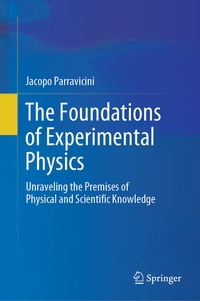
The Foundations of Experimental Physics
Description

Standard STEM courses, for all of their value, do not tend to include systematic lectures or treatment about the nature of the scientific method. This book aims to provide a wide reflection on the general principles of physics and explore the foundations of scientific knowledge as a whole. The author delves into the study of what lies at the basis of science in general, and physics in particular. Themes such as the relation between natural phenomena and mathematical language are addressed, highlighting the main hubs of conceptual development in science. The volume also examines the conceptual and practical instruments that have been progressively developed to investigate the nature of physics. Furthermore, the author discusses the importance of "scientific practice" within the scientific community, emphasizing its role in advancing knowledge and how it contributes to physics as a whole. Divided into three parts, each covering different aspects of physics and its foundations, the text, while assuming basic knowledge of physics and mathematics taught in university courses, is accessible to all STEM students, and will be useful for anyone looking to gain valuable insights into the nature of physics and the methods used to acquire knowledge in this field.
More details
Other editions
Additional editions
Person
Jacopo Parravicini is a Senior Assistant Professor (RTDB) at the Department of Physics & Astronomy at the University of Firenze in Italy. He received his M.D. in Physics in 2006 from the University of Milan, with honors, and completed his Ph.D. in Photonics at the University of Pavia. During his Ph.D., he focused on studying nonlinear optical materials for photonic applications, and was awarded the "A. Righi" prize by the Italian Physical Society in 2008. He has held research positions at various universities and institutes in France and Italy, including the Université de Franche-Comté, the University of L'Aquila, and the "Sapienza" University of Rome. He was also a member of the Institute for Chemical and Physical Processes of the National Research Council of Italy and a research fellow at the Material Science Department of Milano-Bicocca University. His research interests include nonlinear optics, optical and dielectric properties of disordered systems, phase transitions, photovoltaic materials, experimental quantum simulations, and the foundations of Physics, Mathematics, and Natural Sciences. He has authored 74 publications, including 49 in international peer-reviewed journals and 25 in conference proceedings. Professor Parravicini is a member of the Italian Physical Society, and the European Physical Society, and has been a "Senior Member" of the Optical Society of America since 2019.
Content
The bases of scientific knowledge.- The role of Mathematics.- Conceptual and empirical structure of physical quantities.- The development of the founding concept of Physics.- The methodologies of knowledge.- Looking for solid bases: attempts to explain everything.- Looking for solid bases: attempts to demonstrate everything.- True and false in Physics.- How "Science should be done": trying and trying again.- How "Science should not be done": frauds and distortions.- Conclusion: the scientific sight as multiple and human.
