

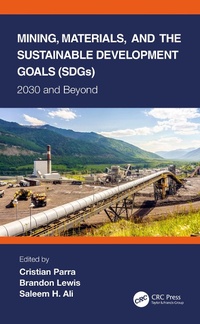
Mining, Materials, and the Sustainable Development Goals (SDGs)
2030 and Beyond
1st Edition
Published on 13. October 2020
232 pages
978-1-000-19336-7 (ISBN)
Description

Mining, Materials, and the Sustainable Development Goals (SDGs): 2030 and Beyond provides a systematic assessment of how the mining and materials sector contributes to the 17 sustainable development goals (SDGs) set forth by the United Nations in 2015. While the target date of 2030 is considered a benchmark for reaching these goals, the book looks beyond this date and considers a longer-term vision.
FEATURES
Written by a consortium of authors from developing and developed countries
Offers coverage of environmental, economic, and social dimensions of the SDGs
Follows the 17 SDGs and includes a short chapter on each, followed by a case example
Includes longer conceptual chapters that consider cross-cutting issues as well
Aimed at those working in minerals, mining, and materials, this work offers readers a practical vision of how these sectors can have a positive impact on meeting these vital global targets.
FEATURES
Written by a consortium of authors from developing and developed countries
Offers coverage of environmental, economic, and social dimensions of the SDGs
Follows the 17 SDGs and includes a short chapter on each, followed by a case example
Includes longer conceptual chapters that consider cross-cutting issues as well
Aimed at those working in minerals, mining, and materials, this work offers readers a practical vision of how these sectors can have a positive impact on meeting these vital global targets.
More details
Edition
1. Auflage
Language
English
Place of publication
London
United Kingdom
Publishing group
Taylor & Francis Ltd
Target group
Professional and scholarly
Illustrations
28 Tables, black and white; 75 Illustrations, black and white
ISBN-13
978-1-000-19336-7 (9781000193367)
Copyright in bibliographic data and cover images is held by Nielsen Book Services Limited or by the publishers or by their respective licensors: all rights reserved.
Schweitzer Classification
Other editions
Additional editions
Cristian Parra | Brandon Lewis | Saleem H. Ali
Mining, Materials, and the Sustainable Development Goals (SDGs)
2030 and Beyond
Book
10/2024
1st Edition
CRC Press
€71.70
Shipment within 15-20 days
Cristian Parra | Brandon Lewis | Saleem H. Ali
Mining, Materials, and the Sustainable Development Goals (SDGs)
2030 and Beyond
Book
10/2020
1st Edition
CRC Press
€185.40
Shipment within 15-20 days
Persons
Cristian Parra is a Chilean-Australian economist at Malthus Global with 20 years of professional experience working with the extractive industry and its stakeholders globally. He has a long track record of senior advising in areas related to socioeconomic issues and progress of mining regions, social and economic mining performance, and impact assessment in developing and developed countries. Cristian has led and participated in projects in 15 countries in more than 50 mining regions across Latin America, Asia-Pacific, and Africa, working with importantmultinational resources companies, development institutions, donors, governments, NGOs, and community groups.
Brandon Lewis is a sustainable investment professional with over a decade of global experience working at the intersection of natural resources, finance, and policy. He has worked on four continents in fields as wide-ranging as mining, renewable energy, forestry, agriculture, project finance, microfinance, and policy. He holds a BSc in Geology, an MSc in Economic Geology, and an MBA in International Development. In 2015 at the World Economic Forum, in collaboration with UNDP and the Columbia Center on Sustainable Investment, he co-authored Mapping Mining to the Sustainable Development Goals: An Atlas.
Saleem H. Ali holds the Blue and Gold Distinguished Professorship in Energy and the Environment at the University of Delaware, where he also directs the Gemstones and Sustainable Development Knowledge Hub, supported by the Tiffany & Co Foundation. He is also a Senior Fellow at Columbia University's Center on Sustainable Investment. Professor Ali has held the Chair in Sustainable Resources Development at the University of Queensland's Sustainable Minerals Institute in Brisbane, Australia (where he retains professorial affiliation).
His books include Treasures of the Earth: Need, Greed and a Sustainable Future, (Yale Univ. Press); Environmental Diplomacy (with Lawrence Susskind, Oxford Univ. Press) and Mining, the Environment and Indigenous Development Conflicts (Univ. of Arizona Press). Corporate and government experience includes employment in General Electric's Technical Leadership Program; a Baker Foundation Fellowship at Harvard Business School and a Research Internship at the UK House of Commons. He is a member of the United Nations International Resource Panel; was chosen as a Young Global Leader by the World Economic Forum in 2011; and received an Emerging Explorer award from the National Geographic Society in 2010. He received his doctorate in Environmental Planning from MIT, a Master's degree in Environmental Studies from Yale University and Bachelor's degree in Chemistry from Tufts University (summa cum laude).
Brandon Lewis is a sustainable investment professional with over a decade of global experience working at the intersection of natural resources, finance, and policy. He has worked on four continents in fields as wide-ranging as mining, renewable energy, forestry, agriculture, project finance, microfinance, and policy. He holds a BSc in Geology, an MSc in Economic Geology, and an MBA in International Development. In 2015 at the World Economic Forum, in collaboration with UNDP and the Columbia Center on Sustainable Investment, he co-authored Mapping Mining to the Sustainable Development Goals: An Atlas.
Saleem H. Ali holds the Blue and Gold Distinguished Professorship in Energy and the Environment at the University of Delaware, where he also directs the Gemstones and Sustainable Development Knowledge Hub, supported by the Tiffany & Co Foundation. He is also a Senior Fellow at Columbia University's Center on Sustainable Investment. Professor Ali has held the Chair in Sustainable Resources Development at the University of Queensland's Sustainable Minerals Institute in Brisbane, Australia (where he retains professorial affiliation).
His books include Treasures of the Earth: Need, Greed and a Sustainable Future, (Yale Univ. Press); Environmental Diplomacy (with Lawrence Susskind, Oxford Univ. Press) and Mining, the Environment and Indigenous Development Conflicts (Univ. of Arizona Press). Corporate and government experience includes employment in General Electric's Technical Leadership Program; a Baker Foundation Fellowship at Harvard Business School and a Research Internship at the UK House of Commons. He is a member of the United Nations International Resource Panel; was chosen as a Young Global Leader by the World Economic Forum in 2011; and received an Emerging Explorer award from the National Geographic Society in 2010. He received his doctorate in Environmental Planning from MIT, a Master's degree in Environmental Studies from Yale University and Bachelor's degree in Chemistry from Tufts University (summa cum laude).
Content
1. GOAL 1: No Poverty. 2. GOAL 2: Zero Hunger. 3. GOAL 3: Good Health and Well-being. 4. GOAL 4: Quality Education. 5. GOAL 5: Gender Equality. 6. GOAL 6: Clean Water and Sanitation. 7. GOAL 7: Affordable and Clean Energy. 8. GOAL 8: Decent Work and Economic Growth. 9. GOAL 9: Industry, Innovation and Infrastructure. 10. GOAL 10: Reduced Inequality. 11. GOAL 11: Sustainable Cities and Communities. 12. GOAL 12: Responsible Consumption and Production. 13. GOAL 13: Climate Action. 14. GOAL 14: Life Below Water. 15. GOAL 15: Life on Land. 16. GOAL 16: Peace and Justice Strong Institutions. 17. GOAL 17: Partnerships to Achieve the Goal.
