

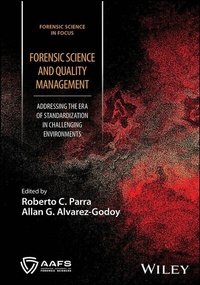
Forensic Science and Quality Management
Description

Explores how global standards in forensic science can be applied across diverse and challenging contexts
The global move toward standardisation in forensic sciences promises reliability, transparency, and a shared professional language. Forensic Science and Quality Management examines how these aspirations intersect with the realities of working in politically, socially, and economically challenging environments. Through expert analysis and international case studies, the volume examines how rigorous standards can-and must-be adapted to function ethically and effectively in contexts marked by limited resources, instability, and humanitarian crises.
Contributions from internationally recognised experts and field practitioners emphasise that achieving quality in forensic science extends beyond procedural compliance-it requires balancing technical accuracy with ethical awareness, contextual understanding, and sensitivity to human rights. In-depth chapters examine the implementation of quality management frameworks in regions around the world, the adaptation of various international protocols, and the application of advanced technologies such as DNA analysis and artificial intelligence. By bringing together theory, practice, and lived experience, this collection challenges the notion that standardisation alone guarantees justice.
Illustrating how forensic professionals innovate within constraints while demonstrating resilience and integrity in the pursuit of human rights, victims' dignity, and the fight against impunity. Forensic Science and Quality Management:
- Analyses how global forensic standards can be adapted to varied social, political, and economic environments
- Draws on real-world examples from Latin America, Africa, and other regions affected by conflict and limited resources
- Offers critical insight into the evolving relationship between standardisation, ethics, and justice - recognising modern forensic science principles as first-order foundations for credibility and accountability
- Discusses the tension between accreditation and genuine institutional strengthening
- Highlights the role of forensic science in promoting accountability, human rights, respect for victims' dignity, and the pursuit of transitional justice
Forensic Science and Quality Management: Addressing the Era of Standardisation in Challenging Environments is essential reading for forensic scientists, criminologists, criminalistics, legal professionals, transitional justice experts, political actors and human rights investigators working in both stable and complex environments. It is also a valuable text for postgraduate courses in forensic science, criminal justice, transitional justice and human rights law within degrees in law, forensic science, humanitarian actions, and social sciences.
More details
Other editions
Additional editions
Persons
Roberto C. Parra, A Peruvian forensic specialist with 25 years of professional experience, he combines scientific rigor and Quality Assurance with extensive work in challenging forensic environments to strengthen institutions. He is currently a member of the forensic team of the United Nations Joint Human Rights Office (UNJHRO) of the Office of the United Nations High Commissioner for Human Rights (OHCHR) in the Democratic Republic of the Congo, contributing to transitional justice processes and the fight against impunity.
Allan G. Alvarez-Godoy, a Guatemalan forensic specialist with extensive international experience, he works for international organizations, where he applies scientific and technical expertise to the investigation of serious crimes. He has worked in challenging and high-risk environments, contributing to transitional justice and the fight against impunity, while strengthening institutions and promoting human rights in conflict and post-conflict contexts.
Content
About the Editors, xv
List of Contributors, xvii
Preface, xix
Series Preface, xxi
Acknowledgments, xxiii
Introduction, xxv
1 Forensic Quality Management and Era of Standardization: Where the Rubber Meets the Road in Challenging Environments, 1
Roberto C. Parra, Eva Bruenisholz, and Claude Roux
1.1 Introduction, 1
1.2 Quality Management in Forensic Science: From Tradition to Transformation, 9
1.3 The Standardization Era: The Forensic Shift and Industrial Ideals, 13
1.4 Quality in Challenging Environments: Where the Rubber Meets the Road, 17
1.5 Conclusion: How Should the Road Actually Appear?, 30
2 Artificial Intelligence in Forensic Science: An Important Opportunity for Challenging Environments, 37
Roberto C. Parra, Gian Carlo Iannacone, and Allan G. Alvarez-Godoy
2.1 Introduction, 37
2.2 Impact of Artificial Intelligence on Forensic Sciences Within the Framework of the Principles of the Sydney Declaration, 40
2.3 Critical Points to Consider in the Implementation of Forensic AI, 46
2.4 Improving Quality Standards in Countries Without ISO Certification, 48
2.5 Ethical Risks and Challenges of Artificial Intelligence in Forensic Science, 50
2.6 Forensic Quality, Operational Skepticism, and Artificial Intelligence as a Bridge Between Standards and Innovation, 56
2.7 Conclusion, 58
3 A Universal Guidance Model: The Minnesota Protocol in Challenging Environments, 63
Roberto C. Parra, Pierre Perich, Allan G. Alvarez-Godoy, Michael Pollanen, Daouda Traore, Jorge L. Vasquez-Guerrero, Omer O. Adjibode, John Mbewu-Bodji, and Sami El Jundi
3.1 Introduction, 63
3.2 Foundations of the Minnesota Protocol (2016), 65
3.3 The Duty to Investigate in Challenging Environments, 68
3.4 Implementation Strategies Adapted to Challenging Contexts, 71
3.5 Best Practices and Relevant Experiences, 74
3.6 Recurring Challenges, 77
3.7 Value of the Protocol as a Universal Standard in the Fight Against Impunity, 78
3.8 Conclusions, 80
4 Deaths in Custody Are a Silent Global Tragedy: An Analysis of Burkina Faso's Challenging Environment in Dialogue with International Experiences, 83
Daouda Traore, Roberto C. Parra, Norbert W. Ramde, Béraré Doudoulgou, Ratouissamda Kagambega, Omer O. Adjibode, and Jorge L. Vasquez-Guerrero
4.1 Introduction, 83
4.2 Death in Custody and Limits on Institutions in Burkina Faso, 85
4.3 Considerations of International Good Practices that Land in the Practice of Challenging Environments, 87
4.4 The Debate About What It Means to Death in Custody: Bioethical and Structural Aspects, 90
4.5 Comparison with China: A Proven System Faces Persistent Structural Challenges, 93
4.6 Recommendations for Action in Challenging Environments, 96
4.7 Conclusion: Protecting Life on the Margins of the System, 99
5 From Conflict to Cooperation: ICRC's Forensic Humanitarian Efforts in Challenging Contexts, 103
Denise Abboud, Vincent Mazraani, Rafael De Abreu E Souza, Maria Dolores Morcillo Mendez, Jane Taylor, and Pierre Guyomarc'h
5.1 Introduction, 103
5.2 The Establishment of the Forensic Unit: An ICRC Commitment to Forensic Humanitarian Action, 104
5.3 The ICRC Forensic Unit, 105
5.4 Forensic Humanitarian Action by ICRC, 107
5.5 Strengthening of Medico Legal Systems in Challenging Environments: Medico-legal Systems and their Role in the Response to Issues of Humanitarian Concern, 108
5.6 Implementation of Quality Management Systems, 112
5.7 Maintaining Quality Management in Forensics, 116
5.8 Challenges and Solutions in Forensic Operations, 116
5.9 Future Directions and Recommendations, 120
5.10 Conclusion, 124
6 Sexual Violence in Armed Conflict: Promoting Forensic Evidence as a Humanitarian Action, 127
Roberto C. Parra, Allan G. Alvarez-Godoy, Daouda Traore, Pierre Perich, Omer O. Adjibode, John Mbewu-Bodji, and Sami EL Jundi
6.1 Introduction: Naming the Unspeakable, Preserving the Invaluable, 127
6.2 Contemporary Approaches to Sexual Violence in Conflict, 129
6.3 Structural and Operational Challenges in Conflict Contexts, 133
6.4 Case Study: DRC Post-conflict and the Implementation of the International Protocol, 137
6.5 Lessons Learned and Replicability, 143
6.6 Methodological Comparison: International Protocol vs. Clinical Form, 144
6.7 Forensic Protection as a Humanitarian Act, 148
.8 Ethical Considerations and Protection of Information, 152
6.9 Towards a Resilient Forensic System in Adverse Contexts, 155
6.10 Conclusion, 158
7 Quality Management in Forensic Science in Panama: Advances, Challenges, and Perspectives, 165
José Vicente Pachar Lucio
7.1 Introduction, 165
7.2 Regulatory Framework and International Context, 166
7.3 Accreditation Progress in Panama, 167
7.4 Challenges Faced During the Process, 168
7.5 Institutional and Social Impact, 170
7.6 Conclusions, 170
8 Peruvian Efforts to Strengthen the Quality of Forensic Practice: Limitations and Advances in Standardization, 173
Gian Carlo Iannacone, Marleny Huerta-Valdivia, Jorge Vasquez-Guerrero, and Roberto C. Parra
8.1 Introduction, 173
8.2 Brief Review of the IMLFC-Perú, 174
8.3 Macro-level Process Flow of the IMLFC-Perú Forensic Services, 178
8.4 Integration of Processes Within the Framework of the Sydney Declaration, 179
8.5 Strategies from IMLFC-Peru for Quality Assurance: Applying the Declaration of Sydney as an Efficient Alternative, 182
8.6 Conclusion, 197
9 Guatemalan's Efforts to Strengthen the Quality of Forensic Practice: Limitations and Advances, 203
Ruth Garcia-Marroquin and Allan G. Alvarez-Godoy
9.1 Introduction, 203
9.2 National Institute of Forensic Sciences of Guatemala (INACIF), 206
9.3 Support from International Cooperation, 216
9.4 Conclusion, 222
10 Latin America in Forensic Action: Quality Standards Alone Do Not Provide an Infallible Quality Assurance, 225
Roberto C. Parra, Gian Carlo Iannacone, Allan G. Alvarez-Godoy, Daniel Castellanos, Ruth Garcia-Marroquin, and Jorge L. Vasquez-Guerrero
10.1 Introduction, 225
10.2 International Standards: Foundations and Limitations in their Forensic Applicability, 228
10.3 Accreditation and Forensic Practice: Diverse Trajectories in Latin America, 231
10.4 Myths and Realities of Quality Discourse: Between the Normative Symbol and Effective Transformation, 237
10.5 Elements for Contextual and Comprehensive Quality: From the Sydney Declaration to Its Applicability in Latin America, 241
11 The Sydney Declaration as an Operational Approach to Challenging Forensic Environments, 251
Roberto C. Parra and Claude Roux
11.1 Introduction, 251
11.2 Reflections Throughout the Volume, 252
11.3 Conclusion, 254
References, 255
Index, 257
