

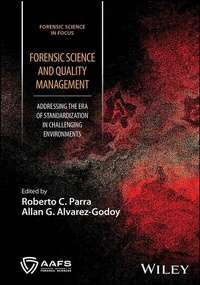
Forensic Science and Quality Management
Description

Explores how global standards in forensic science can be applied across diverse and challenging contexts
The global move toward standardisation in forensic sciences promises reliability, transparency, and a shared professional language. Forensic Science and Quality Management examines how these aspirations intersect with the realities of working in politically, socially, and economically challenging environments. Through expert analysis and international case studies, the volume examines how rigorous standards can-and must-be adapted to function ethically and effectively in contexts marked by limited resources, instability, and humanitarian crises.
Contributions from internationally recognised experts and field practitioners emphasise that achieving quality in forensic science extends beyond procedural compliance-it requires balancing technical accuracy with ethical awareness, contextual understanding, and sensitivity to human rights. In-depth chapters examine the implementation of quality management frameworks in regions around the world, the adaptation of various international protocols, and the application of advanced technologies such as DNA analysis and artificial intelligence. By bringing together theory, practice, and lived experience, this collection challenges the notion that standardisation alone guarantees justice.
Illustrating how forensic professionals innovate within constraints while demonstrating resilience and integrity in the pursuit of human rights, victims' dignity, and the fight against impunity. Forensic Science and Quality Management:
- Analyses how global forensic standards can be adapted to varied social, political, and economic environments
- Draws on real-world examples from Latin America, Africa, and other regions affected by conflict and limited resources
- Offers critical insight into the evolving relationship between standardisation, ethics, and justice - recognising modern forensic science principles as first-order foundations for credibility and accountability
- Discusses the tension between accreditation and genuine institutional strengthening
- Highlights the role of forensic science in promoting accountability, human rights, respect for victims' dignity, and the pursuit of transitional justice
Forensic Science and Quality Management: Addressing the Era of Standardisation in Challenging Environments is essential reading for forensic scientists, criminologists, criminalistics, legal professionals, transitional justice experts, political actors and human rights investigators working in both stable and complex environments. It is also a valuable text for postgraduate courses in forensic science, criminal justice, transitional justice and human rights law within degrees in law, forensic science, humanitarian actions, and social sciences.
More details
Other editions
Additional editions
Persons
Roberto C. Parra, A Peruvian forensic specialist with 25 years of professional experience, he combines scientific rigor and Quality Assurance with extensive work in challenging forensic environments to strengthen institutions. He is currently a member of the forensic team of the United Nations Joint Human Rights Office (UNJHRO) of the Office of the United Nations High Commissioner for Human Rights (OHCHR) in the Democratic Republic of the Congo, contributing to transitional justice processes and the fight against impunity.
Allan G. Alvarez-Godoy, a Guatemalan forensic specialist with extensive international experience, he works for international organizations, where he applies scientific and technical expertise to the investigation of serious crimes. He has worked in challenging and high-risk environments, contributing to transitional justice and the fight against impunity, while strengthening institutions and promoting human rights in conflict and post-conflict contexts.
Content
Introduction
Roberto C. Parra1 and Allan G. Alvarez-Godoy2
1The Specialized Forensic Team of the United Nations Joint Human Rights Office (UNJHRO) in the Democratic Republic of the Congo
2International Forensic Consultant, The Hague, Netherlands
Quality Management, a crucial component of contemporary forensic science, has gained a lot more attention since the last few decades of the 20th century, which has resulted in the development of globally accepted, internationally standardized practices (Pereira, 1985, Willis, 2010; Neuteboom et al., 2023; Wilson-Wilde, 2018; Doyle, 2019; Berger, 2025). However, demands for accountability, transparency, reproducibility, replicability, and overall quality assurance of findings have increased alongside this increased visibility and need for forensic science. Despite this, the global forensic science community is currently facing a broader scientific crisis, marked by issues of trust, reproducibility, and credibility. Serious concerns have been raised by high-profile cases of forensic failures, as well as the lack of consistent scientific validation across numerous procedures (Saks and Faiman, 2008; Koehler et al., 2023; Crispino et al., 2021; and many others). Crispino et al. (2021) have eloquently highlighted a explicit paradox in forensic science: on the one hand, the reports of the U.S. National Academy of Sciences (2009) and the President's Council of Advisors on Science and Technology (PCAST, 2016) emphasize a structural crisis in forensic science. They highlight a lack of methodological rigor, the fragmentation of the disciplines that comprise it, and the absence of clear and uniform standards. Furthermore, they underscore the weight of experts'1 cognitive biases, insufficient impartiality, and weaknesses in quality control. All of this has led to flawed and even erroneous reports, with serious consequences such as judicial errors and wrongful convictions (Saks and Faiman, 2008; Koheler et al., 2023). This delicate situation raises the need for profound reform and an epistemological framework that provides greater coherence and legitimacy to forensic practice (Koheler et al., 2023; Crispino et al., 2021).
On the other hand, social, media, and commercial perceptions offer a completely different picture. Forensic science appears to be an effective and almost infallible field, equipped with cutting-edge technologies and capable of solving complex crimes, including cold cases. It is attributed a central role in the fight against crime, and great expectations are placed on its future thanks to artificial intelligence. The paradox lies in the fact that, while its scientific soundness is questioned in the courts, in the public sphere it is exalted as an almost magical and effective science (Crispino et al., 2021).
To ensure the validity, reliability, and relevance of forensic science in the modern world, a profound reform has been demanded (Koehler et al., 2023). A reinvention that prioritizes methodical research, exhaustive method validation, and transparency of the process is suggested as a way to reverse this situation. Establishing unequivocal standards, fostering a culture of critical evaluation, and supporting continuous development are necessary for this change. Furthermore, the importance of reproducible results and an interdisciplinary approach that combines scientific knowledge with judicial needs is emphasized. Adopting these measures would allow forensic science to respond more successfully to new methodological and technological challenges while improving its real reputation with the public and the legal system (Koheler et al., 2023; Roux et al., 2022; Ross et al., 2025). In parallel with this context of innovation and transformative development, forensic science is also moving toward technical standardization (Ballentyne and Wilson-Wilde, 2020; Wilson-Wilde, 2018; Berger, 2025). Increasing capacity ("more"), improving quality ("better"), shortening execution times ("faster"), reducing costs ("cheaper"), and strengthening the integration of all stages of the workflow ("easier and safer") seem to be the path to modern globalizing forensic science. A true machine, ideally automated, to produce results at low cost, in mass, and with technically standardized precision and constant validation between internationally constructed networks.
An international regulatory framework has been established in the field of forensic science to ensure traceability, quality, and transparency in all procedures. Under such a framework, every step, from the identification and collection of evidence to the presentation of findings in court, would be based on internationally accepted technical standards (Berger, 2025; Wilson-Wilde, 2018; Doyle, 2019). It is argued that these efforts would reduce arbitrary practices, while strengthening the reliability of findings, improving institutional credibility, and facilitating the acceptance of evidence in judicial contexts. In this situation, international standards would be considered necessary to integrate best practices in forensic management, promote continuous improvement, and harmonize procedures. These objectives would be supported by a comprehensive set of ISO standards (ISO 21043-1, ISO 21043-2, ISO 21043-3, ISO 21043-4, ISO 21043-5, ISO/IEC 14001:2015, ISO/IEC 15189:2012, ISO/IEC 17020:2012, ISO/IEC 17025:2017, ISO/IEC 9001:2015) governing terminology, evidence collection, analysis, interpretation, and reporting. Guidelines could also be implemented for quality control, environmental sustainability, inspection agency operations, and laboratory competency. Together, this regulatory framework would provide a crucial system that would strengthen confidence in forensic science as a vital field for the efficient functioning of the legal system. All of this is developed and designed from a Global North perspective, which also involves rigorous accreditation and audit procedures (Neuteboom et al., 2023; Neuteboom and Ross, 2024; Ross and Neuteboom, 2020).
The benefits of this advancement include promoting international comparability of results and strengthening institutional confidence in administrative management. However, a fundamental challenge with its rapid growth and the growing anxiety about the global standardization and automation of processes and procedures is how to ensure that these standards also consider the diversity of environments and needs, especially in situations where conditions are far from ideal, as is clearly the case in the Global South?
This is where the idea of challenging environments comes into play. These settings, which are usually found in the Global South, are distinguished by institutional instability, resource scarcity, structural limitations, enduring inequality, and frequently violent or humanitarian crisis situations. The transfer of models created for forensic environments in the Global North may not work in these challenging environments and may often even ignore the operational and social realities that impact the effectiveness of forensic science. Forensic science that pursues an industrial model, with an emphasis on technical advancement, improvement, and automation as ends in themselves, does not always capture the complexity of these heterogeneous and challenging environments nor does it ensure that forensic science achieves its primary objective: contributing to justice, and the fight against impunity.
The goal of this volume is not to fully address every facet of this discussion. Instead, it aims to create an environment that supports critical but constructive evaluation of how standardization can advance forensic science while maintaining awareness of the variety of contexts in which it works. The chapters collected here caution that accreditation alone does not provide a 100% guarantee of quality, far from casting doubt on its value. In fact, it can lead to false impressions or "mirages" that create a false sense of security among justice officials, the general public, and even the forensic community if institutional strengthening is not continued.
The authors, who have extensive experience working in demanding environments, illustrate this tension throughout the work with case studies, comparative analyses, and theoretical reflections. Examples of how quality is attained by not only meeting standards but also incorporating them into an ethical, adaptable, and contextually relevant operating framework are provided, ranging from the investigation of new tools like artificial intelligence to the contextualized adaptation of international instruments like the Minnesota Protocol. Forensic quality necessitates both technical and scientific rigor, but more importantly, ethical and social sensitivity, as evidenced by cases like deaths in custody in the African region of Burkina Faso, the forensic humanitarian efforts of the International Committee of the Red Cross worldwide, or the forensic documentation of sexual violence in armed conflicts.
Similar to this, the national experiences of Guatemala, Peru, and Panama show that accreditation procedures can spur development if they are supported by plans to bolster administrative, technical, and human resources, as well as political, logistical, and most importantly, financial will. In the absence of this assistance, there is still a chance that accreditation will turn into a stand-alone goal that is more closely related to getting official recognition than to actually improving practices. The "accreditation mirage" concept, which is used in the final chapter to summarize these lessons, serves as a reminder that genuine quality necessitates...
