

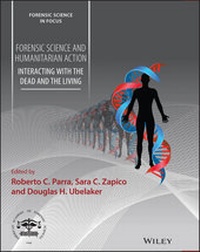
Forensic Science and Humanitarian Action
Description

Using the preservation of the dignity of the deceased as its foundation, Forensic Science and Humanitarian Action: Interacting with the Dead and the Living is a unique examination of the applications of humanitarian forensic science. Spanning two comprehensive volumes, the text is sufficiently detailed for forensic practitioners, yet accessible enough for non-specialists, and discusses both the latest technologies and real-world interactions. Arranged into five sections, this book addresses the 'management of the dead' across five major areas in humanitarian forensic science.
Volume One presents the first three of these areas: History, Theory, Practice, and Legal Foundation; Basic Forensic Information to Trace Missing Persons; and Stable Isotopes Forensics. Topics covered include:
* Protection of The Missing and the Dead Under International Law
* Social, Cultural and Religious Factors in Humanitarian Forensic Science
* Posthumous Dignity and the Importance in Returning Remains of the Deceased
* The New Disappeared - Migration and Forensic Science
* Stable Isotope Analysis in Forensic Anthropology
Volume Two covers two further areas of interest: DNA Analysis and the Forensic Identification Process. It concludes with a comprehensive set of case studies focused on identifying the deceased, and finding missing persons from around the globe, including:
* Forensic Human Identification from an Australian Perspective
* Skeletal Remains and Identification Processing at the FBI
* Migrant Deaths along the Texas/Mexico Border
* Humanitarian Work in Cyprus by The Committee on Missing Persons (CMP)
* Volcán De Fuego Eruption - Natural Disaster Response from Guatemala
Drawing upon a wide range of contributions from respected academics working in the field, Forensic Science and Humanitarian Action is a unique reference for forensic practitioners, communities of humanitarian workers, human rights defenders, and government and non-governmental officials.
More details
Other editions
Additional editions

Persons
Edited by
Roberto C. Parra is Forensic Specialist to the Human Rights Office of the High Commissioner (OHCHR), United Nations; and Bioarchaeology and Stable Isotope Research Laboratory, Vanderbilt University, Nashville, Tennessee, USA.
Sara C. Zapico is Research Collaborator in the Anthropology Department at Florida International University, International Forensic Research Institute, Miami, USA.
Douglas H. Ubelaker is Curator and Senior Scientist in the Department of Anthropology at the National Museum of Natural History, Smithsonian Institution, in Washington, DC, USA.
Content
Section I: History, theory, practice and legal foundation
1. Using forensic science to care for the dead and search for the missing: In conversation with Morris Tidball-Binz Morris Tidball-Binz, Email: mtidballbinz@icrc.org
2. The protection of the missing and the dead under international law Ximena Londoño Romanowsky and Marisela Silva Chau*, Email: masilvachau@icrc.org
3. Extraordinary deathwork: New developments in, and the social significance of, forensic humanitarian action Claire Moon, Email: c.moon@lse.ac.uk
4. Between darts and bullets: A bioarchaeological view on the study of Human Rights and IHL violations Maria del Carmen Vega Dulanto, Email: vega.m@pucp.edu.pe
5. Posthumous dignity and the importance in returning remains of the deceased Sian Cook, Email: s.cook2@uos.ac.uk
6. Unidentified deceased persons: Social life, social death and humanitarian action Roberto C. Parra*, Email: ropachi@gmail.com, Pierre Perich, Élisabeth Anstett, and Jane E. Buikstra
7. A forensic perspective on the new disappeared: Migration revisited Jose Pablo Baraybar*, Email: baraybarjp@gmail.com, Ines Caridi, and Jill Stockwell
8. Iran: the impact of the beliefscape on the risk culture, resilience and disaster risk governance Michaela Ibrion, Email: mibrion5@gmail.com
9. The search for the missing from a humanitarian approach as a Peruvian national policy Monica Barriga, Email: mbarriga@minjus.gob.pe
10. Humanitarian forensic action in the Marawi crisis Sarah Ellinghan*, Email: sellingham@icrc.org and Derek Benedix
Section II: Forensic basic information to trace missing persons
11. Integration of information on missing persons and unidentified human remains: Best practices Diana Emilce Ramirez Páez, Email: psiyana@hotmail.com
12. Forensic archaeology and humanitarian context: Localization, recovery and documentation of human remains Flavio Antonio Estrada Moreno*, Email: flavio_estrada@hotmail.com and Patricia Maita
13. Applications of physiological bases of aging to forensic science: New advances Sara C. Zapico*, Email: saiczapico@gmail.com, Douglas H. Ubelaker, and Joe Adserias-Garriga
14. Adult skeletal sex estimation and the global standardization Heather M. Garvin and Alexandra R. Klales*, Email: alexandra.klales@gmail.com
15. Sexual dimorphism in juvenile skeletons and its real problem Flavio Antonio Estrada Moreno, Email: flavio_estrada@hotmail.com
16. Dental Aging Methods and Population Variation Joe Adserias-Garriga*, Email: mjadserias@hotmail.com and Joel Ignacio Tejada Arana
17. Age assessment in unaccompanied minors: A review Jose Luis Prieto, Email: jlprietocarrero@gmail.com
18. Interdisciplinary approach and technological innovation for dealing with forensic humanitarian cases in complex scenarios Ginna P. Camacho C*, Email: gcamacho@equitas.org.co, Luz Adriana Pérez, and Diana Arango G.
Section III: Stable isotopes forensics and search of missing persons
19. The role of stable isotope analysis in forensic anthropology Douglas H. Ubelaker*, Email: UBELAKED@si.edu and Caroline Francescutti
20. Basic principles of stable isotope analysis in humanitarian forensic science Lesley A. Chesson*, Email: Lesley.Chesson@pae.com, Gregory E. Berg, Clement P. Bataille, Eric J. Bartelink, and Michael P. Richards and Wolfram Meier-Augenstein,
21. Andean isoscapes: Creating and testing oxygen isoscape models to aid in the identification of missing persons in Peru James Zimmer-Dauphinee, Beth K. Scaffidi, and Tiffiny A.Tung*, Email: t.tung@vanderbilt.edu
22. Finding family, finding home: Applying predictive isotope model and other forensic tools on unidentified deceased in Peru Martha R. Palma*, Email: palmamalaga@gmail.com, Roberto C. Parra, Lucio A. Condori and Tiffiny A. Tung
23. Utility of stable isotope ratios of tap water and human hair in determining region of origin in Central and Southern Mexico: Modeling relationships between d2H and d18O isotope inputs in modern Mexican hair Chelsey Juarez*, Email: chelsey.juarez@gmail.com, Robin Ramey, David T. Flaherty, and Belinda S. Akpa
24. Multi-Isotope approaches for region of origin predictions of undocumented border crossers from the U.S./Mexico Border: Biocultural perspectives on diet and travel history Eric J. Bartelink*, Email: ebartelink@csuchico.edu, Lesley Chesson, Bret Tipple, Sarah Hall, and Robyn Kramer
25. Spatial distribution of stable isotope values of human hair: Tools for region of origin and travel history assignment Luciano O. Valenzuela*, Email: lucianoovalenzuela@gmail.com, Lesley A. Chesson, Gabriel Bowen, Thure E. Cerling, and Jim R. Ehleringer
26. Applicability of stable isotope analysis to the Colombian human identification crisis Daniel Castellanos Gutiérrez*, Email: dacaste@gmail.com, Elizabeth A. DiGangi, and Jonathan D. Bethard
27. Application of stable isotopes and geostatistics to infer region of geographic origin for deceased undocumented Latin American migrants Robyn T. Kramer*, Email: rtkramer92@gmail.com, Eric J. Bartelink, Nick Herrmann, Clement Bataille, and Kate Spradley
28. Tracking geographic patterns of contemporary human diet in Brazil using stable isotopes of nail keratin Gabriela Bielefeld Nardoto*, Email: gbnardoto@gmail.com, João Paulo Sena-Souza, Lesley A. Chesson, and Luiz Antonio Martinelli
Section IV: DNA Analysis and Forensic Identification Process
29. Phenotypic markers for forensic purposes Ana Freire-Aradas*, Email: ana.freire3@hotmail.com, Christopher Phillips, Victoria Lareu Huidobro, and Ángel Carracedo
30. Genetic structure and kinship analysis from Peruvian Andean area: Limitations and recommendation for DNA identification on missing persons Gian Carlo Iannacone*, Email: ggiannacone@yahoo.com and Roberto C. Parra*, Email: ropachi@gmail.com
31. Short tandem repeat markers applied to the identification of human remains William Goodwin*, Email: WHGoodwin@uclan.ac.uk, Hassain M.H. Alsafiah, and Ali A.H. Al-Janabi
32. Genetics without non-genetic data in Colombian experience: Forensic difficulties for the correct identification Manuel Paredes, Email: manuel.paredes@medicinalegal.gov.co
33. Is DNA always the answer? Caroline Bennett, Email: caroline.bennett@vuw.ac.nz
Section V: Identifying deceased and finding missing persons
34. Migrant deaths along the Texas/Mexico border: A collaborative approach to forensic identification of human remains Kate Spradley*, Email: mks@txstate.edu and Timothy Gocha
35. The Argentine experience in forensic identification of human remains Mercedes Salado*, Email: msaladopuerto@gmail.com, Laura Catelli, Carola Romanini, Magdalena Romero, and Carlos Vullo
36. The approach to unidentified dead migrants in Italy Cristina Cattaneo*, Email: cristina.cattaneo@unimi.it, Debora Mazzarelli, Lara Olivieri, Danilo De Angelis, Annalisa Cappella, Albarita Vitale, Giulia Caccia, Vittorio Piscitelli, and Agata Iadicicco
37. Identification of human skeletal remains at the Federal Bureau of Investigation (FBI) laboratory Angi M. Christensen*, Email: angi.m.christensen@gmail.com, Ann D. Fasano, Richard B. Marx, John E.B. Stewart, Lisa G. Bailey, and Richard M. Thomas
38. Forensic human identification: An Australian perspective Soren Blau, Email: soren.blau@vifm.org
39. Forensic identification of human remains in Cyprus: The humanitarian work of the Committee on Missing Persons (CMP) Gülbanu K. Zorba*, Email: gulbanu.zorba@cmp-cyprus.org, Theodora Eleftheriou, Istenç Engin, Sophia Hartsioti, and Christiana Zenonos
40. Forensic human identification during humanitarian crisis in Guatemala: Volcán de Fuego deadly eruption Daniel Jimenez, Email: daniel.jimenez.gaytan@gmail.com
41. Peruvian forensic experience in the search for missing persons and the identification of human remains: History, limitations, and future challenges. Roberto C. Parra*, Email: ropachi@gmail.com, Martha R. Palma, Oswaldo Calcina, Joel Ignacio Tejada Arana, Lucio A. Condori and Jose Pablo Baraybar
42. Forensic identification of human remains in Uruguay Alicia Lusiardo*, Email: nibya@yahoo.com, Ximena Salvo, Gustavo Casanova, Natalia Azziz, Rodrigo Bongiovanni, Matías López, and Sofía Rodríguez
43. Forensic analysis of the unidentified dead in Costa Rica from 2000 to the present Georgina Pacheco-Revilla*, Email: gepare@gmail.com and Derek Congram
44. Identifying the unknown and the undocumented: The Johannesburg (South Africa) experience Desiré Brits*, Email: Desire.Brits@wits.ac.za, Maryna Steyn, and Candice Hansmeyer
45. The Colombian experience in forensic identifications process Jairo Vivas and Claudia Vega*, Email: clauvega_497@hotmail.com
46. Chilean experience in forensic identification of human remains Marisol Intriago*, Email: marisol.intriago.mi@gmail.com, Viviana Uribe, and Claudia Garrido
Section VI: Conclusions
47. Humanitarian action: New approaches from forensic science Douglas H. Ubelaker, Sara C. Zapico, and Roberto C. Parra*, Email: ropachi@gmail.com
About the contributors
Joe Adserias-Garriga, DDS, PhD, D-ABFO, is a forensic anthropologist and forensic odontologist from Spain, where she has directed and lectured in different postgraduate programs in forensic science. She is an external advisor to Mossos d'Esquadra (Catalonian Police), who honored her contribution in forensic casework. Dr Adserias-Garriga is currently working as a forensic anthropologist at the Forensic Anthropology Center, Texas State University, United States. She has conducted research collaborations with different entities in the United States and Europe. She is an ABFO Diplomate, and cofounder of the International Group of Forensic Odontology for Human Rights. She is a member of the INTERPOL DVI Odontology SubWorking Group and the INTERPOL DVI Pathology-Anthropology SubWorking Group.
Belinda S. Akpa is an Assistant Professor of Integrated Synthetic and Systems Biology at North Carolina State University. She holds a BA, MEng, and doctorate in Chemical Engineering from the University of Cambridge (UK). A highly interdisciplinary researcher, her current interest is in developing mathematical frameworks that integrate heterogeneous data and help connect molecular phenomena to physiological outcomes. Dr Akpa is broadly interested in mathematical biology, but more specifically in how statistical and mechanistic approaches can be combined to frame targeted experimental strategies. By necessity, these efforts explore the limits of what one can learn from empirical observations and mathematical models, both independently and in integrative studies.
Ali A.H. Al-Janabi graduated with a Bachelor of Dentistry in Iraq and then acquired an MSc in genetics from the University of Baghdad, then going on to work with the Medicolegal Directorate in Baghdad. Here he specialized in forensic genetics, working in the Mass Graves Department and also the Crime Scene Department. He has just returned to the Medicolegal Directorate after completing his PhD in forensic genetics, optimizing the extraction of DNA from bone material from mass graves and crime scenes in Iraq.
Hassain M.H. Alsafiah graduated from King Saud University with a BSc in Biochemistry, and then worked as a forensic geneticist for the Ministry of Interior in Saudi Arabia. He went on to complete a MSc in Medical Genetics at Glasgow University and is now studying for a PhD in Forensic Genetics at the University of Central Lancashire. His research involves studying the population genetics of Saudi Arabia and the application of next-generation sequencing. He will return to be the Head of the Forensic Genetics Laboratory in the Eastern Province, Dammam, once he has completed his PhD.
Élisabeth Anstett, PhD, is a social anthropologist, tenured senior researcher at the Centre National de la Recherche Scientifique (CNRS) in Paris, and Director of the Corpses of Mass Violence and Genocide programme funded by the European Research Council. Her recent works deal with the social impact of mass exhumations, and more broadly with the legacy of genocide and mass violence in Europe. She co-edits the Human Remains and Violence book series published by Manchester University Press, and is also one of the three general editors of Human Remains & Violence: An Interdisciplinary Journal.
Diana Arango Gómez is a political scientist from the National University of Colombia with a Master's degree in Comparative American Studies, University of London. With experience in research and coordination of networks of civil society organizations and advocacy in international and national decision spaces. Executive Director of EQUITAS, Colombia.
Natalia Azziz obtained her degree at the Universidad de la República (Udelar), Uruguay, in 2013. In 2007, she joined the Forensic Anthropological team in Uruguay in the search for detained-disappeared persons during the last military dictatorship (1973-1985). Natalia has been a full member of the Latin American Association of Forensic Anthropology (ALAF) since 2014. She has participated in several meetings and workshops of ALAF. She was also part of the Bioethics Committee of the Administración de los Servicios de Salud del Estado (ASSE) in 2015-2016. She is currently completing a Master's degree in Anthropology at the Facultad de Humanidades y Ciencias de la Educación (Udelar).
Lisa G. Bailey, BA, is a forensic artist with the Federal Bureau of Investigation Laboratory in Quantico, Virginia. She has worked on numerous cases involving the facial approximation of unidentified remains, composite sketches of unknown suspects, as well as age-progressed images of fugitives and missing children. Ms Bailey was an instructor on the FBI Forensic Facial Imaging Course and an Adjunct Faculty Member at the FBI Academy. A veteran of the US Navy, she earned her BA in Visual Art from the University of Maryland and worked as a graphic artist at the Johns Hopkins University Applied Physics Laboratory before joining the Bureau in 2001.
Jose Pablo Baraybar, PhD, is a Peruvian forensic anthropologist and Transregional Forensic Coordinator with the ICRC. He worked for the International Criminal Tribunal for Rwanda and the ex-Yugoslavia, and was head of the Office on Missing Persons and Forensics (OMPF) for the United Nations in Kosovo. Baraybar is a founding member and former Executive Director of the Peruvian Forensic Anthropology Team (EPAF).
Eric J. Bartelink, PhD, D-ABFA, has taught for 13 years at California State University, Chico, where he is currently a full professor and co-director of the Human Identification Laboratory. He is the President of the American Board of Forensic Anthropology and serves on the AAFS Board of Directors. His research interests focus on the bioarchaeology of Native California, dietary reconstruction using stable isotope analysis, and applications within forensic anthropology. He is a coauthor of Essentials of Physical Anthropology, Introduction to Physical Anthropology, and Forensic Anthropology: Current Methods and Practice, and has authored and co-authored numerous articles in scientific journals.
Clement P. Bataille, PhD, received his MSc in environmental engineering in 2008 from the Institut National Polytechniques de Toulouse (France). He received his PhD in Geology in 2014 from the University of Utah. He spent two years in Houston, Texas, working as a geoscientist before returning to academia and taking up a post-doctoral fellowship at the University of North Carolina, Chapel Hill. He joined the University of Ottawa as an assistant professor in Earth and Environmental Sciences in the fall of 2017. His lab group, the SAIVE group (Spatio-temporal Analytics of Isotope Variations in the Environment), uses spatiotemporal isotope variations to (1) develop geolocation tools in ecology and forensic sciences, (2) investigate weathering processes in rivers, and (3) reconstruct paleoenvironments in greenhouse periods.
Derek C. Benedix, PhD, ABFA, received his Bachelor of Arts degree in anthropology from the University of California, Santa Cruz, and his Master of Arts and Doctorate in physical/forensic anthropology from the University of Tennessee, Knoxville. Derek is a board-certified forensic anthropologist by the American Board of Forensic Anthropology. From 2001 to 2015, Derek worked as a forensic anthropologist in the Joint POW/MIA Accounting Command Central Identification Laboratory in both Hawaii and Nebraska. Derek joined the International Committee of the Red Cross (ICRC) in September 2015, and has performed numerous short mission assignments as Forensic Specialist (Manila, Philippines and Athens, Greece), Regional Forensic Advisor (Kathmandu, Nepal), and Regional Forensic Manager for Asia and the Pacific (Jakarta, Indonesia).
Caroline Bennett, PhD, is a lecturer in cultural anthropology at Victoria University of Wellington, New Zealand. Her research considers genocide, violence and post-conflict environments, with particular attention paid to mass graves and the mass dead. Her current research considers mass graves from the Cambodian genocide of 1975-1979. Prior to undertaking a PhD in social anthropology, Caroline spent some time working as a forensic anthropologist. She has published work on disaster victim identification and DNA analysis, justice after genocide, and dealing with the dead following the Khmer Rouge in Cambodia.
Gregory E. Berg, PhD, earned his BA in anthropology from the University of Arizona in 1993, his MA from the bioarchaeology program of Arizona State University in 1999, and his PhD from the University of Tennessee in 2008. He is currently a laboratory manager and forensic anthropologist at the DPAA Laboratory in Hawaii where he works on the recovery and identification of missing US service personnel. His research has concentrated on ancestry and sex determination, trauma analysis, aging techniques, human identification and eyewear, intra- and inter-observer error studies, and isotope analysis - all of which are focused on human identification. He is a diplomate of the American Board of Forensic Anthropology.
Jonathan D. Bethard, PhD, D-ABFA, is currently an Assistant Professor in the Department of Anthropology at the University of South Florida. He received his PhD in Anthropology from the University of Tennessee-Knoxville in 2013. Dr Bethard specializes in forensic anthropology and bioarchaeology and has worked as a consultant in forensic anthropology for the International...
