

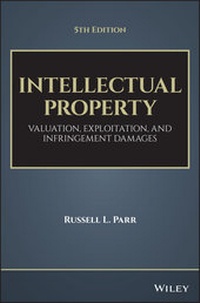
Intellectual Property
Description

Intellectual Property simplifies the process of attaching a dollar amount to intellectual property and intangible assets, be it for licensing, mergers and acquisitions, loan collateral, investment purposes, and determining infringement damages.
Written by Russell L. Parr, an expert in the valuation/intellectual property field, this book comprehensively addresses IP Valuation, the Exploitation Strategies of Licensing and Joint Ventures, and determination of Infringement Damages. The author explains commonly used strategies for determining the value of intellectual property, as well as methods used to set royalty rates based on investment rates of returns.
This book examines the business economics of strategies involving intellectual property licensing and joint ventures, provides analytical models that can be used to determine reasonable royalty rates for licensing and for determining fair equity splits in joint venture arrangements.
Key concepts in this book are brought to life by presenting real-world examples of exploitation strategies being used by major corporations.
* Provides practical tools for and examines the business economics for determining the value intellectual property in licensing and joint venture decisions
* Presents analytical models for determining reasonable royalty rates for licensing and for determining fair equity splits in joint venture arrangements
* Provides a detailed discussion about determining intellectual property infringement damages focusing on lost profits and reasonable royalties.
More details
Other editions
Additional editions
Person
RUSSELL L. PARR, CFA, ASA, is President of Intellectual Property Research Associates (www.ipresearch.com). He is an expert in determining the value of intellectual property. Mr. Parr's books about intellectual property value and management are published in Japanese, Korean, Italian, and English. He is dedicated to the development of comprehensive methods for accurately defining the value of intellectual property.
Content
About the Author xi
Preface xiii
Acknowledgments xvii
Part I Introduction 1
1 Intellectual Property Is the Foundation of Value 3
2 Intellectual Properties Defined 20
3 Intangible Assets Defined 40
4 Business Enterprise 54
Part II Valuation 65
5 Valuation Principles 67
6 Cost Approach 75
7 Market Approach 87
8 Income Approach, Identifying Economic Benefit 95
9 Risk-Adjusted Income 113
10 Valuation Errors 130
11 Early-Stage Technology Valuation 142
12 Special Valuation Situations 155
Part III Exploitation 175
13 Exploitation Strategies 177
14 More on Exploitation Strategies 187
15 Licensing, Negotiations, and Agreements 213
16 Royalty Rates for Licensing 237
17 Use of the 25% Rule in Valuing Intellectual Property 272
18 Determining a Royalty Rate-an Example 291
19 The Magnitude and Meaning of Royalty Misreporting 305
20 Patent Aggregators 313
21 University Licensing 326
22 Joint Ventures 338
23 Intellectual Property Audit and Management 352
24 Organizing for the Future 372
25 Transfer Pricing 384
Part IV Infringement Damages 401
26 Lost Profits 403
27 The Entire Market Value Rule 434
28 Royalty Rates and the Georgia-Pacific Factors 448
29 Evolving Patent Damages 471
30 Trademark, Copyright, and Trade Secret Damages 484
Appendix A Accounting 496
Appendix B Economic Benefit, Timing, and Pattern 507
Appendix C Royalty Rate Data 530
Appendix D Risk and Uncertainty 598
Index 619
ACKNOWLEDGMENTS
I continue to learn about the world of intellectual property from my clients, colleagues, and students and wish to recognize those who have come forth to contribute to this book.
Richard J. Gering, CLP of Asterion Consulting, provides consulting and expert witness services to clients with an emphasis on economic analysis and damages in complex commercial disputes and all forms of intellectual property-copyright, patents, trademark, trade secrets, and trade dress. Economic consulting in intellectual property matters includes commercial success, lost profits, reasonable royalty, price erosion, convoyed sales, and the Entire Market Value Rule. He has testified in arbitrations, depositions, and federal court. Richard has been published in the field of economic damages and valuation of intellectual property and has taught economic damages and strategy at the Villanova University School of Law. Mr. Gering's employment experience includes Big Four and regional accounting firms.
Mr. Gering has a Bachelor of Commerce in Economics and Business Administration (1980) and an Honors in Economics (1981) from the University of Natal Durban in South Africa and an MA in Economics (1986) from the University of Maryland, College Park, where he was a PhD candidate and completed all requirements except for his dissertation. He is a Certified Licensing Professional (CLP). His education has been supplemented by various continuing education courses offered by a variety of professional organizations. He has spoken before professional and educational groups on various aspects of intellectual property, economic damages, and valuation. His contribution to this book was accumulated over many years of comprehensive and challenging steak luncheon discussions about all aspects of intellectual property. Complex issues became so very clear after a few drinks with Richard. Thank you, Richard.
Debora R. Stewart, David J. Lambdin, and Megan E. Farrell, of InvotexIP, LLC have provided a wonderful chapter about auditing license agreement compliance with license and have found that royalty payment underreporting is widespread and it is often not malicious.
Debora R. Stewart, CPA, MBA, is a managing director and founder of InvotexIP, LLC (InvotexIP). InvotexIP assists intellectual property owners with a full range of financial IP advisory services, including royalty audits and license compliance and calculation and expert testimony on damages in IP infringement matters. Ms. Stewart leads InvotexIP's License Management and Royalty Audit and Compliance practice. She has more than 25 years' experience working with corporations, universities, and their counsel on intellectual property matters. She has worked with clients in a wide range of industries, from computer graphics, pharmaceuticals, and biotechnology to consumer goods. Ms. Stewart developed a proprietary Royalty Reporting Process to help clients take a proactive approach to managing royalty reporting and revenue. She has authored several articles and has given presentations and expert testimony on related topics.
David J. Lambdin, CPA, CFE, is a managing director of InvotexIP, LLC and provides a wide range of consulting services, including royalty audits, intellectual property compliance, forensic accounting, and other litigation services. He has more than 25 years of financial analysis, investigations, and accounting experience. Mr. Lambdin provides litigation and claims services on engagements involving all phases of the litigation process both in and out of bankruptcy. His assignments have included intellectual property, breach of contract, accounting malpractice, securities fraud, intellectual property, bankruptcy avoidance actions, claims disputes, and other bankruptcy-related matters. Mr. Lambdin has also managed the financial and accounting aspects of large complex bankruptcies, including working for the debtors and creditors in both reorganizations and liquidations.
Megan E. Farrell is a manager at Invotex, LLC who assists intellectual property owners with a full range of financial IP advisory services, including royalty audits and license compliance, asset management, and calculation of damages in IP infringement matters.
Robert Goldscheider, John Jaroz, and Carla Mulhern have grappled with the complex controversies of the 25% Rule. Their work on this topic has left the entire licensing industry in a much better position. Their study in support of the 25% Rule is a chapter in this book.
Robert Goldscheider was a pioneer in the field of intellectual property licensing and technology transfer. Writer, lecturer, and teacher, he was a renowned member of the Licensing Executives Society and winner of their Gold Medal for outstanding work in the field. Mr. Goldscheider was known as the father of the 25% Rule, a method for calculating royalties when measuring damages in infringement litigations that has been used for over 50 years by countless attorneys.
John C. Jaroz, a managing principal with Analysis Group and director of the firm's Washington, D.C., office, is an economist who specializes in applied microeconomics and industrial organization. He has provided strategy consultation across a wide range of industries and delivered expert testimony in hundreds of depositions, trials, and hearings. His focus is on matters involving intellectual property, licensing, commercial damages, and antitrust. A frequent author and lecturer on the economics of intellectual property protection, Mr. Jarosz is the editor of Eckstrom's Licensing in Foreign and Domestic Operations: The Forms and Substance of Licensing. His articles and papers have been published in the Stanford Technology Law Review, the Federal Circuit Bar Journal, Les Nouvelles: Journal of the Licensing Executives Society, the Journal of Business Valuation, and the Journal of the Patent and Trademark Office Society.
Carla S. Mulhern is managing principal with Analysis Group where she specializes in the application of economic principles to issues arising in complex business litigation. She has served as an expert witness on damages issues in commercial litigation matters, including intellectual property and breach of contract cases, providing testimony in various district and state courts. Ms. Mulhern's intellectual property damages experience includes cases involving allegations of patent, copyright, and trademark infringement, as well as misappropriation of trade secrets; she has also provided expert testimony on these issues in Section 337 cases at the International Trade Commission (ITC). Before the ITC, she has testified on a variety of economic issues, such as domestic industry, remedy, bonding, commercial success, and public interest.
William J. Murphy is Professor of Law, Chair, Commerce & Technology Graduate Programs, University of New Hampshire School of Law. He has taught graduate and undergraduate courses at Harvard in the Extension and the Radcliffe Seminars Programs and in the College of Management at the University of Massachusetts-Boston. He has been a Visiting Professor of Economics at Dartmouth College and a Fulbright Scholar at University College Cork, Ireland. Professor Murphy also co-founded and co-directed the eLaw Summer Institute that was run in cooperation with University College Cork in Cork, Ireland, from 2005 to 2012.
Professor Murphy was an antitrust trial attorney for the Federal Trade Commission's Bureau of Competition (where he earned the Chairman's Commendation for Meritorious Service "for outstanding trial advocacy in complex antitrust matters") before continuing his education at the Harvard Business School where he received his MBA with Distinction, as well as a doctorate in Business Administration. He also received an appointment as an Associates Fellow while at Harvard. During business school, he was a contributing founder of an educational software company and global pharmaceutical clinical trials company. Professor Murphy was one of the founding partners in a Concord law firm specializing in technology-based business law and intellectual property before joining the faculty at UNH Law and for many years served an Of Counsel role to one of the largest New Hampshire law firms.
Professor Murphy has provided a comprehensive discussion about risk and uncertainty as it relates to intellectual property valuation and exploitation in Appendix D.
Patrick Sullivan is an expert at creating profits from intellectual assets and is considered one of the leading conceptual thinkers in extracting value from intellectual capital. He is a founding partner of the ICM Group, a Palo Alto, California-based consulting company focused on managing intellectual capital to maximize value. He is also cofounder of the ICM Gathering, composed of managers of intellectual capital for large, diverse international companies who meet to exchange information on new and innovative management techniques. He is a frequent speaker on a range of topics concerning the management of intellectual capital, including stock value, licensing, and developing profits from IC. He is a member of the Licensing Executives Society (where he was the founding chairman of its Intellectual Capital Management Committee), the World Intellectual Property Trade Forum, and the American Bar Association Intellectual Property Licensing Section, and a fellow of the American Council on Education. He is a frequent contributor of articles on intellectual capital management for leading journals, the author of Profiting from Intellectual Capital, and the coauthor of Technology Licensing: Corporate Strategies for Maximizing Value, both...
