

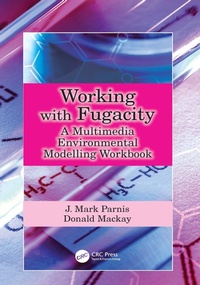
Working with Fugacity
A Multimedia Environmental Modelling Workbook
1st Edition
Published on 4. December 2025
184 pages
978-1-040-44032-2 (ISBN)
Description

Multimedia environmental models are powerful tools for predicting the fate and distribution of
chemicals in the environment. They are used for assessing the potential exposure of ecosystems and
humans to contaminants, as well as for developing and evaluating chemical management approaches.
This book has been developed with the aim of providing support to students and researchers who
are new to fugacity-based environmental modelling or wish to refresh their knowledge and skills.
The nature and approach of fugacity-based calculations is developed methodically and sequentially
from very first steps, with computational details explicitly shown and discussed. Whereas our text
"Multimedia Environmental Models: The Fugacity Approach" gives detailed justification for the
theoretical underpinnings of the fugacity approach, this workbook instead focusses on the step-bystep
exposition of computational details and approaches without excessive theoretical justification.
We believe that this approach will serve to help clarify the necessary computational steps and
approaches needed to design and implement fugacity-based computations in real-life environmental
contexts.
Key Features
Step-by step development of computations and models
Sequenced introduction of topics to help develop computational facility
Screen-shots of model and worksheet calculations with equations revealed for clarity
Explicitly detailed calculations and methodology
Many examples chosen from published works of realistic applications.
chemicals in the environment. They are used for assessing the potential exposure of ecosystems and
humans to contaminants, as well as for developing and evaluating chemical management approaches.
This book has been developed with the aim of providing support to students and researchers who
are new to fugacity-based environmental modelling or wish to refresh their knowledge and skills.
The nature and approach of fugacity-based calculations is developed methodically and sequentially
from very first steps, with computational details explicitly shown and discussed. Whereas our text
"Multimedia Environmental Models: The Fugacity Approach" gives detailed justification for the
theoretical underpinnings of the fugacity approach, this workbook instead focusses on the step-bystep
exposition of computational details and approaches without excessive theoretical justification.
We believe that this approach will serve to help clarify the necessary computational steps and
approaches needed to design and implement fugacity-based computations in real-life environmental
contexts.
Key Features
Step-by step development of computations and models
Sequenced introduction of topics to help develop computational facility
Screen-shots of model and worksheet calculations with equations revealed for clarity
Explicitly detailed calculations and methodology
Many examples chosen from published works of realistic applications.
More details
Edition
1. Auflage
Language
English
Place of publication
London
United Kingdom
Publishing group
Taylor & Francis Ltd
Target group
College/higher education
Professional and scholarly
Illustrations
1 Tables, black and white; 51 Line drawings, black and white; 51 Illustrations, black and white
File size
3,13 MB
ISBN-13
978-1-040-44032-2 (9781040440322)
Copyright in bibliographic data and cover images is held by Nielsen Book Services Limited or by the publishers or by their respective licensors: all rights reserved.
Schweitzer Classification
Other editions
Additional editions
Book
approx. 12/2025
1st Edition
CRC Press
€131.80
Not yet published
Book
approx. 12/2025
1st Edition
CRC Press
€72.90
Not yet published
Persons
J. Mark Parnis is an Emeritus Professor of Chemistry at Trent University in Peterborough, Ontario, Canada. A graduate of the University of Toronto, he is a physical chemist with early research work in metal atom and cluster reactions with organic molecules and a teaching emphasis on quantum mechanics, spectroscopy, and kinetics. In more recent years, he joined forces with Donald Mackay to focus on the development and implementation of techniques for estimating physico-chemical properties of molecular species with an emphasis on environmental modeling applications. He is a former director of the Canadian Environmental Modelling Centre at Trent University and continues to work on applications of fugacity-based models and property estimation techniques in environmental modelling. He maintains and updates the various models developed by Don Mackay's group, which are available from the CEMC Website.
Donald Mackay was an internationally renowned engineer and scientist, the acknowledged pioneer of fugacity-based modeling applications in environmental fate and exposure methodology. Don graduated from the University of Glasgow and was most recently an Emeritus Professor in the School of the Environment at Trent University. He was also Professor Emeritus in the Department of Chemical Engineering and Applied Chemistry of the University of Toronto where he taught for some 30 years and established himself as a pioneer of multimedia modeling in environmental science. Moving to Trent University in 1995, he contributed to the growth and maturation of the environmental science program and established the Canadian Environmental Modelling Centre, which he led until his official retirement in 2002. Since that time, Don continued to work in the field, producing over 750 articles, many books, and numerous reports during his career. The recipient of the Order of Canada and many other awards, Don was a leading figure in the field of environmental fate modeling.
Donald Mackay was an internationally renowned engineer and scientist, the acknowledged pioneer of fugacity-based modeling applications in environmental fate and exposure methodology. Don graduated from the University of Glasgow and was most recently an Emeritus Professor in the School of the Environment at Trent University. He was also Professor Emeritus in the Department of Chemical Engineering and Applied Chemistry of the University of Toronto where he taught for some 30 years and established himself as a pioneer of multimedia modeling in environmental science. Moving to Trent University in 1995, he contributed to the growth and maturation of the environmental science program and established the Canadian Environmental Modelling Centre, which he led until his official retirement in 2002. Since that time, Don continued to work in the field, producing over 750 articles, many books, and numerous reports during his career. The recipient of the Order of Canada and many other awards, Don was a leading figure in the field of environmental fate modeling.
Content
1. Equilibrium Partitioning in Closed Systems - All about Z Values.
2. Equilibrium Partitioning in Complex Media - Bulk Z Values.
3. Open Systems at Steady State - Introducing D-Values.
4. Non-Equilibrated Open Systems - D-Values for Diffusive Transport.
5. Basic Environmental Models - Putting It All Together.
6. Time-Variant Systems - Differential Equations.
2. Equilibrium Partitioning in Complex Media - Bulk Z Values.
3. Open Systems at Steady State - Introducing D-Values.
4. Non-Equilibrated Open Systems - D-Values for Diffusive Transport.
5. Basic Environmental Models - Putting It All Together.
6. Time-Variant Systems - Differential Equations.
