

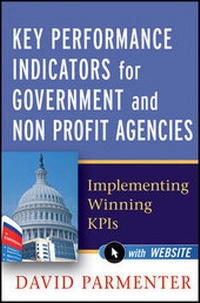
Key Performance Indicators for Government and Non Profit Agencies
Implementing Winning KPIs
Published on 23. March 2012
336 pages
978-1-118-22146-4 (ISBN)
Description

Winning techniques and strategies for nonprofits and governmentagencies in creating successful and critical key performanceindicators
By exploring measures that have transformed businesses, DavidParmenter has developed a methodology that is breathtaking in itssimplicity and yet profound in its impact. Key PerformanceIndicators for Government and Nonprofit Agencies: ImplementingWinning KPIs is a proactive guide representing a significantshift in the way KPIs are developed and used, with an abundance ofimplementation tools for government agencies and nonprofitgroups.
* Implementation variations and short cuts for government andnot-for-profit organizations
* How to brainstorm performance measures
* Templates for reporting performance measures
* A resource kit for a consultant who is acting as a coach /facilitator to the in-house project team
* Also by David Parmenter: Key Performance Indicators:Developing, Implementing, and Using Winning KPIs, SecondEdition
Filled with numerous case studies and checklists to help readersdevelop their KPIs, this book shows government agencies andnonprofits how to select and implement winning key performanceindicators to ensure that their performance management initiativesare successful.
More details
Other editions
Additional editions
David Parmenter
Key Performance Indicators for Government and Non Profit Agencies
Implementing Winning KPIS
Book
05/2012
Wiley
€47.00
Shipment within 10-20 days
Person
David Parmenter is an international presenter who is known for his entertaining and thought-provoking sessions, which have led to substantial change in many organizations. He is a leading expert in the development of winning KPIs, replacing the annual planning process with quarterly rolling planning and management practices that will get you to the top. David has delivered workshops to thousands of attendees in many cities around the world, including Sydney, Melbourne, Hong Kong, Kuala Lumpur, Singapore, Tehran, Jeddah, Muscat, Johannesburg, Prague, Rome, Dublin, London, Manchester, Edinburgh, and Toronto. He has worked for Ernst & Young, BP Oil Ltd, and Arthur Andersen, and is a Fellow of the Institute of Chartered Accountants in England and Wales. David is a regular writer for professional and business journals. He is also the author of Winning CFOs: Implementing and Applying Better Practices and The Leading-Edge Manager's Guide to Success (both from Wiley). David can be contacted via parmenter@waymark.co.nz or +64 4 499 0007. His website, davidparmenter.com, contains many white papers, articles, and freeware that will be useful to readers.
Content
- Cover
- Title Page
- Copyright
- Dedication
- Preface
- Companion to the KPI Book
- Embarking on a KPI/Balanced-Scorecard Project
- Letter to the Chief Executive Officer
- Who Should Read What
- What about Us (The Private Sector)?
- Electronic Media Available
- Acknowledgments
- Part I: Setting the Scene
- Chapter 1: Background
- Are Agencies Really Non Profit Agencies?
- Measurement in Government and Non Profit Agencies
- Unintended Behavior: The Dark Side of Measures
- Balanced Scorecards within Government and Non Profit Agencies
- Checklist: Where Are You in Your Journey with Performance Measures?
- Major Benefits of Performance Measures
- Chapter 2: Myths of Performance Measurement
- Myth 1: Measuring Performance Is Relatively Simple and the Appropriate Measures Are Very Obvious
- Myth 2: You Can Delegate a Performance Management Project to a Consulting Firm
- Myth 3: Your In-House Project Team Can Achieve Success while Continuing with Their Other Duties
- Myth 4: By Tying KPIs to Pay You Will Increase Performance
- Myth 5: Most Measures Lead to Better Performance
- Myth 6: Performance Measures Are Mainly Used to Help Manage Implementation of Strategic Initiatives
- Myth 7: The Balanced Scorecard Was First Off the Blocks
- Myth 8: Measures Fit Neatly into One Balanced-Scorecard Perspective
- Myth 9: The Balanced Scorecard Can Report Progress to Both Management and the Board
- Myth 10: There Are Only Four Balanced-Scorecard Perspectives
- Myth 11: Strategy Mapping Is a Vital Requirement
- Myth 12: All Performance Measures Are KPIs
- Myth 13: Monitoring Monthly Performance Measures Will Improve Performance
- Myth 14: KPIs Are Financial and Nonfinancial Indicators
- Myth 15: The More Measures the Better
- Myth 16: Indicators Are Either Lead (Performance Driver) or Lag (Outcome) Indicators
- Myth 17: We Know What Good Performance Will Look Like Before the Year Starts and, thus, Can Set Relevant Year-End Targets
- Chapter 3: Revitalizing Performance Management
- Foundation Stone 1: Understanding Human Behavior
- Foundation Stone 2: Knowledge of the Paradigm Shifters (Drucker, Collins, Welch, Hamel, Peters, Waterman, and Others)
- Foundation Stone 3: Using an Appropriate Strategy
- Foundation Stone 4: Critical Success Factors Known by All Staff
- Foundation Stone 5: Abandon Processes That Do Not Work
- Rejuvenating Human Resources
- Performance-Related Pay: Correcting the Errors
- Reviewing an Individual's Performance
- Getting the Right People on the Bus
- Jack Welch's 20/70/10 Differentiation Rule
- Secrets from High-Performing Teams
- Toyota's 14 Principles
- Role of Performance Measures: Implementing Winning KPIs
- Quarterly Rolling Planning: The Setting of Targets
- Reporting Performance
- Outside-In View
- Adopting Kaizen
- Working Smarter Not Harder
- Getting Technology to Deliver
- Moving from Management to Leadership
- Chapter 4: Measurement Leadership Has to Come from the Chief Executive Officer
- Barriers to Measurement Leadership
- The Way Forward for the Chief Executive Officer
- Appoint a Chief Measurement Officer
- Chapter 5: Strategy and Its Relevance to Performance Measures
- Define Your Organization's Mission, Vision, Values
- Create a Strategy That Is Understood by Staff
- Ensure That Your Strategy Is Balanced
- Monitor Implementation of Your Strategy
- Creating the Future
- Replace the Annual Planning Process with Rolling Planning
- Part II: Winning KPIs Methodology
- Chapter 6: The Great KPI Misunderstanding
- Key Result Indicators
- Performance and Result Indicators
- Key Performance Indicators
- Seven Characteristics of KPIs
- Difference between Key Results Indicators and KPIs
- Lead and Lag Confusion
- 10/80/10 Rule
- Importance of Timely Measurement
- Chapter 7: Finding Your Organization's Critical Success Factors
- The Missing Link
- Importance of Knowing Your Organization's Critical Success Factors
- Four Tasks For Identifying Organization-Wide Critical Success Factors
- Strategy Mapping
- Chapter 8: Foundation Stones for Implementing Key Performance Indicators
- "Partnership with the Staff, Unions, and Third Parties" Foundation Stone
- "Transfer of Power to the Front Line" Foundation Stone
- "Measure and Report Only What Matters" Foundation Stone
- "Source KPIs from the Critical Success Factors" Foundation Stone
- "Abandon Processes That Do Not Deliver" Foundation Stone
- "Understand Human Behavior" Foundation Stone
- "Organization-Wide Understanding of Winning KPIs Definition" Foundation Stone
- Chapter 9: Implementing the 12-Step Process
- How the 12-Step Model and the Seven Foundation Stones Fit Together
- Step One: Senior Management Team Commitment
- Step Two: Establish a Winning KPI Team Working Full Time on the Project
- Step Three: Establish a Just-Do-It Culture and Process
- Step Four: Set Up a Holistic KPI Development Strategy
- Step Five: Market the KPI System to All Employees
- Step Six: Identify Organization-Wide Critical Success Factors
- Step Seven: Record Performance Measures in a Database
- Step Eight: Select Team-Level Performance Measures
- Step Nine: Select Organizational Winning KPIs
- Step Ten: Develop the Reporting Framework at All Levels
- Step Eleven: Facilitate the Use of Winning KPIs
- Step Twelve: Refine KPIs to Maintain Their Relevance
- Chapter 10: Determining the Measures
- How to Derive Measures
- Brainstorming Measures
- Stacey Barr's PuMP
- Checking KPIs for Behavioral Alignment
- Chapter 11: Case Studies
- Golf Club (Non Profit Membership Organization)
- Surf Life Saving (Non Profit Membership Organization)
- Government Department
- Professional Accounting Body
- Chapter 12: Selling Change
- Selling by Emotional Drivers
- Selling the Move to Winning KPIs
- Chapter 13: Common Critical Success Factors and Their Likely Measures for Government and Non Profit Agencies
- Chapter 14: Reporting Performance Measures
- The Work of Stephen Few in Data Visualization
- Reporting the KPIs to Management and Staff
- Reporting Performance Measures to Management
- Reporting Performance Measures to Staff
- Reporting Performance Measures to the Board
- Reporting Team Performance Measures
- How the Reporting of Performance Measures Fits Together
- Epilogue: Resources
- Key Reference Books
- Key Reference Web Sites
- Appendix A: Foundation Stones of Performance-Related Pay Schemes
- Base the Performance-Related Pay Schemes on a Relative Measure
- At-Risk Portion of Salary Separate From the Scheme
- Linked to a Balanced Performance
- Test to Minimize Risk of Being a Gaming Risk
- Schemes Should Not Be Linked to KPIs
- Schemes Need to Be Communicated
- Schemes Should Be Tested on Past Results
- Additional Foundation Stones for Schemes in the Private Sector
- Appendix B: Effective Recruiting-Getting the Right People on the Bus
- Understand That Time Spent Recruiting Is the Most Valuable Time
- Look for Values and Fit Before Focusing on Expertise
- Cathay Pacific Recruitment
- Peter Drucker's Five-Step Process
- 14 Great Questions to Help Get Select "A" Players
- Use Simulation Exercises and Psychometric Testing
- Involve Your Team in the Final Selection Process
- Ask Your Top Employees for Referrals
- Reference Checks: The Do's and Don'ts
- Appendix C: The Public Sector Can Abandon the Flawed Budget Process
- The Flawed Budgeting Process
- Quarterly Rolling Forecasting and Planning
- Quarterly Rolling Funding in Government and Non Profit Agencies
- Forecasting the Truth
- More Meaningful Monthly Reporting
- Throw Out the Excel Forecasting Model
- Benchmarking Is Now Reborn
- Why Removing the Word Budget Is Important
- The First Steps to Take
- Appendix D: Jack Welch's Strategy Slides
- Appendix E: Suggested Success Factors for Government and Non Profit Agencies
- Appendix F: List of Performance Measures Suitable for Government and Non Profit Agencies
- Appendix G: Presenting the Critical Success Factors to the Board/Government Official
- Appendix H: Main Differences between the Balanced-Scorecard and Winning-KPIs Methodologies
- Main Differences in the Two Methodologies
- Index
