

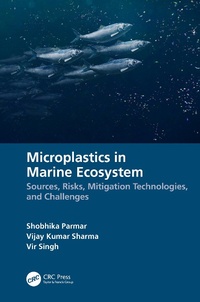
Microplastics in Marine Ecosystem
Sources, Risks, Mitigation Technologies, and Challenges
1st Edition
Published on 11. May 2023
228 pages
978-1-000-87803-5 (ISBN)
Description

This book addresses pertinent issues relating to microplastic pollution including its sources and sink of the microplastics and their environmental fate. It focuses on the impacts of microplastic pollution on marine life and human health. Available conventional methods and future solutions for the prevention and control of the marine microplastic pollution, such as bacterial and marine fungus biodegradation, membrane technology, and bioengineered microbes are included along with limitations and future challenges.
Features:
Provides detailed insight into the marine microplastics pollution, fate, health impacts, and removal technology
Reviews ecological risks and environmental fate of microplastic pollution to the marine ecosystem
Describes control and prevention methods of the microplastics pollution
Covers global legislature for the mitigation of microplastic to the marine environment
Discusses the role of community participation for the reduction of microplastic emissions
This book is aimed at researchers and professionals in environmental engineering, science, and chemistry, marine pollution, marine and aquatic science.
Features:
Provides detailed insight into the marine microplastics pollution, fate, health impacts, and removal technology
Reviews ecological risks and environmental fate of microplastic pollution to the marine ecosystem
Describes control and prevention methods of the microplastics pollution
Covers global legislature for the mitigation of microplastic to the marine environment
Discusses the role of community participation for the reduction of microplastic emissions
This book is aimed at researchers and professionals in environmental engineering, science, and chemistry, marine pollution, marine and aquatic science.
More details
Edition
1. Auflage
Language
English
Place of publication
London
United Kingdom
Publishing group
Taylor & Francis Ltd
Target group
College/higher education
Professional and scholarly
Product notice
Reflowable
Illustrations
22 Tables, black and white; 26 Line drawings, black and white; 14 Halftones, black and white; 40 Illustrations, black and white
ISBN-13
978-1-000-87803-5 (9781000878035)
Copyright in bibliographic data and cover images is held by Nielsen Book Services Limited or by the publishers or by their respective licensors: all rights reserved.
Schweitzer Classification
Other editions
Additional editions
Shobhika Parmar | Vijay Kumar Sharma | Vir Singh
Microplastics in Marine Ecosystem
Sources, Risks, Mitigation Technologies, and Challenges
Book
01/2025
1st Edition
CRC Press
€72.30
Shipment within 10-20 days
Shobhika Parmar | Vijay Kumar Sharma | Vir Singh
Microplastics in Marine Ecosystem
Sources, Risks, Mitigation Technologies, and Challenges
Book
05/2023
1st Edition
CRC Press
€170.80
Shipment within 10-20 days
Persons
Shobhika Parmar is Ph.D. in Environment Science from G. B. Pant University of Agriculture & Technology, Pantnagar, India. She recently served as a Postdoctoral Researcher in Kunming University of Science and Technology, Kunming, China. She also received the Yunnan Provincial Government Funding in China (2019). She has more than eleven years of research experience, focused on environmental issues and problems, remediation strategies. She has about 25 publications in journals of international repute and book chapters in edited books.
Vijay Kumar Sharma received his Ph.D. degree from Banaras Hindu University, Varanasi, India and completed two years of Post-Doctoral Research in Kunming University of Science and Technology, Kunming, China. Currently, he is serving as a visiting scientist at Agricultural Research Organization - Volcani Centre, Israel. He has more than fourteen years of research experience. His research interest is in the bio-potential applications of endophytes and their mechanism. He also has a keen interest in emerging environmental issues and mitigation, and works on few collaborative projects on the same area. Dr. Sharma has published more than 50 research articles and book chapters in journals of international, and edited four books. He is also active as a reviewer and guest editor of some reputed journals. He has also actively participated in many national and international conferences, symposia and workshops related to his research field in India, China and Cyprus.
Vir Singh is currently serving as an Emeritus Professor in the Department of Environmental Science, College of Basic Sciences and Humanities, GB Pant University of Agriculture and Technology, India. He has more than three decades experience in teaching, research, extension, project execution, and research supervision. He has been educated and trained in many universities and institutes in India and has also worked with many reputed organizations outside India, including International Centre for Integrated Mountain Development (ICIMOD) based in Kathmandu, Nepal, Galilee International Management Institute (GIMI) in Israel, and Friedrich-Schiller University in Germany. Prof. Vir Singh has published 55 books, many monographs, lab manuals, and more than 250 research papers, book chapters, and popular articles. His textbook on Environmental Plant Physiology (Taylor and Francis, CRC Press, 2020) brings to the fore a botanical strategy for a climate-smart planet. He is also a Climate Reality Leader committed to creating awareness about the ongoing climate change and its long-term implications on every walk of life. He is also actively engaged in environmental writing. His articles on vital contemporary issues are being widely published in English and Hindi dailies and e-magazines.
Vijay Kumar Sharma received his Ph.D. degree from Banaras Hindu University, Varanasi, India and completed two years of Post-Doctoral Research in Kunming University of Science and Technology, Kunming, China. Currently, he is serving as a visiting scientist at Agricultural Research Organization - Volcani Centre, Israel. He has more than fourteen years of research experience. His research interest is in the bio-potential applications of endophytes and their mechanism. He also has a keen interest in emerging environmental issues and mitigation, and works on few collaborative projects on the same area. Dr. Sharma has published more than 50 research articles and book chapters in journals of international, and edited four books. He is also active as a reviewer and guest editor of some reputed journals. He has also actively participated in many national and international conferences, symposia and workshops related to his research field in India, China and Cyprus.
Vir Singh is currently serving as an Emeritus Professor in the Department of Environmental Science, College of Basic Sciences and Humanities, GB Pant University of Agriculture and Technology, India. He has more than three decades experience in teaching, research, extension, project execution, and research supervision. He has been educated and trained in many universities and institutes in India and has also worked with many reputed organizations outside India, including International Centre for Integrated Mountain Development (ICIMOD) based in Kathmandu, Nepal, Galilee International Management Institute (GIMI) in Israel, and Friedrich-Schiller University in Germany. Prof. Vir Singh has published 55 books, many monographs, lab manuals, and more than 250 research papers, book chapters, and popular articles. His textbook on Environmental Plant Physiology (Taylor and Francis, CRC Press, 2020) brings to the fore a botanical strategy for a climate-smart planet. He is also a Climate Reality Leader committed to creating awareness about the ongoing climate change and its long-term implications on every walk of life. He is also actively engaged in environmental writing. His articles on vital contemporary issues are being widely published in English and Hindi dailies and e-magazines.
Content
Chapter 1. Sources and Sink of Microplastics. Chapter 2. Analytical Methods for the Identification and Assessment of Microplastics. Chapter 3. Ecological Risks and Environmental Fate of Microplastic Pollution. Chapter 4. Human Health impacts of Microplastics Pollution. Chapter 5. Biodegradation of Microplastics by Microbes. Chapter 6. Potential removal of the Microplastics in Marine Environment by Membrane Technology: Limitations and Future Solutions. Chapter 7. Recent Bioengineering advances in the Plastic Biodegradation and Future Challenges. Chapter 8. Biopolymers as an Alternative to the Conventional Plastics. Chapter 9. Global Legislature for the Mitigation of Microplastics in the Marine Environment. Chapter 10. Role of Community Participation for the Reduction of Microplastic Emissions. Chapter 11. Recent Cutting-edge Solutions to Prevent Microplastics Pollution.
