

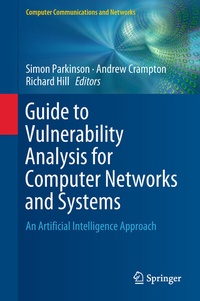
Guide to Vulnerability Analysis for Computer Networks and Systems
Description

This professional guide and reference examines the challenges of assessing security vulnerabilities in computing infrastructure. Various aspects of vulnerability assessment are covered in detail, including recent advancements in reducing the requirement for expert knowledge through novel applications of artificial intelligence. The work also offers a series of case studies on how to develop and perform vulnerability assessment techniques using start-of-the-art intelligent mechanisms.
Topics and features: provides tutorial activities and thought-provoking questions in each chapter, together with numerous case studies; introduces the fundamentals of vulnerability assessment, and reviews the state of the art of research in this area; discusses vulnerability assessment frameworks, including frameworks for industrial control and cloud systems; examines a range of applications that make use of artificial intelligence to enhance the vulnerability assessment processes; presents visualisation techniques that can be used to assist the vulnerability assessment process.In addition to serving the needs of security practitioners and researchers, this accessible volume is also ideal for students and instructors seeking a primer on artificial intelligence for vulnerability assessment, or a supplementary text for courses on computer security, networking, and artificial intelligence.
More details
Other editions
Additional editions
Persons
Dr. Simon Parkinson is a Senior Lecturer in Computer Science in the School of Computing and Engineering, University of Huddersfield, UK.
Prof. Andrew Crampton is a Professor of Computational Mathematics in the School of Computing and Engineering, and the Associate Dean for Teaching and Learning at the University of Huddersfield.
Prof. Richard Hill
is a Professor of Intelligent Systems, the Head of the Department of Informatics, and the Director of the Centre for Industrial Analytics at the University of Huddersfield. His other publications include the successful Springer titles
Guide to Security Assurance for Cloud Computing
,
Big-Data Analytics and Cloud Computing
,
Guide to Cloud Computing
, and
Cloud Computing for Enterprise Architectures
.
Content
Part I: Introduction and State of the Art .- Review of the State of the Art of Vulnerability Assessment Using Artificial Intelligence.- A Survey of Machine Learning Algorithms and Their Application in Information Security.- Part II: Vulnerability Assessment Frameworks .- Vulnerability Assessment of Cybersecurity for SCADA Systems.- A Predictive Model for Risk and Trust Assessment in Cloud Computing: Taxonomy and Analysis for Attack Pattern Detection.- AI and Metrics-Based Vulnerability-Centric Cyber Security Assessment and Countermeasure Selection.- Artificial Intelligence Agents as Mediators of Trustless Security Systems and Distributed Computing Applications.- Part III: Applications of Artificial Intelligence .- Automated Planning of Administrative Tasks Using Historic Events: a File System Case Study.- Defending Against Chained Cyber-Attacks by Adversarial Agents.- Vulnerability Detection and Analysis in Adversarial Deep Learning.- SOCIO-LENS: SpottingUnsolicited Callers Through Network Analysis.- Function Call Graphs Versus Machine Learning for Malware Detection.- Detecting Encrypted and Polymorphic Malware Using Hidden Markov Models.- Masquerade Detection on Mobile Devices.- Identifying File Interaction Patterns in Ransomware Behaviour.- Part IV: Visualisation .- A Framework for the Visualisation of Cyber Security Requirements and its Application in BPMN.- Big Data and Cyber Security: A Visual Analytics Perspective.
