

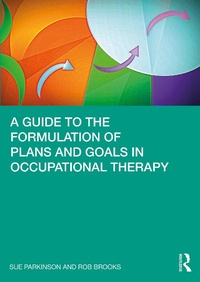
A Guide to the Formulation of Plans and Goals in Occupational Therapy
1st Edition
Published on 29. November 2020
242 pages
978-1-000-26231-5 (ISBN)
Description

This practical guide for occupational therapists introduces a tried and tested method for moving from assessment to intervention, by formulating plans and measurable goals using the influential Model of Human occupation (MOHO).
Section 1 introduces the concept of formulation - where it comes from, what it involves, why it is important, and how assessment information can be guided by theoretical frameworks and organised into a flowing narrative. Section 2 provides specific instructions for constructing occupational formulations using the Model of Human Occupation. In addition, a radically new way for creating aspirational goals is introduced - based on a simple acronym - which will enable occupational therapists to measure sustained changes rather than single actions. Section 3 presents 20 example occupational formulations and goals, from a wide range of mental health, physical health and learning disability settings, as well as a prison service, and services for homeless people and asylum seekers.
Designed for practising occupational therapists and occupational students, this is an essential introduction for all those who are looking for an effective way to formulate plans and goals based on the Model of Human Occupation.
Section 1 introduces the concept of formulation - where it comes from, what it involves, why it is important, and how assessment information can be guided by theoretical frameworks and organised into a flowing narrative. Section 2 provides specific instructions for constructing occupational formulations using the Model of Human Occupation. In addition, a radically new way for creating aspirational goals is introduced - based on a simple acronym - which will enable occupational therapists to measure sustained changes rather than single actions. Section 3 presents 20 example occupational formulations and goals, from a wide range of mental health, physical health and learning disability settings, as well as a prison service, and services for homeless people and asylum seekers.
Designed for practising occupational therapists and occupational students, this is an essential introduction for all those who are looking for an effective way to formulate plans and goals based on the Model of Human Occupation.
Reviews / Votes
"The book addresses the widely acknowledged challenge of bridging the theory to practice gap by demonstrating how to use occupation focused knowledge in practice: articulating why formulation is important and establishing it within a clear theoretical framework, before explaining in detail and demonstrating through examples how formulations are constructed. With clear language and short, readable chapters, the book is accessible and useful for busy therapists, and will appeal to students, novice, and experienced therapists alike...The unassuming title belies the power-packed content of this book. Reflecting the voices of authors and therapists, and with an emphasis on demonstrating occupational formulation through diverse examples as well as providing theoretical information and clear instructions, the book caters for different learning styles. Representing excellent value for money, it holds relevance for occupational therapists in any practice setting who are seeking a clear, practical guide for implementing occupational formulation to support collaborative, occupation-centered practice." Lorrae Mynard, Occupational Therapy In Health CareMore details
Edition
1. Auflage
Language
English
Place of publication
London
United Kingdom
Publishing group
Taylor & Francis Ltd
Target group
College/higher education
Professional and scholarly
Product notice
Reflowable
Illustrations
53 Tables, black and white; 17 Line drawings, black and white; 17 Illustrations, black and white
ISBN-13
978-1-000-26231-5 (9781000262315)
Copyright in bibliographic data and cover images is held by Nielsen Book Services Limited or by the publishers or by their respective licensors: all rights reserved.
Schweitzer Classification
Other editions
Additional editions
Sue Parkinson | Rob Brooks
A Guide to the Formulation of Plans and Goals in Occupational Therapy
Book
11/2020
1st Edition
Routledge
€54.20
Shipment within 15-20 days

Sue Parkinson | Rob Brooks
A Guide to the Formulation of Plans and Goals in Occupational Therapy
Book
11/2020
1st Edition
Routledge
€217.20
Shipment within 15-20 days
Persons
Sue Parkinson practised as an occupational therapist for many years. Sue is the lead author of the Model of Human Occupation Screening Tool (MOHOST) and author of an occupational intervention programme called Recovery through Activity. She works as a freelance trainer providing an online advisory and supervision service.
Rob Brooks is the Course Director for Occupational Therapy at Leeds Beckett University. His clinical practice, teaching, and research have focused on enabling occupational participation for children, young people, and their families.
Rob Brooks is the Course Director for Occupational Therapy at Leeds Beckett University. His clinical practice, teaching, and research have focused on enabling occupational participation for children, young people, and their families.
Content
Section 1:Understanding the Concept of a Formulation 1.Where does the idea of formualtion come from? 2.What is a formulation? 3.Why Create a Formulation? 4.How are formulations compiled? Part 2:Constructing Occupational Formulations and Goals 5.Structuring the Occupational Identity 6.Structuring the Occupational Competence section 7.Determining the key issues for Occupational Adaptaion. 8.Wrapping up the Formulation 9.Negotiating measurable occupational goals Part 3:Example Occupational Formulations and Goals I.Paediatric Service II.Children's Mental Health Service III.Adolescent Mental Health Service. IV.Perinatal Mental Health Service V.Acute Mental Health Service VI.Primary Care Service VII.Community Mental Health Service VIII.Mental Health Rehabilitation Service IX.Secure Mental Health Service X.Prison Service XI.Serivce for Homeless People XII.Traumatic Stress Service XIII.Independent Vocational Service XI.Acute Physical Service XV.Community Reablement Service XVI.Adult Social Care Service XVII.Intermediate Care Service XVIII.Care Home Liason Service XIX.Learning Disability Day Service XX.Community Learning Disability Service
