

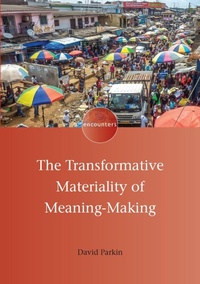
The Transformative Materiality of Meaning-Making
Published on 18. August 2021
400 pages
978-1-80041-149-4 (ISBN)
Description

This book explores verbal and non-verbal communication from a social anthropological viewpoint, drawing on ethnographic data from fieldwork in East Africa. It gives an overview of developments since the 1960s in the anthropology of language use and how these have influenced the author's thinking. The volume makes the argument that language and other forms of communication involve semiotic transactions between interlocuters; that such communicative exchanges do more than convey information; and that they give identity to the recipients of such transactions who reciprocate by defining speakers. The density and situational totality of such semiotic exchange can moreover be regarded as a kind of materiality, both in terms of their impact on social interaction and in how interlocuters interact bodily as well as verbally among themselves.
Reviews / Votes
This important book brings acute observation to central sociolinguistic themes like multilingualism, linguistic change, standardisation, power and creativity, and situates them with great subtlety and depth in the political, cultural and historical processes in which they play a part. More than that, it provides vivid insight into key developments in social scientific thought over the last five decades, and richly illustrates the power and scope for a social anthropology of language. * Ben Rampton, King's College London, UK * This is a superb collection of chapters that captures David Parkin's impressive scholarship over 60 years. Theoretically dense, the book offers a wide range of ethnographic data from Eastern Africa. Parkin's work highlights how much scholars have to learn from meaning-making practices in Africa. I highly recommend it. * Cecile B. Vigouroux, Simon Fraser University, Canada * This impressive and insightful collection invites readers to replace scholarly fixation on static modes of classifying languages and people with the approach captured by the poignant phrase that gives the book its title and innovative analytic: 'the transformative materiality of meaning-making'. * Charles L. Briggs, University of California, Berkeley, USA *More details
Series
Language
English
Place of publication
Bristol
United Kingdom
Target group
College/higher education
Product notice
Reflowable
ISBN-13
978-1-80041-149-4 (9781800411494)
Copyright in bibliographic data and cover images is held by Nielsen Book Services Limited or by the publishers or by their respective licensors: all rights reserved.
Schweitzer Classification
Other editions
Additional editions
David Parkin
The Transformative Materiality of Meaning-Making
Book
08/2021
Multilingual Matters
€83.40
Shipment within 10-20 days
Person
David Parkin is an Emeritus Fellow of All Souls College, University of Oxford, UK, where he was a Professor of Social Anthropology. His research focuses on the coordination of multimodal communication.
Content
Acknowledgements
Introduction
Part 1: Communication as Transaction and Becoming
1. From Multilingual Classification to Translingual Ontology: A Turning Point
2. Emergent and Stabilised Multilingualism: Polyethnic Peer Groups in Urban Kenya
3. Language Choice in Two Kampala Housing Estates
4. Language Switching in Nairobi
5. The Creativity of Abuse
6. Exchanging Words
Part 2: Political and Formulaic Communication
7. Political Language
8. Language, Government and the Play on Purity and Impurity: Arabic, Swahili and the Vernaculars in Kenya
9. Being and Selfhood among Intermediary Swahili
10. Controlling the U-turn of Knowledge
11. The Politics of Naming Among the Giriama
Part 3: The Materiality of Language and Communication
12. Unpacking Anthropology
13. Revisiting: Keywords, Transforming Phrases, and Cultural Concepts
14. Loud Ethics and Quiet Morality among Muslim Healers in Eastern Africa
15. Reason, Emotion, and the Embodiment of Power
16. The Power of Incompleteness: Innuendo in Swahili Women's Dress
17. Simultaneity and Sequencing in the Oracular Speech of Kenyan Diviners
References
Index
Introduction
Part 1: Communication as Transaction and Becoming
1. From Multilingual Classification to Translingual Ontology: A Turning Point
2. Emergent and Stabilised Multilingualism: Polyethnic Peer Groups in Urban Kenya
3. Language Choice in Two Kampala Housing Estates
4. Language Switching in Nairobi
5. The Creativity of Abuse
6. Exchanging Words
Part 2: Political and Formulaic Communication
7. Political Language
8. Language, Government and the Play on Purity and Impurity: Arabic, Swahili and the Vernaculars in Kenya
9. Being and Selfhood among Intermediary Swahili
10. Controlling the U-turn of Knowledge
11. The Politics of Naming Among the Giriama
Part 3: The Materiality of Language and Communication
12. Unpacking Anthropology
13. Revisiting: Keywords, Transforming Phrases, and Cultural Concepts
14. Loud Ethics and Quiet Morality among Muslim Healers in Eastern Africa
15. Reason, Emotion, and the Embodiment of Power
16. The Power of Incompleteness: Innuendo in Swahili Women's Dress
17. Simultaneity and Sequencing in the Oracular Speech of Kenyan Diviners
References
Index
