

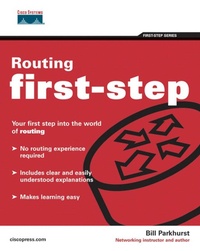
Routing First-Step
1st Edition
Published on 8. September 2004
432 pages
978-1-58705-424-2 (ISBN)
Description

Your first step into the world of routing
No routing experience required
Includes clear and easily understood explanations
Makes learning easy
Your first step to understanding routing begins here!
Learn routing basics simply and easily
Explore how network traffic gets from here to there
Understand routing tools and technologies
Reinforce your understanding with chapter review questions
Welcome to the world of routing!
Routing is the technology that enables worldwide Internet communication. Many people involved with networking technologies or companies need to know how routing works. But learning about routing tends to involve a complex web of terms and acronyms-a language that can be difficult and unfamiliar.
No routing experience needed!
Routing First-Step explains the basics of Internet routing in language all of us can understand. This book takes you on a guided tour of routing, starting with systems you are familiar with: the postal system, the telephone system, and the interstate highway system. From there, you'll learn routing simply and easily. Whether you are looking to take your first step into a career in networking or are interested only in gaining knowledge of the technology, this book is for you!
No routing experience required
Includes clear and easily understood explanations
Makes learning easy
Your first step to understanding routing begins here!
Learn routing basics simply and easily
Explore how network traffic gets from here to there
Understand routing tools and technologies
Reinforce your understanding with chapter review questions
Welcome to the world of routing!
Routing is the technology that enables worldwide Internet communication. Many people involved with networking technologies or companies need to know how routing works. But learning about routing tends to involve a complex web of terms and acronyms-a language that can be difficult and unfamiliar.
No routing experience needed!
Routing First-Step explains the basics of Internet routing in language all of us can understand. This book takes you on a guided tour of routing, starting with systems you are familiar with: the postal system, the telephone system, and the interstate highway system. From there, you'll learn routing simply and easily. Whether you are looking to take your first step into a career in networking or are interested only in gaining knowledge of the technology, this book is for you!
More details
Edition
1. Auflage
Language
English
Place of publication
Indianapolis
United States
Publishing group
Pearson Education (US)
Target group
Professional and scholarly
File size
3,45 MB
ISBN-13
978-1-58705-424-2 (9781587054242)
Copyright in bibliographic data and cover images is held by Nielsen Book Services Limited or by the publishers or by their respective licensors: all rights reserved.
Schweitzer Classification
Other editions
Additional editions
William R. Parkhurst
Routing First-Step
Book
09/2004
Cisco Press
€65.79
Article exhausted; check different version
Person
Bill Parkhurst is an advisory engineer at Cisco Systems and a technical advisor for Cisco certifications. Bill has taught networking to students on five continents at all levels, from beginner to advanced. Before joining Cisco, Bill taught networking at Wichita State University and now has the pleasure of working with many of his former students.
Content
1. Routing and Switching in Everyday Life.
Postal System.
Package Protocol.
Addressing Protocol.
Mail Delivery Protocol.
Highway System.
Telephone System.
Summary.
Chapter Review Questions.
2. A16 B16 C16, As Easy As 012, 102, 112.
Decimal Numbering System.
Binary Numbering System.
Octal Numbering System.
Hexadecimal Numbering System.
Dotted Decimal Notation.
Conversions Between Number Systems.
Binary to Octal.
Binary to Hexadecimal.
Binary to Decimal.
Binary to Dotted Decimal.
Octal to Binary.
Octal to Hexadecimal.
Octal to Decimal.
Octal to Dotted Decimal.
Hexadecimal to Binary.
Hexadecimal to Octal.
Hexadecimal to Decimal.
Hexadecimal to Dotted Decimal.
Decimal to Binary.
Decimal to Octal.
Decimal to Hexadecimal.
Fun Binary Number Facts.
Summary.
Chapter Review Questions.
3. Internet Addressing and Routing.
Internet Addressing.
Internet Addressing Protocol.
Classful IP Addresses.
Private IP Addresses.
Address Resolution.
Intra-LAN Communication.
Inter-LAN Communication.
IP Header Format.
TCP/IP Layered Protocol Model.
Classless Internet Addressing.
IP Routing and Route Summarization.
Supernets.
IP Version 4 and IP Version 6.
IPv6 Address Format.
IPv6 Address Types.
Summary.
Chapter Review Questions.
References.
4. Routing IP.
Delivering Snail Mail and E-Mail-Any Difference?
Basic IP Router Configuration.
Routing Information Protocol Version 1.
Counting to Infinity.
Convergence.
Variable-Length Subnet Masks.
Hop Count Limitation.
RIPv1 Algorithm.
RIP Version 2.
Security.
Route Summarization.
Summary.
Chapter Review Questions.
References.
5. Cisco Interior Gateway Protocols.
Introducing IGRP.
IGRP Metrics.
IGRP Limitations.
Introducing EIGRP.
EIGRP Neighbor Discovery.
Basic EIGRP Configuration.
EIGRP Metrics.
EIGRP Route Update Algorithm.
EIGRP Network Summarization.
Comparing IGRP and EIGRP.
Summary.
Chapter Review Questions.
References.
6. Open Shortest Path First-Better, Stronger, Faster.
OSPF Areas.
Link States.
OSPF Router ID.
Basic OSPF Configuration.
OSPF Neighbor Discovery.
OSPF Timers.
OSPF Metrics.
OSPF Router Types.
OSPF Route Types.
OSPF Area Types.
Stub Area.
Totally Stubby Area.
Not-So-Stubby Area (NSSA).
Totally Not-So-Stubby Area.
OSPF External Route Summarization.
OSPF Route Summarization.
OSPF Virtual Links.
Selecting the Shortest Path.
OSPF LSA Types.
Summary.
Chapter Review Questions.
References.
7. Intermediate System-to-Intermediate System-Better, Stronger, Faster, and Scarier.
Comparing IS-IS and IP Networks.
IS-IS Areas.
IS-IS Link States.
Basic Single Area IS-IS Configuration.
IS-IS Metrics.
IS-IS Multiple Area Configuration.
IS-IS Route Summarization.
Route Leaking.
Comparing IS-IS and OSPF.
Summary.
Chapter Review Questions.
References.
8. Border Gateway Protocol-The Glue That Holds the Internet Together.
Understanding the Need for BGP.
BGP Attributes.
Autonomous System Path Attribute-AS_PATH.
WEIGHT Attribute.
Local Preference Attribute-LOCAL_PREF.
Metric or MULTI_EXIT_DISC (MED) Attribute.
ORIGIN Attribute.
NEXT_HOP Attribute.
Community Attribute.
Basic BGP Configuration-EBGP.
Advertising IP Prefixes.
Using the network Command to Inject Routes.
Using Redistribution to Inject Routes.
Using BGP to Inject Routes.
Basic BGP Configuration-IBGP.
IBGP and Loopback Interfaces.
Scaling IBGP.
BGP Route Summarization.
BGP Decision Process.
Summary.
Chapter Review Questions.
References.
9. Multicast-What the Post Office Can't Do.
Comparing Unicast and Multicast Routing.
Multicast Switching.
IGMP.
CGMP.
IGMP Snooping.
Multicast Forwarding.
Protocol Independent Multicast Routing Protocol.
PIM Dense Mode.
PIM Sparse Mode.
Reserved Multicast Addresses.
Summary.
Chapter Review Questions.
References.
Answers to Chapter Review Questions.
Postal System.
Package Protocol.
Addressing Protocol.
Mail Delivery Protocol.
Highway System.
Telephone System.
Summary.
Chapter Review Questions.
2. A16 B16 C16, As Easy As 012, 102, 112.
Decimal Numbering System.
Binary Numbering System.
Octal Numbering System.
Hexadecimal Numbering System.
Dotted Decimal Notation.
Conversions Between Number Systems.
Binary to Octal.
Binary to Hexadecimal.
Binary to Decimal.
Binary to Dotted Decimal.
Octal to Binary.
Octal to Hexadecimal.
Octal to Decimal.
Octal to Dotted Decimal.
Hexadecimal to Binary.
Hexadecimal to Octal.
Hexadecimal to Decimal.
Hexadecimal to Dotted Decimal.
Decimal to Binary.
Decimal to Octal.
Decimal to Hexadecimal.
Fun Binary Number Facts.
Summary.
Chapter Review Questions.
3. Internet Addressing and Routing.
Internet Addressing.
Internet Addressing Protocol.
Classful IP Addresses.
Private IP Addresses.
Address Resolution.
Intra-LAN Communication.
Inter-LAN Communication.
IP Header Format.
TCP/IP Layered Protocol Model.
Classless Internet Addressing.
IP Routing and Route Summarization.
Supernets.
IP Version 4 and IP Version 6.
IPv6 Address Format.
IPv6 Address Types.
Summary.
Chapter Review Questions.
References.
4. Routing IP.
Delivering Snail Mail and E-Mail-Any Difference?
Basic IP Router Configuration.
Routing Information Protocol Version 1.
Counting to Infinity.
Convergence.
Variable-Length Subnet Masks.
Hop Count Limitation.
RIPv1 Algorithm.
RIP Version 2.
Security.
Route Summarization.
Summary.
Chapter Review Questions.
References.
5. Cisco Interior Gateway Protocols.
Introducing IGRP.
IGRP Metrics.
IGRP Limitations.
Introducing EIGRP.
EIGRP Neighbor Discovery.
Basic EIGRP Configuration.
EIGRP Metrics.
EIGRP Route Update Algorithm.
EIGRP Network Summarization.
Comparing IGRP and EIGRP.
Summary.
Chapter Review Questions.
References.
6. Open Shortest Path First-Better, Stronger, Faster.
OSPF Areas.
Link States.
OSPF Router ID.
Basic OSPF Configuration.
OSPF Neighbor Discovery.
OSPF Timers.
OSPF Metrics.
OSPF Router Types.
OSPF Route Types.
OSPF Area Types.
Stub Area.
Totally Stubby Area.
Not-So-Stubby Area (NSSA).
Totally Not-So-Stubby Area.
OSPF External Route Summarization.
OSPF Route Summarization.
OSPF Virtual Links.
Selecting the Shortest Path.
OSPF LSA Types.
Summary.
Chapter Review Questions.
References.
7. Intermediate System-to-Intermediate System-Better, Stronger, Faster, and Scarier.
Comparing IS-IS and IP Networks.
IS-IS Areas.
IS-IS Link States.
Basic Single Area IS-IS Configuration.
IS-IS Metrics.
IS-IS Multiple Area Configuration.
IS-IS Route Summarization.
Route Leaking.
Comparing IS-IS and OSPF.
Summary.
Chapter Review Questions.
References.
8. Border Gateway Protocol-The Glue That Holds the Internet Together.
Understanding the Need for BGP.
BGP Attributes.
Autonomous System Path Attribute-AS_PATH.
WEIGHT Attribute.
Local Preference Attribute-LOCAL_PREF.
Metric or MULTI_EXIT_DISC (MED) Attribute.
ORIGIN Attribute.
NEXT_HOP Attribute.
Community Attribute.
Basic BGP Configuration-EBGP.
Advertising IP Prefixes.
Using the network Command to Inject Routes.
Using Redistribution to Inject Routes.
Using BGP to Inject Routes.
Basic BGP Configuration-IBGP.
IBGP and Loopback Interfaces.
Scaling IBGP.
BGP Route Summarization.
BGP Decision Process.
Summary.
Chapter Review Questions.
References.
9. Multicast-What the Post Office Can't Do.
Comparing Unicast and Multicast Routing.
Multicast Switching.
IGMP.
CGMP.
IGMP Snooping.
Multicast Forwarding.
Protocol Independent Multicast Routing Protocol.
PIM Dense Mode.
PIM Sparse Mode.
Reserved Multicast Addresses.
Summary.
Chapter Review Questions.
References.
Answers to Chapter Review Questions.
