

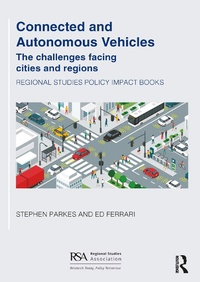
Connected and Autonomous Vehicles
The challenges facing cities and regions
1st Edition
Published on 24. February 2023
100 pages
978-1-000-84500-6 (ISBN)
Description

The past decade has seen substantial progress towards the development of Connected and Autonomous Vehicles (CAVs). Accompanying the technological developments, there has been much dialogue around the potential for CAVs to help solve a range of economic, social, and environmental issues. Some of CAVs purported benefits include, for example, greater efficiency in the use of existing transport infrastructure, improved safety through removing human error, and widening access to automobility. However, there are also many potential downsides, and whether and how CAVs will deliver on their promise remains shrouded in much uncertainty and not a small degree of scepticism.
This book views developments around CAVs through the lens of local policymakers and the towns and cities they represent. We argue it is now time to expand the dialogue to include consideration for towns and cities beyond those early adopters to understand how they will fare, and how CAVs might interact with other important policy agendas facing them.
We discuss the different challenges that CAVs will pose for the urban built environment and the required forms of preparedness for these. We also explore how CAVs will interact with other uses and users of cities, including potentially competing efforts to enhance urban wellbeing and liveability. Finally, we consider how responses to CAVs are being developed and what the implications of these are.
This book will appeal to policymakers, practitioners, and academics interested in the potential impacts of CAVs and in understanding more about how they will shape and interact with cities and regions in the near future.
This book views developments around CAVs through the lens of local policymakers and the towns and cities they represent. We argue it is now time to expand the dialogue to include consideration for towns and cities beyond those early adopters to understand how they will fare, and how CAVs might interact with other important policy agendas facing them.
We discuss the different challenges that CAVs will pose for the urban built environment and the required forms of preparedness for these. We also explore how CAVs will interact with other uses and users of cities, including potentially competing efforts to enhance urban wellbeing and liveability. Finally, we consider how responses to CAVs are being developed and what the implications of these are.
This book will appeal to policymakers, practitioners, and academics interested in the potential impacts of CAVs and in understanding more about how they will shape and interact with cities and regions in the near future.
More details
Series
Edition
1. Auflage
Language
English
Place of publication
London
United Kingdom
Publishing group
Taylor & Francis Ltd
Product notice
Reflowable
Illustrations
2 Tables, color; 4 Line drawings, color; 18 Halftones, color; 22 Illustrations, color
File size
11,11 MB
ISBN-13
978-1-000-84500-6 (9781000845006)
Copyright in bibliographic data and cover images is held by Nielsen Book Services Limited or by the publishers or by their respective licensors: all rights reserved.
Schweitzer Classification
Other editions
Additional editions
Stephen Parkes | Ed Ferrari
Connected and Autonomous Vehicles
The challenges facing cities and regions
Book
02/2023
1st Edition
Routledge
€45.00
Shipment within 10-20 days
Persons
Stephen Parkes is a Research Fellow in the Centre for Regional Economic and Social Research (CRESR) at Sheffield Hallam University, UK.
Ed Ferrari is Director of the Centre for Regional Economic and Social Research (CRESR) at Sheffield Hallam University, UK.
Ed Ferrari is Director of the Centre for Regional Economic and Social Research (CRESR) at Sheffield Hallam University, UK.
Content
1. Introduction 2. The transition to connected and autonomous vehicles 3. The challenges posed by CAVs for the built environment 4. Alignment with concurrent policy agendas promoting liveability 5. Responding to the arrival of increasingly connected and autonomous vehicles 6. Conclusions
