

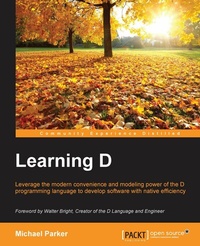
Learning D
Leverage the modern convenience and modelling power of the D programming language to develop software with native efficiency
Published on 13. January 2025
464 pages
978-1-78528-934-7 (ISBN)
Description

Leverage the modern convenience and modeling power of the D programming language to develop software with native efficiency.
Key Features
Acquire the skills to understand the fundamentals of D through its support for imperative and object-oriented programming
Take advantage of D's powerful compile-time features, templates and ranges to apply generative, generic, and functional style
A systematic guide that will help you become familiar with the concepts in D with the help of simple and easy-to-understand examples
Book DescriptionD is a modern programming language that is both powerful and efficient. It combines multiple paradigms in a way that opens up a whole new world of software design. It is used to develop both desktop and web applications, with future targets including mobile, and is available on multiple platforms. It is familiar to anyone with some experience in one or more of the C-family languages. However, hidden in the similarities are several differences that can be surprising when trying to apply common idioms from other languages. When learning D on your own, this can make it more time-consuming to master. In order to make the most of the language and become an idiomatic D programmer, it's necessary to learn how to think in D. This book familiarizes you with D from the ground up, with a heavy focus on helping you to avoid surprises so that you can take your D knowledge to the next level more quickly and painlessly. Your journey begins with a taste of the language and the basics of compiling D programs with DMD, the reference D compiler developed by Digital Mars, and DUB, a community-developed build utility and package manager. You then set out on an exploration of major language features. This begins with the fundamentals of D, including built-in types, conditionals, loops and all of the basic building-blocks of a D program, followed by an examination of D's object-oriented programming support. You'll learn how these features differ from languages you may already be familiar with. Next up are D's compile-time features, such as Compile-Time Function Evaluation and conditional compilation, then generic programming with templates. After that, you'll learn the more advanced features of ranges and functional pipeline programming. To enhance your D experience, you are next taken on a tour of the D ecosystem and learn how to make D interact with C. Finally, you get a look at D web development using the vibe.d project and the book closes with some handy advice on where to go next.What you will learn
Compile programs with DMD and manage projects with DUB
Work efficiently by binding your D programs with new and existing C libraries
Generate code at compile-time to enhance runtime performance
Implement complex templates for more powerful generic code
Write idiomatic D with range-based functional pipelines
Use the DUB repository to find a link with a variety of D libraries
Implement a web-app in D from the ground up
Who this book is forThis book is intended for those with some background in a C-family language who want to learn how to apply their knowledge and experience to D. Perhaps you're a college student looking to use D for hobby projects, or a career programmer interested in expanding your skillset. This book will help you get up to speed with the language and avoid common pitfalls that arise when translating C-family experience to D.
Key Features
Acquire the skills to understand the fundamentals of D through its support for imperative and object-oriented programming
Take advantage of D's powerful compile-time features, templates and ranges to apply generative, generic, and functional style
A systematic guide that will help you become familiar with the concepts in D with the help of simple and easy-to-understand examples
Book DescriptionD is a modern programming language that is both powerful and efficient. It combines multiple paradigms in a way that opens up a whole new world of software design. It is used to develop both desktop and web applications, with future targets including mobile, and is available on multiple platforms. It is familiar to anyone with some experience in one or more of the C-family languages. However, hidden in the similarities are several differences that can be surprising when trying to apply common idioms from other languages. When learning D on your own, this can make it more time-consuming to master. In order to make the most of the language and become an idiomatic D programmer, it's necessary to learn how to think in D. This book familiarizes you with D from the ground up, with a heavy focus on helping you to avoid surprises so that you can take your D knowledge to the next level more quickly and painlessly. Your journey begins with a taste of the language and the basics of compiling D programs with DMD, the reference D compiler developed by Digital Mars, and DUB, a community-developed build utility and package manager. You then set out on an exploration of major language features. This begins with the fundamentals of D, including built-in types, conditionals, loops and all of the basic building-blocks of a D program, followed by an examination of D's object-oriented programming support. You'll learn how these features differ from languages you may already be familiar with. Next up are D's compile-time features, such as Compile-Time Function Evaluation and conditional compilation, then generic programming with templates. After that, you'll learn the more advanced features of ranges and functional pipeline programming. To enhance your D experience, you are next taken on a tour of the D ecosystem and learn how to make D interact with C. Finally, you get a look at D web development using the vibe.d project and the book closes with some handy advice on where to go next.What you will learn
Compile programs with DMD and manage projects with DUB
Work efficiently by binding your D programs with new and existing C libraries
Generate code at compile-time to enhance runtime performance
Implement complex templates for more powerful generic code
Write idiomatic D with range-based functional pipelines
Use the DUB repository to find a link with a variety of D libraries
Implement a web-app in D from the ground up
Who this book is forThis book is intended for those with some background in a C-family language who want to learn how to apply their knowledge and experience to D. Perhaps you're a college student looking to use D for hobby projects, or a career programmer interested in expanding your skillset. This book will help you get up to speed with the language and avoid common pitfalls that arise when translating C-family experience to D.
All prices
More details
Edition
Digital original
Language
English
Place of publication
Birmingham
United Kingdom
Target group
Professional and scholarly
US School Grade: College Graduate Student
Edition type
Digital original
File size
6,54 MB
ISBN-13
978-1-78528-934-7 (9781785289347)
Copyright in bibliographic data and cover images is held by Nielsen Book Services Limited or by the publishers or by their respective licensors: all rights reserved.
Schweitzer Classification
Other editions
Additional editions
Michael Parker
Learning D
Leverage the modern convenience and modelling power of the D programming language to develop software with native efficiency
Book
11/2015
Packt Publishing
€64.40
Shipment within 3-4 weeks
Person
Parker Michael :
Michael Parker created the popular D library collection, Derelict, in 2004, and has been the primary maintainer ever since. He also blogs about the language at The One with D, and is a coauthor of the book Learn to Tango with D, Apress. He lives in Seoul, South Korea, with his wife, Mi Kyoung, and their dogs, Charlie, Happy, Joey, and Toby.
Michael Parker created the popular D library collection, Derelict, in 2004, and has been the primary maintainer ever since. He also blogs about the language at The One with D, and is a coauthor of the book Learn to Tango with D, Apress. He lives in Seoul, South Korea, with his wife, Mi Kyoung, and their dogs, Charlie, Happy, Joey, and Toby.
Content
Table of Contents
How to Get a D in Programming
Building a Foundation with D Fundamentals
Programming Objects the D Way
Running Code at Compile Time
Generic Programming Made Easy
Understanding Ranges
Composing Functional Pipelines with Algorithms and Ranges
Exploring the Wide World of D
Connecting D with C
Taking D Online
Taking D to the Next Level
How to Get a D in Programming
Building a Foundation with D Fundamentals
Programming Objects the D Way
Running Code at Compile Time
Generic Programming Made Easy
Understanding Ranges
Composing Functional Pipelines with Algorithms and Ranges
Exploring the Wide World of D
Connecting D with C
Taking D Online
Taking D to the Next Level

