

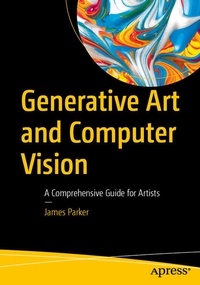
Generative Art and Computer Vision
Description

Understand how to combine computer vision and generative art. The book shows how computer vision methods can be applied to art.
The book will start with an introductory chapter on computer vision and generative art followed by chapters on specific means of producing genre artworks generatively. The following seven chapters deal with the seven traditional bases for art education (i.e., elements of art: line, value, color, shape, texture, form, and space); each will show specifically how machine vision and computer graphic methods can be applied to that element.
The book provides a comprehensive view of combining machine vision and art; some of the code provided has no analogy elsewhere. The book is intended to explain:
- What exactly is generative art?
- What does a generative artist do and know?
- How does one start creating generative artwork?
- What resources are out there to help artists who are not really programmers, or programmers who are not really artist?
You Will
- Find out about extracting line data from images as well as drawing lines
- Understand contrast and brightness enhancements
- Learn about subtractive color schemes and Munsell color in a practical way
Who Is This Book For
Generative artists who don't program well or at all will greatly appreciate this book. There will be plenty of material for those who do not code, including simple code and an appendix to help them get started.
More details
Other editions
Additional editions
Person
James R Parker has a BSc in Mathematics, an MSc in Computer Science, and a PhD in Informatics (with greatest distinction) from the State University of Gent. He was a professor of Computer Science for 27 years and has been a professor of Art for 14 years. He teaches a generative art course at the University of Calgary (as well as programming for artists, electronics for artists, game design).
He specializes in computer vision and has published multiple books on that subject. James has participated in many art exhibitions and sold works. He is a juried member of the Alberta Society of Artists for professional artists.
James has written and published 16 books on subjects like computer vision, video game creation, generative art, and others. He also writes fiction, was the original bass player for the band Detour, and is a pretty fair cook.
Content
Chapter 1: Introduction: Vision and Art.- Chapter 2: Line.- Chapter 3: Value.- Chapter 4: Color.- Chapter 5: Shape.- Chapter 6: Texture.- Chapter 7: Form.- Chapter 8: Space.- Chapter 9: Motion.- Appendix I - Math for graphics and vision.- Appendix II - Basic programming.
