

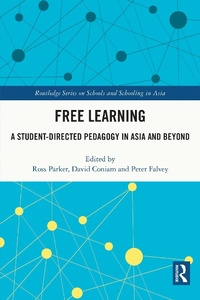
Free Learning
A Student-Directed Pedagogy in Asia and Beyond
1st Edition
Published on 29. November 2021
342 pages
978-1-000-48369-7 (ISBN)
Description

This edited volume explores, investigates and analyses Free Learning - an innovative approach to student-directed learning which seeks to challenge educational norms from within. The volume is framed by a recognition of the urgent need for transformation of our educational systems.
In traditional education, students work through a teacher-directed linear syllabus, at a pace dictated by the teacher, with summative assessment hurdles at too-frequent intervals. Progression and direction are determined solely by the teacher. In Free Learning, students determine their own learning pathway through a non-linear syllabus, which can be visualised as a mind map. Students may then complete as many units as they either have time for or are interested in, moving from one unit to another on the basis of having formatively satisfied the demands of each individual unit.
This volume showcases the value and potential of Free Learning in contemporary practice and is intended to bridge theory and practice. The structure of the book reflects this complementary fit, with contributions from practitioners describing Free Learning as a learning and teaching tool in a range of educational settings, subjects and age-ranges. It also contains qualitative and quantitative analyses by researchers exploring the uptake of Free Learning and students' responses to the methodology.
Researchers and educators who are interested in student-directed methodologies, especially in Asia, will find that the practical accounts and analyses of Free Learning contained within provide much food for thought with regard to redefining student learning.
In traditional education, students work through a teacher-directed linear syllabus, at a pace dictated by the teacher, with summative assessment hurdles at too-frequent intervals. Progression and direction are determined solely by the teacher. In Free Learning, students determine their own learning pathway through a non-linear syllabus, which can be visualised as a mind map. Students may then complete as many units as they either have time for or are interested in, moving from one unit to another on the basis of having formatively satisfied the demands of each individual unit.
This volume showcases the value and potential of Free Learning in contemporary practice and is intended to bridge theory and practice. The structure of the book reflects this complementary fit, with contributions from practitioners describing Free Learning as a learning and teaching tool in a range of educational settings, subjects and age-ranges. It also contains qualitative and quantitative analyses by researchers exploring the uptake of Free Learning and students' responses to the methodology.
Researchers and educators who are interested in student-directed methodologies, especially in Asia, will find that the practical accounts and analyses of Free Learning contained within provide much food for thought with regard to redefining student learning.
More details
Series
Edition
1. Auflage
Language
English
Place of publication
London
United Kingdom
Publishing group
Taylor & Francis Ltd
Target group
College/higher education
Professional and scholarly
Product notice
Reflowable
Illustrations
23 Tables, black and white; 2 Line drawings, black and white; 54 Halftones, black and white; 56 Illustrations, black and white
ISBN-13
978-1-000-48369-7 (9781000483697)
Copyright in bibliographic data and cover images is held by Nielsen Book Services Limited or by the publishers or by their respective licensors: all rights reserved.
Schweitzer Classification
Other editions
Additional editions
Ross Parker | David Coniam | Peter Falvey
Free Learning
A Student-Directed Pedagogy in Asia and Beyond
Book
05/2023
1st Edition
Routledge
€64.00
Shipment within 15-20 days
Ross Parker | David Coniam | Peter Falvey
Free Learning
A Student-Directed Pedagogy in Asia and Beyond
Book
11/2021
1st Edition
Routledge
€231.50
Shipment within 15-20 days
Persons
Ross Parker is Director of Technology & Assessment at International College Hong Kong. He is passionate about making learning a positive, anxiety-free process centred around personal transformation. Ross is the founder of Gibbon, the open-source school platform, through which he has also developed the Free Learning pedagogy. As a public speaker, Ross has presented at conferences and workshops around the world.
David Coniam is Head of Research at LanguageCert, Greece, and Adjunct Professor at the Education University of Hong Kong. He has been working and researching in English-language teaching, education and assessment for almost 50 years. His main publication and research interests are in language assessment, language teaching methodology and academic writing and publishing.
Peter Falvey is a teacher educator. A former Head of Department in the Faculty of Education, the University of Hong Kong, he is currently affiliated in an honorary professorial role with the Education University of Hong Kong. His main publication and research interests are in language assessment, first- and second-language writing methodology, and text linguistics.
David Coniam is Head of Research at LanguageCert, Greece, and Adjunct Professor at the Education University of Hong Kong. He has been working and researching in English-language teaching, education and assessment for almost 50 years. His main publication and research interests are in language assessment, language teaching methodology and academic writing and publishing.
Peter Falvey is a teacher educator. A former Head of Department in the Faculty of Education, the University of Hong Kong, he is currently affiliated in an honorary professorial role with the Education University of Hong Kong. His main publication and research interests are in language assessment, first- and second-language writing methodology, and text linguistics.
Content
Section 1: Introduction 1. Opening Up 2. Introduction and Background to Free Learning Section 2: Literature Background: Theoretical, Practical and Educational Perspectives 3. Grounding the Free Learning Model: Theoretical Perspectives 4. Grounding the Free Learning Model: Practical Perspectives 5. Curriculum Innovation and Free Learning at International College Hong Kong 6. Building Relationships, Living the Curriculum 7. Assessment in Free Learning Section 3: How Free Learning Works: Examples of Free Learning in Practice 8. Implementing Free Learning 9. A Free Learning Approach to STEM Delivery 10. The Adoption of Free Learning in a Pre-Service Teacher Education Programme: A Possible Crisis Response 11. Deconstructing the Curriculum: Introducing Free Learning to a Computer Science Course 12. Comparing and Evaluating Professional Development Workshops Conducted via Free Learning and Face-To-Face Modes: The Hong Kong NET Scheme Section 4: Evaluation of Free Learning 13. The Evaluation of Free Learning at International College Hong Kong 14. Free Learning: A Guinea Pig's Retrospective 15. A Quantitative Exploration of Student Attitudes to Free Learning and of Grades Achieved 16. A Qualitative Inquiry into Student Attitudes towards Free Learning 17. The Mastery Transcript Section 5: Conclusion: Where to from Here? 18. Conclusion and Looking Forward
