

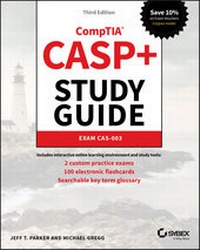
CASP+ CompTIA Advanced Security Practitioner Study Guide
Exam CAS-003
3rd Edition
Published on 23. January 2019
688 pages
978-1-119-47771-6 (ISBN)
Description

Comprehensive coverage of the new CASP+ exam, with hands-on practice and interactive study tools
The CASP+ CompTIA Advanced Security Practitioner Study Guide: Exam CAS-003, Third Edition, offers invaluable preparation for exam CAS-003. Covering 100 percent of the exam objectives, this book provides expert walk-through of essential security concepts and processes to help you tackle this challenging exam with full confidence. Practical examples and real-world insights illustrate critical topics and show what essential practices look like on the ground, while detailed explanations of technical and business concepts give you the background you need to apply identify and implement appropriate security solutions. End-of-chapter reviews help solidify your understanding of each objective, and cutting-edge exam prep software features electronic flashcards, hands-on lab exercises, and hundreds of practice questions to help you test your knowledge in advance of the exam.
The next few years will bring a 45-fold increase in digital data, and at least one third of that data will pass through the cloud. The level of risk to data everywhere is growing in parallel, and organizations are in need of qualified data security professionals; the CASP+ certification validates this in-demand skill set, and this book is your ideal resource for passing the exam.
* Master cryptography, controls, vulnerability analysis, and network security
* Identify risks and execute mitigation planning, strategies, and controls
* Analyze security trends and their impact on your organization
* Integrate business and technical components to achieve a secure enterprise architecture
CASP+ meets the ISO 17024 standard, and is approved by U.S. Department of Defense to fulfill Directive 8570.01-M requirements. It is also compliant with government regulations under the Federal Information Security Management Act (FISMA). As such, this career-building credential makes you in demand in the marketplace and shows that you are qualified to address enterprise-level security concerns. The CASP+ CompTIA Advanced Security Practitioner Study Guide: Exam CAS-003, Third Edition, is the preparation resource you need to take the next big step for your career and pass with flying colors.
The CASP+ CompTIA Advanced Security Practitioner Study Guide: Exam CAS-003, Third Edition, offers invaluable preparation for exam CAS-003. Covering 100 percent of the exam objectives, this book provides expert walk-through of essential security concepts and processes to help you tackle this challenging exam with full confidence. Practical examples and real-world insights illustrate critical topics and show what essential practices look like on the ground, while detailed explanations of technical and business concepts give you the background you need to apply identify and implement appropriate security solutions. End-of-chapter reviews help solidify your understanding of each objective, and cutting-edge exam prep software features electronic flashcards, hands-on lab exercises, and hundreds of practice questions to help you test your knowledge in advance of the exam.
The next few years will bring a 45-fold increase in digital data, and at least one third of that data will pass through the cloud. The level of risk to data everywhere is growing in parallel, and organizations are in need of qualified data security professionals; the CASP+ certification validates this in-demand skill set, and this book is your ideal resource for passing the exam.
* Master cryptography, controls, vulnerability analysis, and network security
* Identify risks and execute mitigation planning, strategies, and controls
* Analyze security trends and their impact on your organization
* Integrate business and technical components to achieve a secure enterprise architecture
CASP+ meets the ISO 17024 standard, and is approved by U.S. Department of Defense to fulfill Directive 8570.01-M requirements. It is also compliant with government regulations under the Federal Information Security Management Act (FISMA). As such, this career-building credential makes you in demand in the marketplace and shows that you are qualified to address enterprise-level security concerns. The CASP+ CompTIA Advanced Security Practitioner Study Guide: Exam CAS-003, Third Edition, is the preparation resource you need to take the next big step for your career and pass with flying colors.
More details
Other editions
New editions
Nadean H. Tanner | Jeff T. Parker
CASP+ CompTIA Advanced Security Practitioner Study Guide
Exam CAS-004
E-Book
09/2022
4th Edition
Wiley
€38.99
Available for download
Additional editions

Book
03/2019
3rd Edition
Sybex Inc.,U.S.
€58.81
Shipment within 15-20 days
Content
- Intro
- CompTIA® CASP+® Study Guide
- Acknowledgments
- About the Authors
- Contents at a Glance
- Contents
- Table of Exercises
- Introduction
- Assessment Test
- Answers to Assessment Test
- Chapter 1 Cryptographic Tools and Techniques
- The History of Cryptography
- Cryptographic Services
- Cryptographic Goals
- Cryptographic Terms
- Cipher Types and Methods
- Symmetric Encryption
- Data Encryption Standard
- Triple DES
- Rijndael
- Advanced Encryption Standard
- International Data Encryption Algorithm
- Rivest Cipher Algorithms
- Asymmetric Encryption
- Diffie-Hellman
- RSA
- Elliptic Curve Cryptography
- ElGamal
- Hybrid Encryption
- Hashing
- Hashing and Message Digests
- Digital Signatures
- Public Key Infrastructure
- Certificate Authority
- Registration Authority
- Certificate Revocation List
- Digital Certificates
- Certificate Distribution
- The Client's Role in PKI
- Implementation of Cryptographic Solutions
- Application Layer Encryption
- Transport Layer Encryption
- Internet Layer Controls
- Physical Layer Controls
- Cryptocurrency
- Blockchain
- Steganography
- Cryptographic Attacks
- Summary
- Exam Essentials
- Review Questions
- Chapter 2 Comprehensive Security Solutions
- Advanced Network Design
- Network Authentication Methods
- Placement of Fixed/Mobile Devices
- Placement of Hardware and Application
- 802.1x
- Mesh Networks
- Remote Access
- Virtual Networking and Placement of Security Components
- SCADA
- VoIP
- TCP/IP
- Network Interface Layer
- Internet Layer
- Transport Layer
- Application Layer
- Secure Communication Solutions
- Network Data Flow
- SSL Inspection
- Domain Name Service
- Securing Zone Transfers
- Start of Authority
- Secure DNS
- Transaction Signature
- Fast Flux DNS
- Lightweight Directory Access Protocol
- Secure Directory Services
- Active Directory
- Security Information and Event Management
- Database Activity Monitoring
- Federated ID
- Single Sign-On
- Kerberos
- Secure Facility Solutions
- Building Layouts
- Facilities Manager
- Secure Network Infrastructure Design
- Router Configuration
- Enterprise Service Bus
- Web Services Security
- Summary
- Exam Essentials
- Review Questions
- Chapter 3 Securing Virtualized, Distributed, and Shared Computing
- Enterprise Security
- Software-Defined Networking
- Cloud Computing
- Cloud Service Models
- Cloud Computing Providers and Hosting Options
- Benefits of Cloud Computing
- Security of On-Demand/Elastic Cloud Computing
- Data Sovereignty
- Cloud Computing Vulnerabilities
- Cloud Storage
- Cloud-Augmented Security Services
- Virtualization
- Virtual Desktop Infrastructure
- Virtualized Servers
- Virtual LANs
- Virtual Networking and Security Components
- Enterprise Storage
- Summary
- Exam Essentials
- Review Questions
- Chapter 4 Host Security
- Firewalls and Network Access Control
- Host-Based Firewalls
- Persistent Agent
- Non-Persistent Agent
- Agent-Based Technology
- Agentless-Based Technology
- Trusted Operating Systems
- Endpoint Security Solutions
- Common Threats to Endpoint Security
- Anti-Malware
- Antivirus
- Hunt Teaming
- Anti-Spyware
- Spam Filters
- Host Hardening
- Asset Management
- Data Exfiltration
- External I/O Restrictions on Hardware
- Intrusion Detection and Prevention
- Network Management, Monitoring, and Security Tools
- Security Devices
- Operational and Consumer Network-Enabled Devices
- Summary
- Exam Essentials
- Review Questions
- Chapter 5 Application Security and Penetration Testing
- Application Security Design Considerations
- Specific Application Issues
- Cross-Site Scripting (XSS)
- Cross-Site Request Forgery
- Improper Error Handling
- Geotagging
- Clickjacking
- Session Management
- Input Validation
- SQL Injection
- Application Sandboxing
- Application Security Frameworks
- Software Assurance
- Standard Libraries
- NX/XN Bit Use
- ASLR Use
- Code Quality
- Code Analyzers
- Development Approaches
- DevOps
- Waterfall Approach
- Incremental Approach
- Spiral Approach
- Continuous Integration
- Versioning
- Secure Coding Standards
- Documentation
- Requirements Definition
- Security Requirements Traceability Matrix (SRTM)
- System Design Document
- Test Plans
- Validation and Acceptance Testing
- Regression
- User Acceptance Testing
- Unit Testing
- Integration Testing
- Peer Review
- Application Exploits
- Privilege Escalation
- Improper Storage of Sensitive Data
- Secure Cookie Storage and Transmission
- Context-Aware Management
- Geolocation/Geofencing
- User Behavior
- Time-based Restrictions
- Security Restrictions
- Malware Sandboxing
- Pivoting
- Open-Source Intelligence
- Social Media
- WHOIS
- Routing Tables
- DNS Records
- Memory Dumping
- Client-Side Processing vs. Server-Side Processing
- JSON/REST
- Browser Extensions
- Ajax
- JavaScript/Applets
- Flash
- HTML5
- SOAP
- Web Services Security
- Buffer Overflow
- Memory Leaks
- Integer Overflow
- Race Conditions (TOC/TOU)
- Resource Exhaustion
- Data Remnants
- Use of Third-Party Libraries
- Code Reuse
- Security Assessments and Penetration Testing
- Test Methods
- Penetration Testing Steps
- Assessment Types
- Red, Blue, and White Teaming
- Red Team: The Bad Guys
- Blue Team: The Good Guys
- White Team: The Judge and Jury
- Vulnerability Assessment Areas
- Security Assessment and Penetration Test Tools
- Footprinting Tools
- Port Scanning Tools
- Fingerprinting Tools
- Vulnerability Scanners
- Protocol Analyzer Tools
- Passive Vulnerability Scanners
- SCAP Scanners
- Network Enumeration Tools
- Visualization Tools
- File Integrity Monitoring Tools
- Log Analysis Tools
- Password-Cracking Tools
- Fuzzing and False Injection Tools
- Wireless Tools
- HTTP Interceptors
- Local Exploitation Tools/Frameworks
- Antivirus
- Reverse Engineering Tools
- Physical Security Tools
- Summary
- Exam Essentials
- Review Questions
- Chapter 6 Risk Management
- Risk Terminology
- Identifying Vulnerabilities
- Operational Risks
- Risk in Business Models
- Risk in External and Internal Influences
- Adherence to Risk Management Frameworks
- Enterprise Resilience
- Risks with Data
- The Risk Assessment Process
- Asset Identification
- Information Classification
- Risk Assessment
- Risk Analysis Options
- Implementing Controls
- Continuous Monitoring
- Business Continuity Planning
- Enterprise Security Architecture Frameworks and Governance
- Best Practices for Risk Assessments
- Summary
- Exam Essentials
- Resources
- Review Questions
- Chapter 7 Policies, Procedures, and Incident Response
- A High-Level View of Documentation
- The Policy Development Process
- Policies and Procedures
- Business Documents Used to Support Security
- Documents and Controls Used for Sensitive Information
- Why Security?
- Personally Identifiable Information Controls
- Data Breaches
- Policies Used to Manage Employees
- Training and Awareness for Users
- Auditing Requirements and Frequency
- The Incident Response Framework
- Incident and Emergency Response
- Facilitate Incident Detection and Response
- Vulnerabilities Yet to Discover
- Incident Response Support Tools
- Severity of Incidents and Breaches
- Digital Forensics Tasks
- Summary
- Exam Essentials
- Review Questions
- Chapter 8 Security Research and Analysis
- Applying Research Methods to Determine Industry Trends and Impact on the Enterprise
- Performing Ongoing Research
- Best Practices
- New Technologies
- Situational Awareness
- Client-Side Attacks
- Knowledge of Current Vulnerabilities and Threats
- Research Security Implications of Emerging Business Tools
- Global IA Industry Community
- Research Security Requirements for Contracts
- Analyze Scenarios to Secure the Enterprise
- Benchmarking and Baselining
- Prototyping and Testing Multiple Solutions
- Cost-Benefit Analysis
- Analyze and Interpret Trend Data to Anticipate Cyber Defense Needs
- Reviewing the Effectiveness of Existing Security Controls
- Conducting Lessons Learned and After-Action Reviews
- Reverse Engineering or Deconstructing Existing Solutions
- Creation, Collection, and Analysis of Metrics
- Analyzing Security Solutions to Ensure They Meet Business Needs
- Using Judgment to Solve Difficult Problems
- Summary
- Exam Essentials
- Review Questions
- Chapter 9 Enterprise Security Integration
- Integrate Enterprise Disciplines to Achieve Secure Solutions
- Governance, Risk, and Compliance
- Interpreting Security Requirements and Goals to Communicate with Stakeholders from Other Disciplines
- Providing Objective Guidance and Impartial Recommendations to Staff and Senior Management on Security Processes and Controls
- Establish Effective Collaboration within Teams to Implement Secure Solutions
- Disciplines
- Integrate Hosts, Storage, Networks, and Applications into a Secure Enterprise Architecture
- Adapt Data Flow Security to Meet Changing Business Needs
- Logical Deployment Diagram and Corresponding Physical Deployment Diagram of All Relevant Devices
- Secure Infrastructure Design
- Standards
- Design Considerations during Mergers, Acquisitions, and Demergers/Divestitures
- Technical Deployment Models (Outsourcing, Insourcing, Managed Services, Partnership)
- Implementing Cryptographic Techniques
- Security and Privacy Considerations of Storage Integration
- In-House Developed vs. Commercial vs. Commercial Customized
- Interoperability Issues
- Security Implications of Integrating Enterprise Applications
- Integrate Mobility Management
- Containerization
- Mobile Management Techniques
- Signature and Application Concerns
- Whose Device Is It Anyway?
- Summary
- Exam Essentials
- Review Questions
- Chapter 10 Security Controls for Communication and Collaboration
- Selecting the Appropriate Control to Secure Communications and Collaboration Solutions
- Security of Unified Collaboration
- VoIP
- VoIP Implementation
- Trust Models and Remote Access
- Mobile Device Management
- Tethering
- Secure External Communications
- Secure Implementation of Collaboration Sites and Platforms
- Prioritizing Traffic with QoS
- Mobile Devices
- Integrate Advanced Authentication and Authorization Technologies to Support Enterprise Objectives
- Authentication
- Federation and SAML
- Identity Proofing
- Identity Propagation
- Authorization
- SOAP
- Single Sign-On
- Attestation
- Certificate-Based Authentication
- Implement Security Activities across the Technology Life Cycle
- Systems Development Life Cycle
- Adapt Solutions to Address Emerging Threats and Security Trends
- Validating System Designs
- Integrate Security Controls for Mobile and Small Form Factor Devices
- Physical Security Tools for Security Assessment
- Summary
- Exam Essentials
- Review Questions
- Appendix A Answers to Review Questions
- Chapter 1: Cryptographic Tools and Techniques
- Chapter 2: Comprehensive Security Solutions
- Chapter 3: Securing Virtualized, Distributed and Shared Computing
- Chapter 4: Host Security
- Chapter 5: Application Security and Penetration Testing
- Chapter 6: Risk Management
- Chapter 7: Policies, Procedures, and Incident Response
- Chapter 8: Security Research and Analysis
- Chapter 9: Enterprise Security Integration
- Chapter 10: Security Controls for Communication and Collaboration
- Appendix B CASP+ Lab Manual
- What You'll Need
- Lab A1: Verifying a Baseline Security Configuration
- Lab A2: Introduction to a Protocol Analyzer
- Lab A3: Performing a Wireless Site Survey
- Lab A4: Using Windows Remote Access
- Connecting to the Remote Desktop PC
- Lab A5: Configuring a VPN Client
- Lab A6: Using the Windows Command-Line Interface (CLI)
- Lab A7: Cisco IOS Command-Line Basics
- Lab A8: Shopping for Wi-Fi Antennas
- Lab A9: Cloud Provisioning
- Lab A10: Introduction to Windows Command-Line Forensic Tools
- Lab A11: Introduction to Hashing Using a GUI
- Lab A12: Hashing from the Command Line
- Verifying File Integrity from a Command Line
- Verifying File Integrity on a Downloaded File
- Lab A13: Cracking Encrypted Passwords
- Lab A14: Threat Modeling
- Lab A15: Social Engineering
- Lab A16: Downloading, Verifying, and Installing a Virtual Environment
- Lab A17: Exploring Your Virtual Network
- Lab A18: Port Scanning
- Lab A19: Introduction to the Metasploit Framework
- Lab A20: Sniffing NETinVM Traffic with Wireshark
- Suggestions for Further Exploration of Security Topics
- Index
- Advert
- EULA
