

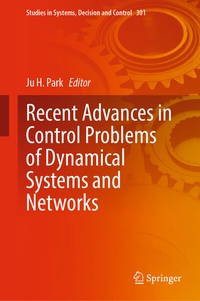
Recent Advances in Control Problems of Dynamical Systems and Networks
1st Edition
Published on 11. August 2020
XXXIX, 527 pages
978-3-030-49123-9 (ISBN)
Description

This edited book introduces readers to new analytical techniques and controller design schemes used to solve the emerging "hottest" problems in dynamic control systems and networks.
In recent years, the study of dynamic systems and networks has faced major changes and challenges with the rapid advancement of IT technology, accompanied by the 4th Industrial Revolution. Many new factors that now have to be considered, and which haven't been addressed from control engineering perspectives to date, are naturally emerging as the systems become more complex and networked. The general scope of this book includes the modeling of the system itself and uncertainty elements, examining stability under various criteria, and controller design techniques to achieve speci?c control objectives in various dynamic systems and networks.
In terms of traditional stability matters, this includes the following special issues: ?nite-timestability and stabilization, consensus/synchronization, fault-tolerant control, event-triggered control, and sampled-data control for classical linear/nonlinear systems, interconnected systems, fractional-order systems, switched systems, neural networks, and complex networks. In terms of introducing graduate students and professional researchers studying control engineering and applied mathematics to the latest research trends in the areas mentioned above, this book offers an excellent guide.
In recent years, the study of dynamic systems and networks has faced major changes and challenges with the rapid advancement of IT technology, accompanied by the 4th Industrial Revolution. Many new factors that now have to be considered, and which haven't been addressed from control engineering perspectives to date, are naturally emerging as the systems become more complex and networked. The general scope of this book includes the modeling of the system itself and uncertainty elements, examining stability under various criteria, and controller design techniques to achieve speci?c control objectives in various dynamic systems and networks.
In terms of traditional stability matters, this includes the following special issues: ?nite-timestability and stabilization, consensus/synchronization, fault-tolerant control, event-triggered control, and sampled-data control for classical linear/nonlinear systems, interconnected systems, fractional-order systems, switched systems, neural networks, and complex networks. In terms of introducing graduate students and professional researchers studying control engineering and applied mathematics to the latest research trends in the areas mentioned above, this book offers an excellent guide.
More details
Other editions
Additional editions
Book
08/2020
Springer
€192.59
Shipment within 7-9 days
Person
Ju H. Park (Jessie Park) received the Ph.D. degree in Electronics and Electrical Engineering from Pohang University of Science and Technology(POSTECH), Pohang, Republic of Korea, in 1997. From May 1997 to February 2000, he was a Research Associate Fellow in Engineering Research Center-Automation Research Center, POSTECH. He joined Yeungnam University, Kyongsan, Republic of Korea, in March 2000, where he is currently the Chuma Chair Professor.
From 2006 to 2007, he was a visiting professor in the Department of Mechanical Engineering, Georgia Institute of Technology. His research interests include robust control and ?ltering, neural networks, complex networks, fuzzy systems, multi-agent systems, chaotic systems, embedded systems, signal processing, intelligent vehicles, and applied mathematics. He has published a number of papers more than 600 in top leading journals and two books titled "Recent Advances in Control and Filtering of Dynamic Systemswith Constrained Signals" and "Dynamic Systems with Time Delays: Stability and Control" in these areas. Prof. Park serves as an Editor of the INTERNATIONAL JOURNAL OF CONTROL, AUTOMATION AND SYSTEMS, Springer-Nature.
He is also a Subject Editor/Advisory Editor/Associate Editor/Editorial Board member for several international journals, including IET CONTROL THEORY AND APPLICATIONS, APPLIED MATHEMATICS AND COMPUTATION, JOURNAL OF THE FRANKLIN INSTITUTE, NONLINEAR DYNAMICS, COGENT ENGINEERING, ENGINEERING REPORTS, IEEE TRANSACTIONS ON FUZZY SYSTEMS, IEEE TRANSACTIONS ON NEURAL NETWORKS AND LEARNING SYSTEMS, IEEE TRANSACTIONS ON CYBERNETICS, and so on. Since 2015, he is a recipient of Highly Cited Researcher Award by Clarivate Analytics (formerly, Thomson Reuters) and listed in 3 ?elds, engineering, computer sciences, and mathematics in 2019. He is a FELLOW of the Korean Academy of Science and Technology (KAST).
From 2006 to 2007, he was a visiting professor in the Department of Mechanical Engineering, Georgia Institute of Technology. His research interests include robust control and ?ltering, neural networks, complex networks, fuzzy systems, multi-agent systems, chaotic systems, embedded systems, signal processing, intelligent vehicles, and applied mathematics. He has published a number of papers more than 600 in top leading journals and two books titled "Recent Advances in Control and Filtering of Dynamic Systemswith Constrained Signals" and "Dynamic Systems with Time Delays: Stability and Control" in these areas. Prof. Park serves as an Editor of the INTERNATIONAL JOURNAL OF CONTROL, AUTOMATION AND SYSTEMS, Springer-Nature.
He is also a Subject Editor/Advisory Editor/Associate Editor/Editorial Board member for several international journals, including IET CONTROL THEORY AND APPLICATIONS, APPLIED MATHEMATICS AND COMPUTATION, JOURNAL OF THE FRANKLIN INSTITUTE, NONLINEAR DYNAMICS, COGENT ENGINEERING, ENGINEERING REPORTS, IEEE TRANSACTIONS ON FUZZY SYSTEMS, IEEE TRANSACTIONS ON NEURAL NETWORKS AND LEARNING SYSTEMS, IEEE TRANSACTIONS ON CYBERNETICS, and so on. Since 2015, he is a recipient of Highly Cited Researcher Award by Clarivate Analytics (formerly, Thomson Reuters) and listed in 3 ?elds, engineering, computer sciences, and mathematics in 2019. He is a FELLOW of the Korean Academy of Science and Technology (KAST).
Content
Linear and Nonlinear Dynamic Systems.- Switched Systems and Hybrid Control.- Fractional-Order Systems.- Dynamical Networks.- Index.
