

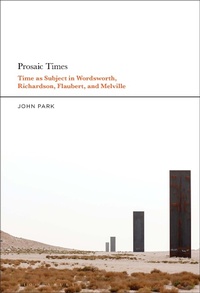
Prosaic Times
Time as Subject in Wordsworth, Richardson, Flaubert, and Melville
1st Edition
Published on 5. September 2024
208 pages
979-8-7651-0873-4 (ISBN)
Description

Analyzing the stylistic innovations most characteristic in pivotal works of literary realism, Prosaic Times shows how their styles are not merely ornamental but fundamental to building their own temporalities.
By capturing the temporal dimensions in Wordsworth's The Prelude, Richardson's Clarissa, Flaubert's "Un Coeur Simple," and Melville's Moby Dick, John Park argues that these literary works of realism - the artistic claim to represent life as it is - do not necessarily depend upon the plotline of the story they tell. The reduced significance placed on plot is counterbalanced by something else: an experience of duration, a sheer extension of time in reading, a sense of time stemming from the unique stylistic innovations in each work.
Contrasting with the view that realism represents social conditions, this book claims that while realist works represent society, they themselves are not bound to social conditions. Instead, literary realism accounts for ways of configuring history that render social conditions understandable. The active quality of language, of what narrative discourse says and does in forming our understanding of real things and events, is brought directly to the reader's attention in these works.
Through close readings that analyze, among other things, the natural objects and scenes of experience; dense, temporal overlapping of accounts; the depiction of the quotidian ways of a village; and the boundless occasion for "timeless" metaphysical reflections, Park shows how narration not only "takes" time, but ultimately makes time part of the experience it represents to the reader.
By capturing the temporal dimensions in Wordsworth's The Prelude, Richardson's Clarissa, Flaubert's "Un Coeur Simple," and Melville's Moby Dick, John Park argues that these literary works of realism - the artistic claim to represent life as it is - do not necessarily depend upon the plotline of the story they tell. The reduced significance placed on plot is counterbalanced by something else: an experience of duration, a sheer extension of time in reading, a sense of time stemming from the unique stylistic innovations in each work.
Contrasting with the view that realism represents social conditions, this book claims that while realist works represent society, they themselves are not bound to social conditions. Instead, literary realism accounts for ways of configuring history that render social conditions understandable. The active quality of language, of what narrative discourse says and does in forming our understanding of real things and events, is brought directly to the reader's attention in these works.
Through close readings that analyze, among other things, the natural objects and scenes of experience; dense, temporal overlapping of accounts; the depiction of the quotidian ways of a village; and the boundless occasion for "timeless" metaphysical reflections, Park shows how narration not only "takes" time, but ultimately makes time part of the experience it represents to the reader.
More details
Edition
1. Auflage
Language
English
Place of publication
New York
United States
Publishing group
Bloomsbury Publishing Plc
Target group
Professional and scholarly
ISBN-13
979-8-7651-0873-4 (9798765108734)
Copyright in bibliographic data and cover images is held by Nielsen Book Services Limited or by the publishers or by their respective licensors: all rights reserved.
Schweitzer Classification
Other editions
Additional editions
Book
approx. 03/2026
Bloomsbury Academic USA
€44.70
Not yet published
Book
09/2024
Bloomsbury Academic USA
€112.85
Shipment within 15-20 days
Person
John Park is Assistant Professor of English at the New College of Florida, USA. He was previously a lecturer at the University of Washington, USA, and has also taught at Mercer County Community College, Baruch College CUNY, New York University, and Princeton University.
Content
Acknowledgments
1. The Prose of Romanticism and Realism
2. The Production of Spatialized Time
3. Wordsworth's Still Time
4. Marking "Now" in Richardson's Clarissa: or The History of a Young Lady
5. Time Estranged: Flaubert's "Un Coeur Simple"
6. Stylization of the Pronoun "It" and the Labor of Representation in Herman Melville's Moby Dick; Or, The Whale
Notes
Bibliography
Index
1. The Prose of Romanticism and Realism
2. The Production of Spatialized Time
3. Wordsworth's Still Time
4. Marking "Now" in Richardson's Clarissa: or The History of a Young Lady
5. Time Estranged: Flaubert's "Un Coeur Simple"
6. Stylization of the Pronoun "It" and the Labor of Representation in Herman Melville's Moby Dick; Or, The Whale
Notes
Bibliography
Index
