

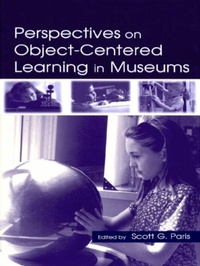
Perspectives on Object-Centered Learning in Museums
Published on 1. April 2002
408 pages
978-1-135-64528-1 (ISBN)
Description

Originating in a recent NSF conference held at the University of Michigan, this book examines the latest ideas about how children interact with objects and through that interaction acquire new understandings, attitudes, and feelings. Although museum education provides the primary setting within which object-centered learning is explored, the analyses apply to a wide range of learning environments. Despite the demonstrated importance of object-centered learning for both academic and life-long learning, until now there has been little psychological research on the topic. Key features of this outstanding new book include:
*Cross-disciplinary Focus--This is the first book to examine object-centered learning using the perspectives of such diverse fields as science, history, literacy, and art.
*Museum Focus--The explosion of interest in museums of all kinds provides a natural launching pad for conceptual and practical discussions of object-based learning and informal learning environments.
Vignettes--In order to ground the conceptual analyses, each chapter includes vignettes describing people actively engaged with objects in a specific setting.
This volume is appropriate for advanced students and researchers in educational psychology, cognitive psychology, science education, and persons directly involved in museum education.
*Cross-disciplinary Focus--This is the first book to examine object-centered learning using the perspectives of such diverse fields as science, history, literacy, and art.
*Museum Focus--The explosion of interest in museums of all kinds provides a natural launching pad for conceptual and practical discussions of object-based learning and informal learning environments.
Vignettes--In order to ground the conceptual analyses, each chapter includes vignettes describing people actively engaged with objects in a specific setting.
This volume is appropriate for advanced students and researchers in educational psychology, cognitive psychology, science education, and persons directly involved in museum education.
Reviews / Votes
"This first comprehensive volume on current museum learning research is an indispensable introduction to an emerging research domain. Upper-division undergraduates and above."-CHOICE
"This book is an examination of the museum experience, more particularly the interactions between children, objects and museums. It is a welcome addition to the literature."
-British Journal of Educational Psychology
"The wide variety of articles and museum types represented here make this a useful volume for just about everybody interested in informal learning in museums. As Falk says in his forward, 'I personally came away from reading this book with many new ideas and thoughts about not just objects and children in museums but about how to even begin to think about the museum experience".
-Visitor Studies Today!
"In many ways this book reminded me, quite appropriately, of an exhibit collection: It is nonlinear, multiple-voiced, somewhat loosely connected, provocative in places, and interesting to browse or return to later. Its strength lies not in any single unifying theoretical framework but in the multiplicity of its perspectives and the memorability of its narratives."
-American Journal of Psychology
"...provides a range of perspectives related to the concept of object-centered learning in museums....The perspectives cover a variety of theoretical structures within which museum researchers and practitioners can frame their thinking....This book clearly has many strengths..."
-Museum National
"The diversity of ideas and perspectives included is likely to increase readers' estimation of the potential of object-based learning in museums and also their understanding of the challenges inherent in assessing and enhancing the impact of the museum experience."
-Contemporary Psychology APA REVIEW OF BOOKS
"This topic has explosive potential. Teachers, especially at the elementary and middle school grades, are avid about hands-on learning."
-Phil Winne
Simon Fraser University
"As someone who has spent a lifetime investigating people in museums, I personally came away from reading this book with many new ideas and thoughts about not just objects and children in museums, but about how to think about the museum experience."
-John Falk
Director, Institute for Learning Innovation, Annapolis, MD
More details
Language
English
Place of publication
London
United Kingdom
Publishing group
Taylor & Francis Ltd
Target group
Professional and scholarly
File size
10,79 MB
ISBN-13
978-1-135-64528-1 (9781135645281)
Copyright in bibliographic data and cover images is held by Nielsen Book Services Limited or by the publishers or by their respective licensors: all rights reserved.
Schweitzer Classification
Other editions
Additional editions
Scott G. Paris
Perspectives on Object-Centered Learning in Museums
Book
04/2002
Routledge
€232.90
Shipment within 10-20 days
Person
Paris, Scott G.
Content
Contents: Foreword. Preface. Part I: Studying Learning With Objects in Contexts.L. Dierking, The Role of Context in Children's Learning From Objects and Experiences. S. Rowe, The Role of Objects in Active, Distributed Meaning-Making. S.G. Paris, S.E. Hapgood, Children Learning With Objects in Informal Learning Environments. E.M. Evans, M.S. Mull, D.A. Poling, The Authentic Object? A Child's-Eye View. C.O. Frost, When the Object Is Digital: Properties of Digital Surrogate Objects and Implications for Learning. D.C. Michener, I.J. Schultz, Through the Garden Gate: Objects and Informal Education for Environmental and Cultural Awareness in Arboreta and Botanic Gardens. J.V. Wertsch, Epistemological Issues About Objects. Part II: Discipline-Based Explorations of Objects.B. Piscitelli, K. Weier, Learning With, Through, and About Art: The Role of Social Interactions. R. Bain, K.M. Ellenbogen, Placing Objects Within Disciplinary Perspectives: Examples From History and Science. S.E. Hapgood, A.S. Palincsar, Fostering an Investigatory Stance: Using Text to Mediate Inquiry With Museum Objects. L.J. Rennie, T.P. McClafferty, Objects and Learning: Understanding Young Children's Interaction With Science Exhibits. C.E. van Kraayenoord, S.G. Paris, Reading Objects. L. Schauble, Cloaking Objects in Epistemological Practices. Part III: Conversations About Objects.M. Borun, Object-Based Learning and Family Groups. M.A. Callanan, J.L. Jipson, M.S. Soennichsen, Maps, Globes, and Videos: Parent-Child Conversations About Representational Objects. K.A. Morrissey, Pathways Among Objects and Museum Visitors. G. Leinhardt, K. Crowley, Objects of Learning, Objects of Talk: Changing Minds in Museums. D.B. Beane, M.S. Pope, Leveling the Playing Field Through Object-Based Service Learning. S. Duensing, The Object of Experience.
