

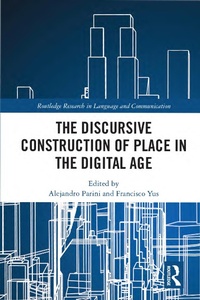
The Discursive Construction of Place in the Digital Age
1st Edition
Published on 30. June 2023
244 pages
978-1-000-89824-8 (ISBN)
Description

This collection calls for greater attention to the need for a clearer understanding of the role of discourse in the process of placemaking in the digital age and the increasing hybridisation of physical and virtual worlds.
The volume outlines a new conceptualisation of place in the time of smartphones, whose technological and social affordances evoke placemaking as a collaborative endeavour which allows users to create and maintain a sense of community around place as shareable or collective experience. Taken together, the chapters argue for a greater emphasis on the ways in which users employ discourse to manage this physical-virtual interface in digital interactions and in turn, produce "remixed" cultural practices that draw on diverse digital semiotic resources and reflect their everyday experiences of place and location. The book explores a wide range of topics and contexts which embody these dynamics, including livestreaming platforms, mourning in the digital age, e-service encounters, and Internet forums. While the overlay of physical and virtual information on location-based media is not a new phenomenon, this volume argues that, in the face of its increasing pervasiveness, we can better understand its unfolding and future directions for research by accounting for the significance of place in today's interactions.
This book will be of interest to students and scholars in discourse analysis, digital communication, pragmatics, and media studies.
The volume outlines a new conceptualisation of place in the time of smartphones, whose technological and social affordances evoke placemaking as a collaborative endeavour which allows users to create and maintain a sense of community around place as shareable or collective experience. Taken together, the chapters argue for a greater emphasis on the ways in which users employ discourse to manage this physical-virtual interface in digital interactions and in turn, produce "remixed" cultural practices that draw on diverse digital semiotic resources and reflect their everyday experiences of place and location. The book explores a wide range of topics and contexts which embody these dynamics, including livestreaming platforms, mourning in the digital age, e-service encounters, and Internet forums. While the overlay of physical and virtual information on location-based media is not a new phenomenon, this volume argues that, in the face of its increasing pervasiveness, we can better understand its unfolding and future directions for research by accounting for the significance of place in today's interactions.
This book will be of interest to students and scholars in discourse analysis, digital communication, pragmatics, and media studies.
More details
Series
Edition
1. Auflage
Language
English
Place of publication
London
United Kingdom
Publishing group
Taylor & Francis Ltd
Target group
College/higher education
Illustrations
9 Tables, black and white; 6 Line drawings, black and white; 41 Halftones, black and white; 47 Illustrations, black and white
ISBN-13
978-1-000-89824-8 (9781000898248)
Copyright in bibliographic data and cover images is held by Nielsen Book Services Limited or by the publishers or by their respective licensors: all rights reserved.
Schweitzer Classification
Other editions
Additional editions
Alejandro Parini | Francisco Yus
The Discursive Construction of Place in the Digital Age
Book
11/2024
1st Edition
Routledge
€63.30
Shipment within 10-20 days
Alejandro Parini | Francisco Yus
The Discursive Construction of Place in the Digital Age
Book
06/2023
1st Edition
Routledge
€196.30
Shipment within 10-20 days
Persons
Alejandro Parini is Dean of the Faculty of Languages and International Studies and Full Professor of English linguistics at the University of Belgrano, Argentina. His areas or interest and research include the study of digital discourse and language ideologies and new media.
Francisco Yus is Full Professor at the University of Alicante (Spain). He has published extensively on internet communication, about which he has proposed the theory of cyberpragmatics. He has also studied the pragmatics of humorous communication.
Francisco Yus is Full Professor at the University of Alicante (Spain). He has published extensively on internet communication, about which he has proposed the theory of cyberpragmatics. He has also studied the pragmatics of humorous communication.
Content
Contents
PART I: MACRO APPROACHES
1. The discursive construction of place through the online-offline interface. From physical locations to wikispaces (Alejandro Parini and Francisco Yus).
2. The best thing on twitch today was a bike messenger: Experiencing metropolis, mobility and place through live-streaming (Aparajita Bhandari and Lee Humphreys).
3. Digital first-order place, velocity and chronotope in globalized communication (Isolda E. Carranza).
4. Space, place and TikTok: propaganda, documentation and accountability (David Nichols).
PART II: MICRO APPROACHES
5. The lived experience of place in a Twitter affinity space around the death of sports celebrity Maradona (Patricia Bou-Franch).
6. The off/online nexus and public spaces: Morality, civility, and aggression in the attribution and ratification of the Karen social identity (Pilar Garces-Conejos Blitvich and Lucia Fernandez-Amaya).
7. The physical-digital interface: What does "ici" ("here") mean in a written online discussion? (Michel Marcoccia).
8. Spatial deixis within political discourse on Twitter (Ana Pano Alaman).
9. The role of location information sharing in e-service encounters on Mercado Libre (Maria Elena Placencia and Hebe Powell).
Index
PART I: MACRO APPROACHES
1. The discursive construction of place through the online-offline interface. From physical locations to wikispaces (Alejandro Parini and Francisco Yus).
2. The best thing on twitch today was a bike messenger: Experiencing metropolis, mobility and place through live-streaming (Aparajita Bhandari and Lee Humphreys).
3. Digital first-order place, velocity and chronotope in globalized communication (Isolda E. Carranza).
4. Space, place and TikTok: propaganda, documentation and accountability (David Nichols).
PART II: MICRO APPROACHES
5. The lived experience of place in a Twitter affinity space around the death of sports celebrity Maradona (Patricia Bou-Franch).
6. The off/online nexus and public spaces: Morality, civility, and aggression in the attribution and ratification of the Karen social identity (Pilar Garces-Conejos Blitvich and Lucia Fernandez-Amaya).
7. The physical-digital interface: What does "ici" ("here") mean in a written online discussion? (Michel Marcoccia).
8. Spatial deixis within political discourse on Twitter (Ana Pano Alaman).
9. The role of location information sharing in e-service encounters on Mercado Libre (Maria Elena Placencia and Hebe Powell).
Index
