

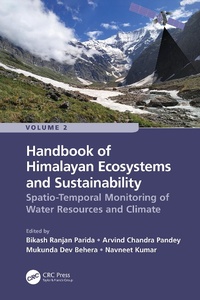
Handbook of Himalayan Ecosystems and Sustainability, Volume 2
Spatio-Temporal Monitoring of Water Resources and Climate
1st Edition
Published on 22. November 2022
400 pages
978-1-000-78434-3 (ISBN)
Description

Volume 2: Handbook of Spatio-Temporal Monitoring of Water Resources and Climate is aimed to describe the current state of knowledge and developments of geospatial technologies (Remote Sensing and Geographic Information Systems) for assessing and managing water resources under climate change. It is a collective achievement of renowned researchers and academicians working in the Hindu Kush Himalayan (HKH) mountain range. The HKH region is a part of the Third Pole outside the polar regions due to its largest permanent snow cover. Importantly, the Himalayan belt is geologically fragile and vulnerable to geohazards (e.g. landslides, land subsidence, rockfalls, debris flow, avalanches, and earthquakes). Therefore, critical assessment and geospatial solutions are indispensable to safeguard the natural resources and human beings in the Himalayas using space-borne satellite datasets. This book also showcases various remote sensing techniques and algorithms in the field of urban sprawling, urban microclimate and air pollution. The potential impacts of climate change on the cryosphere and water resources are also highlighted. This comprehensive Handbook is highly interdisciplinary and explains the role of geospatial technologies in studying the water resources of the Himalayas considering climate change.
Key Features
This book is unique as it focuses on the utility of satellite data for monitoring snow cover variability, snowmelt runoff, glacier lakes, avalanche susceptibility and flood modeling.
Explain how Remote Sensing techniques are useful for mapping and managing the morphology and ecology of the Himalayan River.
Addresses how geospatial technologies are valuable for understanding climate change impact on hydrological extremes, the potential impact of land use/land cover change (LULC) on hydrology and water resources management.
It highlights the impact of LULC changes on land surface temperature, groundwater, and air pollution in urban areas.
Includes contributions from global professionals working in the HKH region.
Readership
The Handbook serves as a valuable reference for students, researchers, scientists, Hydrologists, hydro-ecologists, meteorologists, geologists, decision makers and all others who wish to advance their knowledge on monitoring and managing water resources and urban ecosystem using remote sensing in the HKH region considering climate change.
Key Features
This book is unique as it focuses on the utility of satellite data for monitoring snow cover variability, snowmelt runoff, glacier lakes, avalanche susceptibility and flood modeling.
Explain how Remote Sensing techniques are useful for mapping and managing the morphology and ecology of the Himalayan River.
Addresses how geospatial technologies are valuable for understanding climate change impact on hydrological extremes, the potential impact of land use/land cover change (LULC) on hydrology and water resources management.
It highlights the impact of LULC changes on land surface temperature, groundwater, and air pollution in urban areas.
Includes contributions from global professionals working in the HKH region.
Readership
The Handbook serves as a valuable reference for students, researchers, scientists, Hydrologists, hydro-ecologists, meteorologists, geologists, decision makers and all others who wish to advance their knowledge on monitoring and managing water resources and urban ecosystem using remote sensing in the HKH region considering climate change.
More details
Edition
1. Auflage
Language
English
Place of publication
London
United Kingdom
Publishing group
Taylor & Francis Ltd
Target group
College/higher education
Professional and scholarly
Product notice
Reflowable
Illustrations
73 Tables, black and white; 124 Line drawings, color; 12 Line drawings, black and white; 32 Halftones, color; 156 Illustrations, color; 12 Illustrations, black and white
ISBN-13
978-1-000-78434-3 (9781000784343)
Copyright in bibliographic data and cover images is held by Nielsen Book Services Limited or by the publishers or by their respective licensors: all rights reserved.
Schweitzer Classification
Other editions
Additional editions
Bikash Ranjan Parida | Arvind Chandra Pandey | Mukunda Dev Behera
Handbook of Himalayan Ecosystems and Sustainability, Volume 2
Spatio-Temporal Monitoring of Water Resources and Climate
Book
03/2025
1st Edition
CRC Press
€110.30
Shipment within 10-20 days
Bikash Ranjan Parida | Arvind Chandra Pandey | Mukunda Dev Behera
Handbook of Himalayan Ecosystems and Sustainability, Volume 2
Spatio-Temporal Monitoring of Water Resources and Climate
Book
11/2022
1st Edition
CRC Press
€245.53
Shipment within 10-20 days
Persons
Bikash Ranjan Parida is an assistant professor at Central University of Jharkhand (CUJ), India since September 2016. He received his M.Sc. in Geoinformatics (2006) from the University of Twente and his PhD from the University of Hamburg/ Max Planck Institute for Meteorology (2011). Prior to joining CUJ, he was employed by various premium institutes involved in Earth and Environmental studies He has contributed to several national research projects such as Science and Engineering Research Board (SERB) under the Department of Science and Technology (DST), Start-Up Research Grant by UGC, NISAR project by SAC, Ahmedabad, ISRO. He has more than 40 research publications in peer-reviewed journals.
A.C. Pandey is a professor in the Department of Geoinformatics at Central University of Jharkhand (CUJ), India. He is the former Head of the Department of Geoinformatics (2013-2020) and the former Dean of the School of Natural Resource Management (2013-2016) at CUJ. He has been the CUJ Coordinator for ISRO and EDUSAT program since 2013. From 2004-2013 he was an associate professor of Remote Sensing in Birla Institute of Technology. He received his Ph.D. degree in Geology from Department of Geology at the University of Delhi in 2001. He has published more than 70 articles and two edited books. He is the recipient of NASA-SERVIR Fellowship in 2013 to work on Himalayan glaciers in Zanskar Valley, J&K.
Mukunda Dev Behera has made outstanding contributions to the fields of forest remote sensing and ecological climatology. His research innovations have fundamentally transformed the study of phytogeography, with attention to ecological functioning of three ecosystem components, plant diversity-water-energy. Dr. Behera has been a Guest Editor for six special issues and has served in three editorial boards of Springer's journals: Biodiversity and Conservation, Environmental Monitoring and Assessment, and Tropical Ecology. With over 20-year research and teaching experience, he has published over 100 articles.
Navneet Kumar is a senior researcher at the Center for Development Research (ZEF), University of Bonn in Germany. He received his PhD in Engineering from the University of Bonn. His main research fields are water and natural resources management and Geoinformatics. Dr. Kumar has contributed to several projects in Algeria, Ethiopia, India, Mali, Niger and Uzbekistan. These projects include research on the impact assessment of climate change and land use change. He has presented his work in several international conferences and has published with several journals.
A.C. Pandey is a professor in the Department of Geoinformatics at Central University of Jharkhand (CUJ), India. He is the former Head of the Department of Geoinformatics (2013-2020) and the former Dean of the School of Natural Resource Management (2013-2016) at CUJ. He has been the CUJ Coordinator for ISRO and EDUSAT program since 2013. From 2004-2013 he was an associate professor of Remote Sensing in Birla Institute of Technology. He received his Ph.D. degree in Geology from Department of Geology at the University of Delhi in 2001. He has published more than 70 articles and two edited books. He is the recipient of NASA-SERVIR Fellowship in 2013 to work on Himalayan glaciers in Zanskar Valley, J&K.
Mukunda Dev Behera has made outstanding contributions to the fields of forest remote sensing and ecological climatology. His research innovations have fundamentally transformed the study of phytogeography, with attention to ecological functioning of three ecosystem components, plant diversity-water-energy. Dr. Behera has been a Guest Editor for six special issues and has served in three editorial boards of Springer's journals: Biodiversity and Conservation, Environmental Monitoring and Assessment, and Tropical Ecology. With over 20-year research and teaching experience, he has published over 100 articles.
Navneet Kumar is a senior researcher at the Center for Development Research (ZEF), University of Bonn in Germany. He received his PhD in Engineering from the University of Bonn. His main research fields are water and natural resources management and Geoinformatics. Dr. Kumar has contributed to several projects in Algeria, Ethiopia, India, Mali, Niger and Uzbekistan. These projects include research on the impact assessment of climate change and land use change. He has presented his work in several international conferences and has published with several journals.
Content
Introduction to Himalaya. Section 1: Geospatial Approaches for Monitoring Cryosphere and Hydro- Climatic Disasters. Monitoring Spatio-Temporal Glacier Dynamics and Snow Cover Variability Focused on Runoff Variability Among Major Glaciers in Zanskar Valley, Ladakh, India. Glacier Velocity Estimation Over Select Large Glaciers in Himalaya. Monitoring Spatio-Temporal Patterns of Glacial Lakes in Sikkim Himalayas Using Satellite Data and Nonparametric Statistical Testing Techniques. Monitoring Flooding Inundation Using SAR Data: A Case Study on Brahamputra River Basin. Modelling Floodwater Depth Using GIS-Based Spatial Statistical Technique: A Case Study on Gandak River Basin. Identification of Flood Hotspot Zone Using GIS-Based Spatial Statistical Technique: A Case Study on Kosi River Basin. Section 2. Geospatial Approaches for Monitoring Water Resources and Climate Change. Climate Change Impact on Hydrological Extremes of Himalayan River Basin in Hindu-Kush Himalayan Region. Climate Change Projections Using CMIP6 Gcms in Himalayan River Basin: A Case Study in Koshi River Basin, Nepal. Impact of Structural Barriers on the Morphology and Ecology of the Himalayan Rivers. Modeling the Potential Impact of Land Use and Land Cover Change on the Hydrology of Himalayan River Basin: A Case Study of Manipur River, India. The Application of Remote Sensing for Water Resources Management in Data-Scarce Watersheds in the Hindukush-Himalaya Region: A Case of Kabul River Basin. Management Issues of Wetlands in Himalayan Foothills: A Case Study of Baigul Wetland. Section 3: Geospatial Approaches for Monitoring Urban Ecosystem. Urban Sprawl and Future Growth Projection Vis A Vis Groundwater Resource Availability in Hill Township of Shillong, India. Effect of Lockdown on Aerosol Optical Depth and NO2 Over Major Cities of Indian Himalayan Region. Study on Spatial Distribution, Temporal Variation and Growth Trends of Particulate Matter, Sulfur Dioxide, Nitrogen Oxides and Ammonia from Anthropogenic Sources Over India. Spatial Distribution of Particulate Organic Carbon Over India and Prediction of its Deposition in the Himalayas Through GIS-WRF-Camx Modeling System.
