

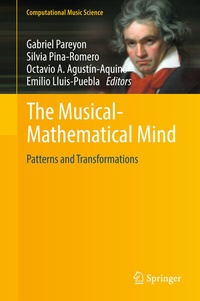
The Musical-Mathematical Mind
Description

This book presents a deep spectrum of musical, mathematical, physical, and philosophical perspectives that have emerged in this field at the intersection of music and mathematics. In particular the contributed chapters introduce advanced techniques and concepts from modern mathematics and physics, deriving from successes in domains such as Topos theory and physical string theory.
The authors include many of the leading researchers in this domain, and the book will be of value to researchers working in computational music, particularly in the areas of counterpoint, gesture, and Topos theory.
Reviews / Votes
"It is impossible to summarize a work of such depth. Suffice it to say that abstract algebra, topology, number theory, geometry, and so on are all involved. If you are a serious devotee of musical-mathematical theory and have a very extensive background in both areas, the book will be a treasure." (James Van Speybroeck, Computing Reviews, April, 2018)More details
Other editions
Additional editions
Content
Introduction.- Extended Counterpoint Symmetries and Continuous Counterpoint.- A Survey of Applications of the Discrete Fourier Transform in Music Theory.- Gestures on Locales and Localic Topoi.- A Proposal for a Music Writing for the Visually Impaired.- Group Theory for Pitch Sequence Representation.- The Mechanics of Tipping Points.- Lexicographic Orderings of Modes and Morphisms.- Music of Quantum Circles.- Algebraic Combinatorics on Modes.- Proportion, Perception, Speculation.- Models and Algorithms for Music Generated by Physiological Processes.- Music, Expectation, and Information Theory.- Gestural Dynamics in Modulation: (Towards) A Musical String Theory.- The Sense of Subdominant: A Fregean Perspective on Music-Theoretical Conceptualization.- How Learned Patterns Allow Artist-Level Improvisers to Focus on Planning and Interaction During Improvisation.- Wooden Idiophones: Classification Through Phase Synchronization Analysis.- A Fuzzy Rule Model for High-Level Musical Featureson Automated Composition Systems.- The Musical Experience Between Measurement and Computation.- Generic Additive Synthesis.- Dynamical Virtual Sounding Networks.- Melodic Pattern Segmentation of Polyphonic Music as a Set Partitioning Problem.- Diagrams, Games and Time (Towards the Analysis of Open Form Scores).- On Minimal Change Musical Morphologies.
