

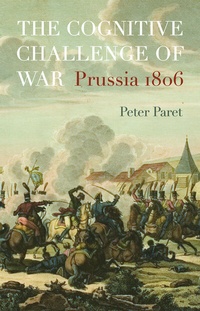
The Cognitive Challenge of War
Prussia 1806
1st Edition
Published on 16. June 2015
176 pages
978-1-4008-3134-0 (ISBN)
Description

The compelling story of the military campaign that changed how we think about war
Responding to the enemy's innovation in war presents problems to soldiers and societies of all times. This book traces Napoleon's victory over Prussia in 1806 and Prussia's effort to recover from defeat to show how in one particular historical episode operational analyses together with institutional and political decisions eventually turned defeat to victory.
The author moves from a comparative study of French and Prussian forces to campaign narrative and strategic analysis. He examines processes of change in institutions and doctrine, as well as their dependence on social and political developments, and interprets works of art and literature as indicators of popular and elite attitudes toward war, which influence the conduct of war and the kind and extent of military innovation. In the concluding chapter he addresses the impact of 1806 on two men who fought on opposing sides in the campaign and sought a new theoretical understanding of war-Henri Jomini and Carl von Clausewitz.
Fields of history that are often kept separate are brought together in this book, which seeks to replicate the links between different areas of thought and action as they exist in reality and shape events.
Responding to the enemy's innovation in war presents problems to soldiers and societies of all times. This book traces Napoleon's victory over Prussia in 1806 and Prussia's effort to recover from defeat to show how in one particular historical episode operational analyses together with institutional and political decisions eventually turned defeat to victory.
The author moves from a comparative study of French and Prussian forces to campaign narrative and strategic analysis. He examines processes of change in institutions and doctrine, as well as their dependence on social and political developments, and interprets works of art and literature as indicators of popular and elite attitudes toward war, which influence the conduct of war and the kind and extent of military innovation. In the concluding chapter he addresses the impact of 1806 on two men who fought on opposing sides in the campaign and sought a new theoretical understanding of war-Henri Jomini and Carl von Clausewitz.
Fields of history that are often kept separate are brought together in this book, which seeks to replicate the links between different areas of thought and action as they exist in reality and shape events.
More details
Other editions
Additional editions
Book
08/2018
Princeton University Press
€21.30
Shipment within 10-20 days
Book
09/2009
Princeton University Press
€23.51
Article exhausted; check different version
Person
Peter Paret is professor emeritus at the Institute for Advanced Study. He has written widely on the history of war and society and on the relationship of art, society, and politics. He is the author of Clausewitz and the State (Princeton), now in its third revised edition. Most recently he gave the 2008 Lees Knowles Lectures at Cambridge University, on which this book is based, and was guest curator for the spring 2009 exhibition Myth and Modernity at the Princeton University Art Museum.
Content
List of Illustrations vii
Acknowledgments ix
Chapter 1: Two Battles 1
Chapter 2: Violence in Words and Images 33
Chapter 3: Responses and Reform 72
Chapter 4: The Conquest of Reality by Theory 104
Notes 145
Index 159
Acknowledgments ix
Chapter 1: Two Battles 1
Chapter 2: Violence in Words and Images 33
Chapter 3: Responses and Reform 72
Chapter 4: The Conquest of Reality by Theory 104
Notes 145
Index 159
